Good first issue candidates
An analysis often names the file and the line involved and what to try, which is what a newcomer needs to start. An issue with the label good first issue shows on the contribute page of the repository and in GitHub's searches for newcomers. So the assistant tells the maintainers which issues could get it, and leaves the decision to them.
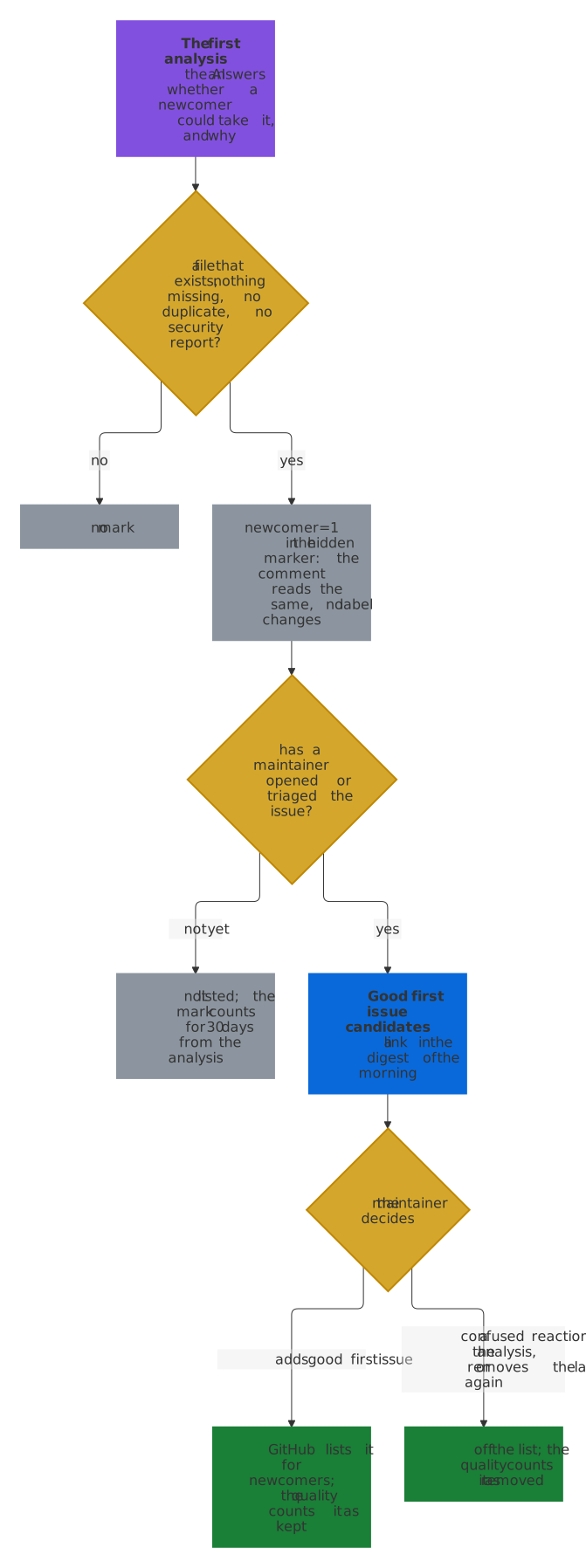
- The AI suggests, and never labels. The schema of its answer has no such label to choose, and the labels of the group
contributionaren't among those thatlabels.mdlists for it. Nothing invites a contributor on its own, since the maintainer has the last word. - Nothing shows on the issue. The comment reads the same with the mark as without it, and the labels are the same: the mark is
newcomer=1in the hidden marker of the analysis. The reason of the AI, at most 200 characters on one line and in the maintainers' language, shows only in the summary of the run that posted the analysis. The log of theapplyjob holds it like the rest of the answer, so a security report has none. - What may fit: a confirmed, small, local change, such as a bug with a located cause or a fix of the documentation. An open design question, or a change that takes knowledge of the whole project, doesn't.
- What the script checks, whatever the AI says: at least one file among the references that exists in the repository, nothing in
missing_information, no possible duplicate, no security report and no other repository that the issue may belong in. A reporter's text can talk the AI into a suggestion, and these checks and the maintainer's triage come after it.
What the digest lists
The fourth part of the digest of the morning sweep, Good first issue candidates, has the open issues whose last analysis of the last 30 days has the mark and that a maintainer has opened or triaged, which means that they no longer have needs-triage. Each is a link with the day of its analysis, as in every list of the digest:
**Good first issue candidates: 1**

- [#12](…): analyzed 5 days ago

The AI thinks that someone new to the project could take these; it sets no label. Add `good first issue` to those you confirm. A 😕 on the analysis takes one off this list.
- Add the label to those you confirm. A label of the group
contributiontakes the issue off the list, alsohelp wanted. - Say no with a 😕 on the analysis. It says no to the candidate alone, and the AI learns nothing from it. Removing the label again says no as well, so that an issue doesn't return after you took it back. A 👎 takes it off the list too, but it says that the analysis itself was wrong: it counts in the feedback of the quality numbers, and the AI reads it as a correction. Reporters see each reaction like any other, and one of anyone who may not push counts for nothing.
- It leaves the list without a word when it closes, when its analysis is older than 30 days, when a later analysis by hand no longer marks it, when it waits on someone else, as with
needs-info,possible-duplicateorfixed-in-next-release, or withduplicate,invalid,wontfixorassistant-muted.
The first day of a month, the quality numbers count the issues marked in the 30 days before: kept with a label of the group, removed by a maintainer's no, closed without a label, and waiting.
Turn it on
The starter labels.toml has the two labels, so a new repository has it from its first analysis. In a repository that keeps its own, add them, or move those it has from another group, as decision in a repository of the blueprint. Do that after the update to the release that brings the group, since check of an older one refuses it:
[[label]]
name = "good first issue"
color = "7057ff"
description = "Good for newcomers"
group = "contribution"

[[label]]
name = "help wanted"
color = "008672"
description = "Extra attention is needed"
group = "contribution"
Without labels of the group, the AI isn't asked, so an analysis costs nothing more, and the digest and the quality numbers have no such part. The first label of the group is the one that the digest tells you to add.