Configuration
A repository sets up the issue assistant in three files of .github/, which install writes as starters when they are missing: the labels, the settings, and the findings of code scanning that it accepts. They change through pull requests like the code, and check makes sure of them in the CI.
Settings
.github/labels.toml
[[label]]
name = "area: cards"
color = "bfdadc"
description = "Dashboard cards"          # at most 100 characters
group = "area"                            # type, area, topic, lifecycle, decision, release or dependabot
form_options = ["Live card", "Training card"]   # answers of the Area field that choose it

[[label]]
name = "enhancement"
color = "a2eeef"
description = "New feature or improvement"
group = "type"
ask = false                               # never ask reporters of this kind for information
.github/issue-assistant/config.toml
[engine]
name = "claude"                 # the engine of ENGINES
# model = "claude-opus-5-5"     # the engine's default model if left out; a letter or digit, then letters, digits and ._:@/[]- only
# light_model = "claude-sonnet-5-5"  # the replies to one comment, yes or no; model if left out
# effort = "medium"             # low, medium, high, xhigh or max, for the models that take it; their default if left out
max_turns = 40                  # turns of an analysis and a question; a follow-up gets half, a reply a tenth, each at least 4; 1 to 200
max_budget_usd = 1.00           # the dollars at which one run stops; more than 0, at most 100
max_per_day = 20                # analyses, follow-ups and replies after a release in 24 hours; 0: only maintainers, by hand
max_per_author_per_day = 3      # analyses of one reporter's new issues in 24 hours
release_replies = 2             # comments of the reporter after each release that the AI reads

[context]
max_issues = 1000               # closed issues that an analysis reads besides every open one: those that changed last
max_discussions = 1000          # discussions that an analysis reads: those that changed last

[links]
hosts = ["docs.example.com"]    # besides this repository

[forms]
area_field = "Area"
unmapped_options = ["Other"]

[transparency]
files = ["SUPPORT.md"]

[releases]
close_with_release = true       # false: fixed issues don't wait for a release

[lifecycle]
remind_after_days = 15          # the reminder after the last question without an answer
close_after_days = 30           # the closing, on the day that the reminder names; more than remind_after_days
duplicate_grace_days = 3        # a sure duplicate closes this long after the notice
reopen_after_release_days = 30  # the reporter's comment after a release reopens the issue this long
max_follow_ups = 2              # follow-ups of the AI on the reporter's answers; 0: none
exempt_labels = ["pinned", "security"]   # never reminded, closed or locked by the sweep
exempt_assignees = false        # true: assigned issues are exempt too
exempt_upvotes = 0              # issues with at least this many 👍 are exempt; 0: off
lock_closed_after_days = 0      # lock issues closed longer, at least reopen_after_release_days; 0: off
Each key has the type that it has here. A file that isn't TOML, or a value of another type, such as max_per_day = "5", stops every command with an error that names the file and the key. A key that the assistant doesn't know, such as close_with_releases or a section [release], would leave the default in place unnoticed: check fails on it and names the key that was probably meant, and every other command warns of it.
flowchart TB
  accTitle: What the assistant does with a problem of its settings
  accDescr: Every command reads labels.toml and config.toml. A file that isn't TOML stops every command, with the line of the mistake. A value of another type than its key's stops every other command with an error that names the key; check reads the rest with the defaults and names every problem at once. A key that the assistant doesn't know changes nothing, so check fails on it and names the key that was probably meant, while the other commands warn of it and keep the default.
  read(["labels.toml and<br>config.toml"]) --> toml{"TOML?"}
  toml -- "no" --> broken["every command stops,<br>naming the line"]
  toml -- "yes" --> typed{"each value of<br>its key's type?"}
  typed -- "no" --> which{"check?"}
  which -- "no" --> stops["the command stops,<br>naming each value"]
  which -- "yes" --> named["check names it<br>with every other problem"]
  typed -- "yes" --> known{"each key<br>known?"}
  known -- "no" --> typo["check fails with the key<br>that was probably meant;<br>other commands warn"]
  known -- "yes" --> runs["the command runs"]
  classDef source fill:#d4a72c33,stroke:#bf8700,stroke-width:2px
  classDef question fill:#d4a72c33,stroke:#bf8700,stroke-width:2px
  classDef stop fill:#cf222e26,stroke:#cf222e,stroke-width:2px
  classDef safe fill:#1a7f3726,stroke:#1a7f37,stroke-width:2px
  class read source
  class toml,typed,which,known question
  class broken,stops,named,typo stop
  class runs safe
The labels of an issue form may be a list or one text of names separated by commas, as GitHub allows, and the area field may be a dropdown with multiple: true: each option that a reporter chooses adds its label.
Findings
Code scanning reports findings of CodeQL, OpenSSF Scorecard and other tools in the repository's Security tab. Some can't or shouldn't be fixed, such as Scorecard's Code-Review for a project with one maintainer. .github/findings.toml accepts those, each with a reason, in a file that changes only through pull requests:
[[accept]]
tool = "Scorecard"        # the tool as code scanning names it
rule = "CodeReviewID"     # the rule, such as py/unused-import
reason = "won't fix"      # false positive, won't fix or used in tests
comment = "One maintainer: nobody else can approve a pull request."
# path = "tests/"         # optional: only alerts in this file or folder
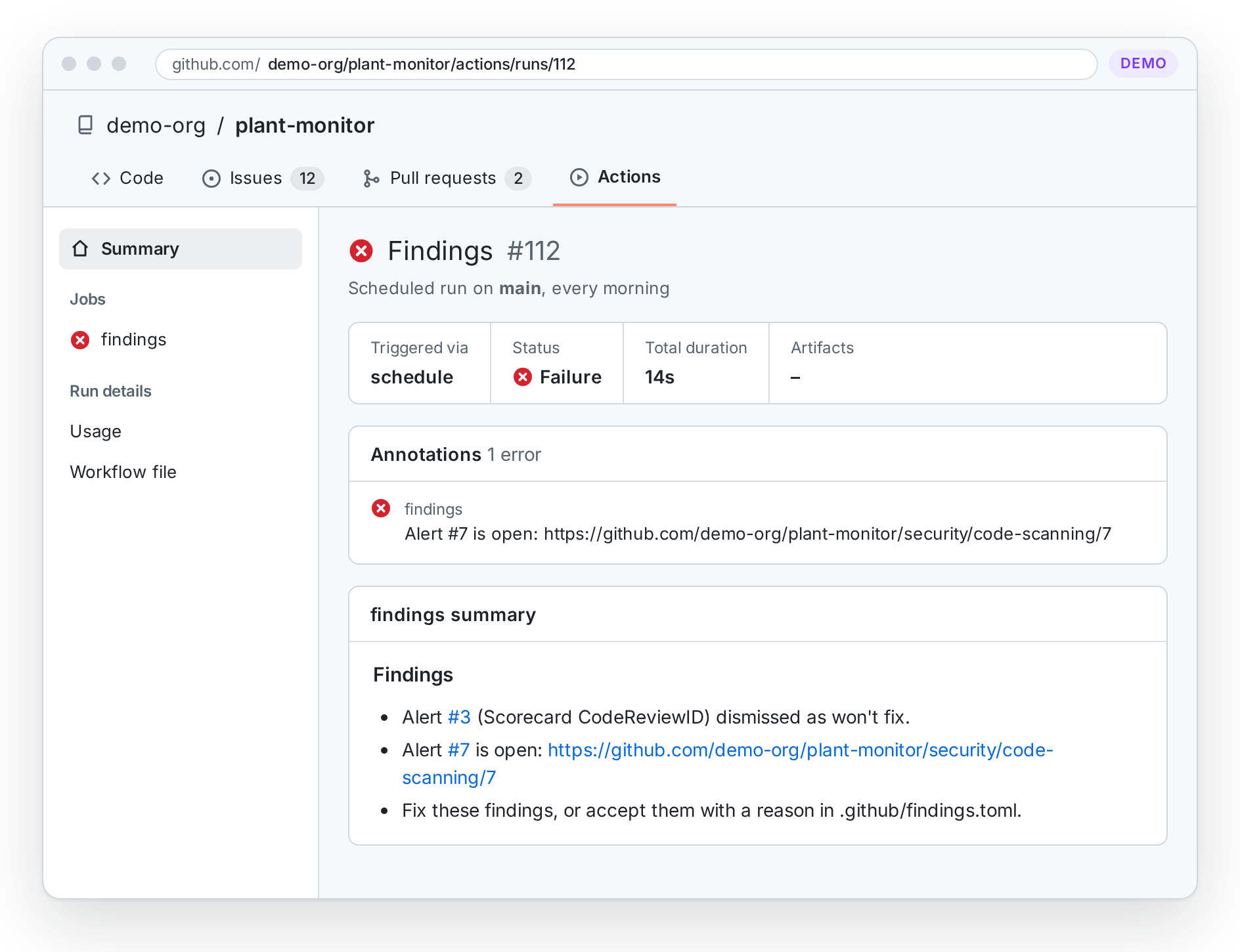
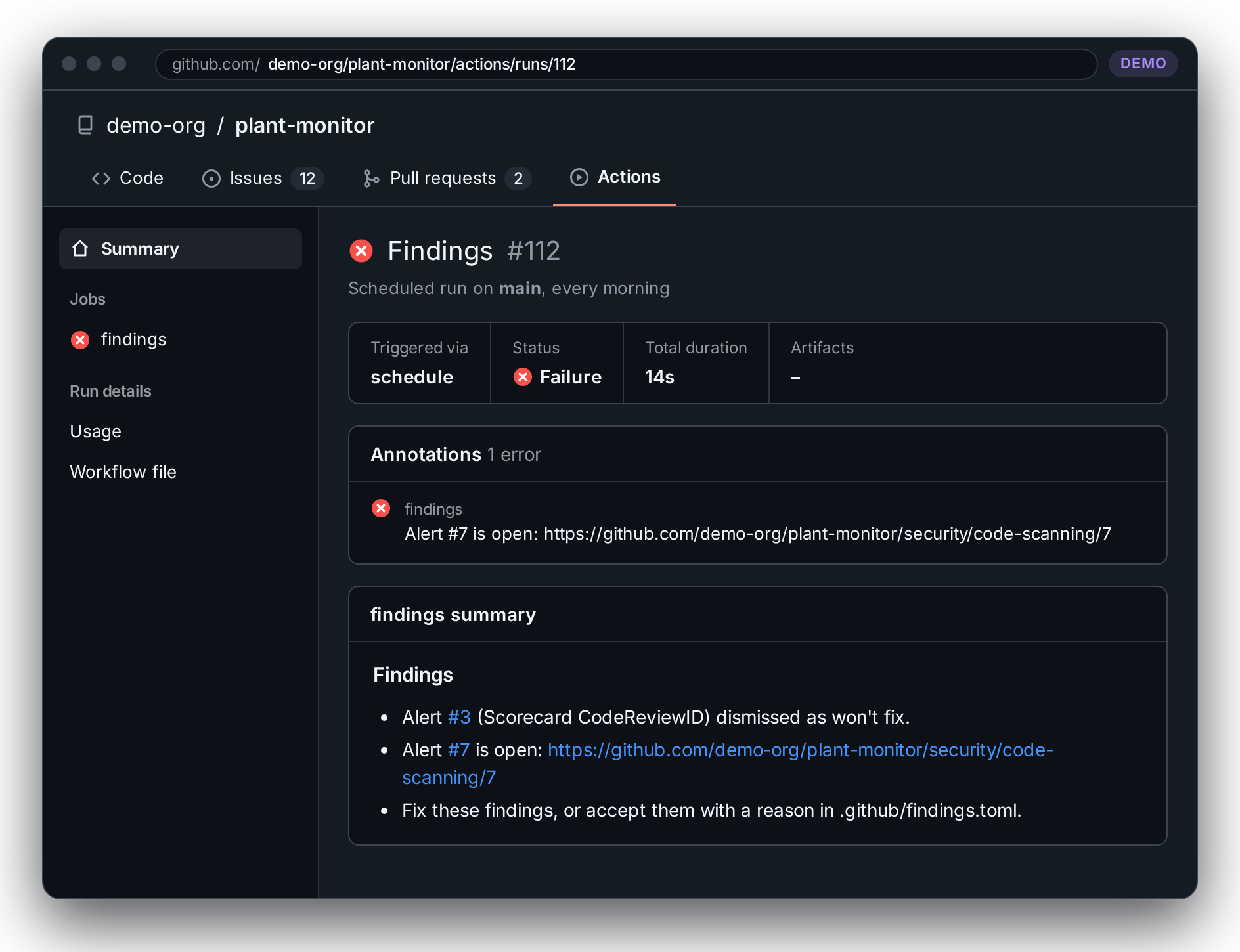
The Findings workflow dismisses every open alert that an entry covers, with the entry's reason and comment, and fails while any other alert is open. GitHub tells the maintainer about the failed run; its summary links the alerts by number. check makes sure that every entry has a tool, a rule, one of GitHub's reasons and a comment, and no key that it doesn't know: a typo such as paths would accept the alerts of the rule in every file, so it stops the Findings workflow too. Code scanning needs the workflow's security-events: write; Dependabot's and secret scanning's alerts are out of its reach and stay with Dependabot's own pull requests and notifications.
A daily run with one accepted and one open finding, in a demo project:
Every key
Each key of the three files, its type, its default and what check makes sure of. A key that says required has no default. Besides, check makes sure that every value has the type of its key, and fails on every key that these tables don't have, naming the key that was probably meant, such as form_options for form_option.
labels.toml
Each [[label]] of .github/labels.toml is a label of the repository:
| Key | Type | Default | What it does | What check makes sure of |
|---|---|---|---|---|
name |
string | required | The name of the label | 1 to 50 characters, as GitHub allows, and no other label has it, in any case: GitHub takes bug and Bug for one label |
color |
string | required | Its colour, six hexadecimal digits without # |
Six digits, such as d73a4a |
description |
string | required | What the label means; GitHub shows it with the label | 1 to 100 characters |
group |
string | required | type, area, topic, lifecycle, decision, release or dependabot. The AI chooses one label of the group type, the kind of the issue, and any of area and topic |
One of these groups, and at least one label of the group type |
form_options |
list of strings | [] |
The answers of the area field of the issue forms that choose the label; of a dropdown with multiple: true, each chosen answer adds its label |
Only kinds, areas and topics have them; each is an option of a form and belongs to one label alone |
ask |
boolean | true |
For a kind: whether the AI may ask its reporters for information | It is true or false |
The group lifecycle needs the seven labels that the assistant sets: needs-triage, needs-info, stale, possible-duplicate, duplicate, invalid and fixed-in-next-release, the last one only while close_with_release is true.
config.toml
.github/issue-assistant/config.toml is optional; without it, every key has its default.
| Key | Type | Default | What it does | What check makes sure of |
|---|---|---|---|---|
[engine] name |
string | "claude" |
The AI engine that writes the analysis | An engine of the assistant: claude |
[engine] model |
string | "" |
The model; empty for the engine's default, claude-opus-5-5 for Claude |
A model name: a letter or a digit, then letters, digits and ._:@/[]- |
[engine] light_model |
string | "" |
The model of the replies to one comment, which only judge it, yes or no: whether a maintainer's comment waits for the reporter, and whether a problem persists after the release; empty for model |
A model name, as for model |
[engine] effort |
string | "" |
How much the model thinks, for the models that take it; empty for the model's default | low, medium, high, xhigh or max |
[engine] max_turns |
integer | 40 |
The most turns of a first analysis and of a maintainer's question; a follow-up gets half of them, and a reply to one comment a tenth, each rounded up and at least 4 (or max_turns when it is fewer), which a reply needs |
A whole number, 1 to 200 |
[engine] max_budget_usd |
number | 1.00 |
The most dollars that one run of the engine may cost, as the engine counts them at the prices of its API; once a run has spent this sum it stops without an answer, so a run can go past it by the cost of its last turn, and the summary of the job says so | A number, more than 0 and at most 100 |
[engine] max_per_day |
integer | 20 |
The most AI runs that people who don't maintain the repository start in 24 hours: analyses of new issues, follow-ups and replies after a release; 0 lets only maintainers start the AI, by hand |
A whole number, 0 or more |
[engine] max_per_author_per_day |
integer | 3 |
The most analyses of one reporter's new issues in 24 hours | A whole number, 0 or more |
[engine] release_replies |
integer | 2 |
How many comments of the reporter the AI reads after each release that closed their issue | A whole number, 0 or more |
[context] max_issues |
integer | 1000 |
How many closed issues an analysis and a follow-up read besides every open one: those that changed last; see what the AI reads | A whole number, 0 or more |
[context] max_discussions |
integer | 1000 |
How many discussions an analysis and a follow-up read: those that changed last; 0 reads none |
A whole number, 0 or more |
[links] hosts |
list of strings | [] |
The hosts that links in the comments may lead to, besides the repository itself | Each is a host name, such as docs.example.com |
[forms] area_field |
string | "Area" |
The dropdown of the issue forms whose answer chooses an area label | Each of its options belongs to one label, or to unmapped_options |
[forms] unmapped_options |
list of strings | ["Other"] |
Answers of that dropdown that choose no label | A list of strings |
[transparency] files |
list of strings | ["SUPPORT.md"] |
The files that tell reporters which AI reads their issue; the footer of every analysis and follow-up links the first, at its heading What happens with your issue when it has one | Each exists and names the engine and its vendor: Claude and Anthropic |
[releases] close_with_release |
boolean | true |
Whether a fixed issue stays open until a release ships the fix; false for a repository without releases |
It is true or false |
[lifecycle] remind_after_days |
integer | 15 |
The days after the last question without an answer until the reminder, which names the day the issue closes | 1 to 3650, and the descriptions of needs-info and stale in labels.toml name no other days |
[lifecycle] close_after_days |
integer | 30 |
The days after the last question until an issue without an answer closes as not planned, on the day that the reminder named | More than remind_after_days, up to 3650 |
[lifecycle] duplicate_grace_days |
integer | 3 |
The days after the notice of a sure duplicate until it closes, unless someone objects | 1 to 3650, and the description of possible-duplicate names no other days |
[lifecycle] reopen_after_release_days |
integer | 30 |
The days after a release closed an issue in which a comment of its reporter that the problem persists reopens it | 1 to 3650 |
[lifecycle] max_follow_ups |
integer | 2 |
How often the AI follows up on the reporter's answers to its questions; 0 for never |
0 to 3650 |
[lifecycle] exempt_labels |
list of strings | ["pinned", "security"] |
Issues with one of these labels, in any case, are never reminded, closed as unanswered or as a duplicate, or locked | A list of strings |
[lifecycle] exempt_assignees |
boolean | false |
Whether issues assigned to someone are exempt as well | It is true or false |
[lifecycle] exempt_upvotes |
integer | 0 |
Issues with at least this many 👍 are exempt as well; 0 exempts none for their 👍 |
0 to 3650 |
[lifecycle] lock_closed_after_days |
integer | 0 |
The sweep locks issues closed for more than this many days as resolved, with one line that points to a new issue, at most 25 in a sweep; 0 locks none |
0, or at least reopen_after_release_days and up to 3650 |
findings.toml
Each [[accept]] of .github/findings.toml accepts the alerts of one rule of code scanning:
| Key | Type | Default | What it does | What check makes sure of |
|---|---|---|---|---|
tool |
string | required | The tool, as code scanning names it, in any case | It isn't empty |
rule |
string | required | The rule, such as py/unused-import |
It isn't empty |
reason |
string | required | The reason that GitHub records for the dismissal | false positive, won't fix or used in tests |
comment |
string | required | Why, in words, shown with the dismissed alert | 1 to 200 characters |
path |
string | "" |
Only alerts in this file, or in the files of this folder, such as vendor for vendor/board.js but not vendored/board.js; empty for every file |
Nothing; a key that the table doesn't have, such as paths, stops the findings command too, since the acceptance would cover every file |