What one run may cost
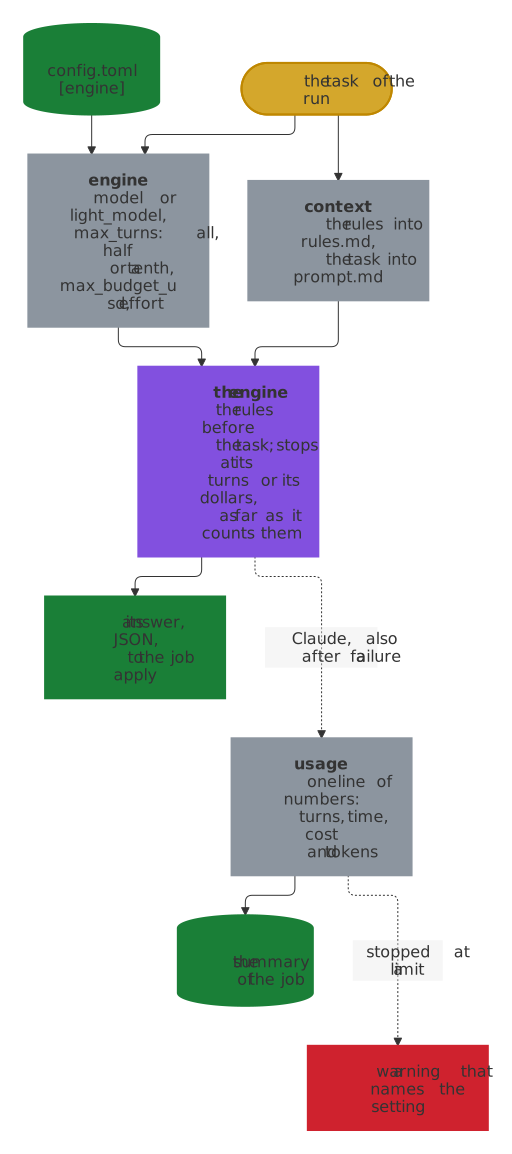
The limits count the runs; [engine] in config.toml also bounds each one. For the task of a run, the step engine chooses the model, the turns and the dollars at which the engine stops, and the step of the engine passes them to its command line.
| Task | Model | Turns by default | What it reads |
|---|---|---|---|
A first analysis, triage |
model |
40, all of max_turns |
the issue, the other issues, the discussions and the repository |
| A follow-up | model |
20, half of max_turns |
the same, with the reporter's answers to the questions |
A maintainer's question, /assistant ask |
model |
40, all of max_turns |
the issue, the question and the repository |
| A reply to a maintainer's comment or after a release | light_model, else model |
4, a tenth of max_turns, but never fewer than 4 |
the issue and the one comment that it judges, yes or no |
- A run of Claude stops once it has spent
max_budget_usd, $1.00 unless you set another sum, as Claude counts it at the prices of its API. It checks the sum between its calls to the API, so a run can go past it by the cost of its last turn. Gemini stops at its turns, and Codex and Copilot at the time of the job, as Engines shows. An issue written to make the AI read on gets no further than the turns and the dollars of its task, and a run that stops there posts nothing. effortsets how much a model that takes it thinks, fromlow, the cheapest, tomax; without it, the model's default runs.- The rules come first.
contextwrites them into.issue-assistant/rules.md, and the engine takes them before its task and apart from the texts of GitHub that it reads in the folder: Claude as its system prompt, Codex as its developer instructions, and Gemini and Copilot, which take no system prompt, at the top of their prompt. - What each run of Claude cost is one line in the summary of its job, numbers only, also after a failure: the model, how the run ended, its turns and time, its cost against
max_budget_usdand its tokens, such as claude-opus-5-5 answered after 15 of 40 turns and 52 s, $0.202 of $1.00, 412,345 tokens in (398,000 of them from the cache) and 3,210 out. A run that stopped at its turns or its dollars also gets a warning that names the setting to raise.