When GitHub fails
GitHub has bad minutes too: a rate limit, a server error, an incident. The assistant never takes such an error for an answer, so a bad minute never changes what it posts:
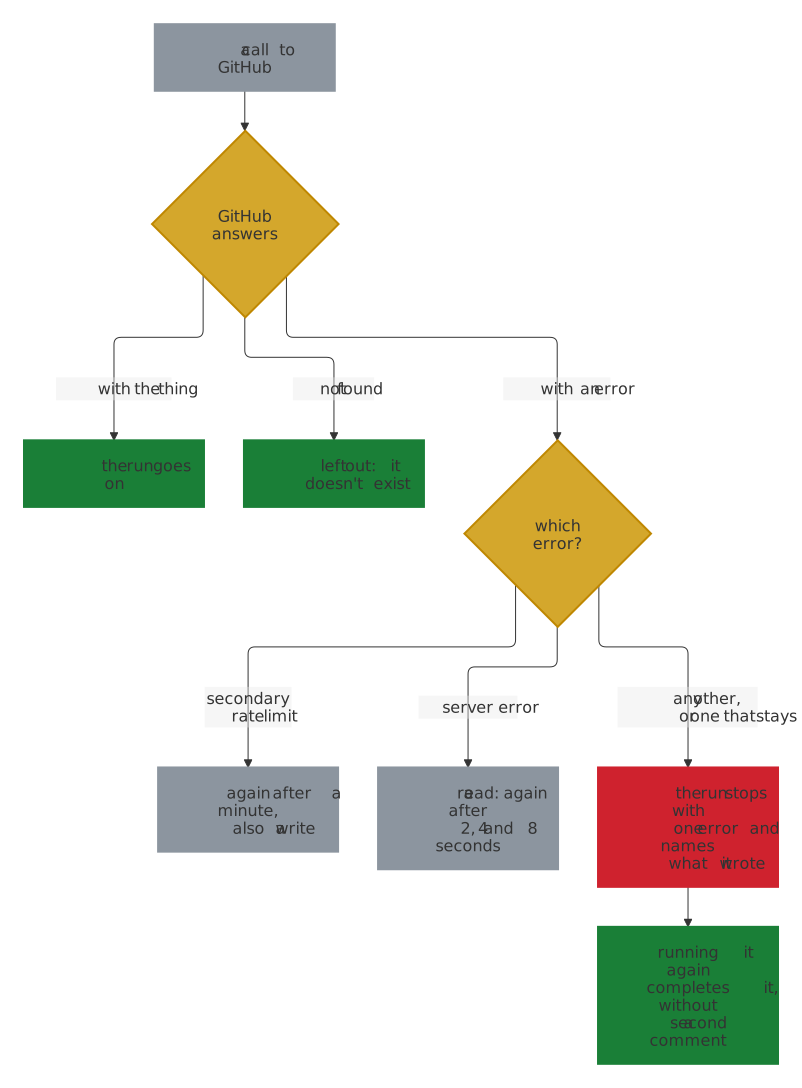
- Only "not found" means missing. A duplicate, a related issue or discussion, or a release that GitHub says doesn't exist is left out. A rate limit or a server error stops the run instead, so an analysis never leaves out a duplicate that GitHub didn't show for a moment, and the AI never reads "no release yet" because GitHub failed.
- A failure of a moment runs again. A read that a server error or a broken connection stopped runs again after 2, 4 and 8 seconds. A call that a secondary rate limit refused runs again after a minute, a write too, since GitHub did nothing with it. A write that a server error stopped doesn't run again, since GitHub may have done it all the same: the run stops, and running it again completes it.
- The labels come before the comment. An analysis or a follow-up adds its labels first,
possible-duplicateamong them, then its comment, andneeds-infolast: an issue never waits for an answer to a question that GitHub didn't post, so the sweep never reminds its reporter or closes it for that. Running the job again posts a missing comment once. When the comment is there and labels are missing, after a failure in between or from a run of an earlier version, it adds them without a second comment: the labels of the answer, andneeds-infoandpossible-duplicateas the comment said. A label that someone added or removed after the comment stays as it is, and so does an issue whose reporter answered. - One issue never stops the sweep. Every step and every issue of the daily sweep runs on its own. One that GitHub fails is a warning in the log, the others are done, and the run fails at the end, so that GitHub tells the maintainer. The next sweep completes it: each step checks what is done, so no reminder or closing comment is posted twice, and an issue closes before its labels go, so that the sweep finds it again. A fixed issue gets its labels before its notice: it stops waiting for an answer and gets
fixed-in-next-release, so a notice that GitHub fails never leaves it to be closed unanswered. - One clear error. A command that GitHub stops ends with one error in the log, not a Python traceback, and its summary lists what the run wrote before and the write that failed.