Languages
The assistant answers every reporter in their language, with fourteen catalogs of its own words and a folded summary for maintainers who don't read that language.
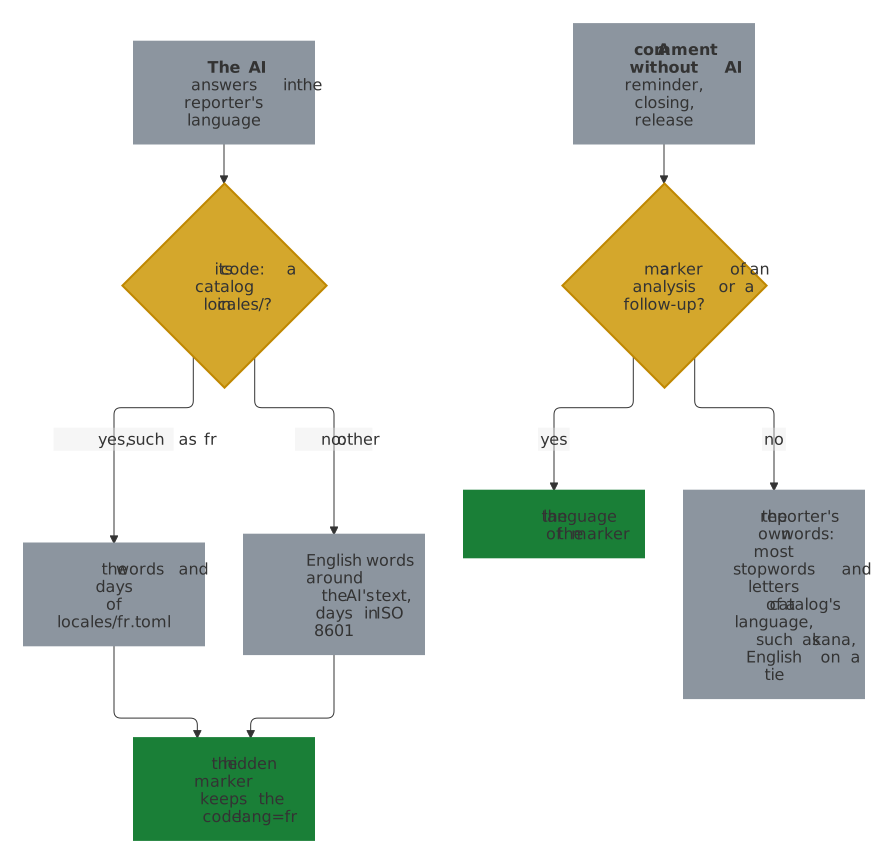
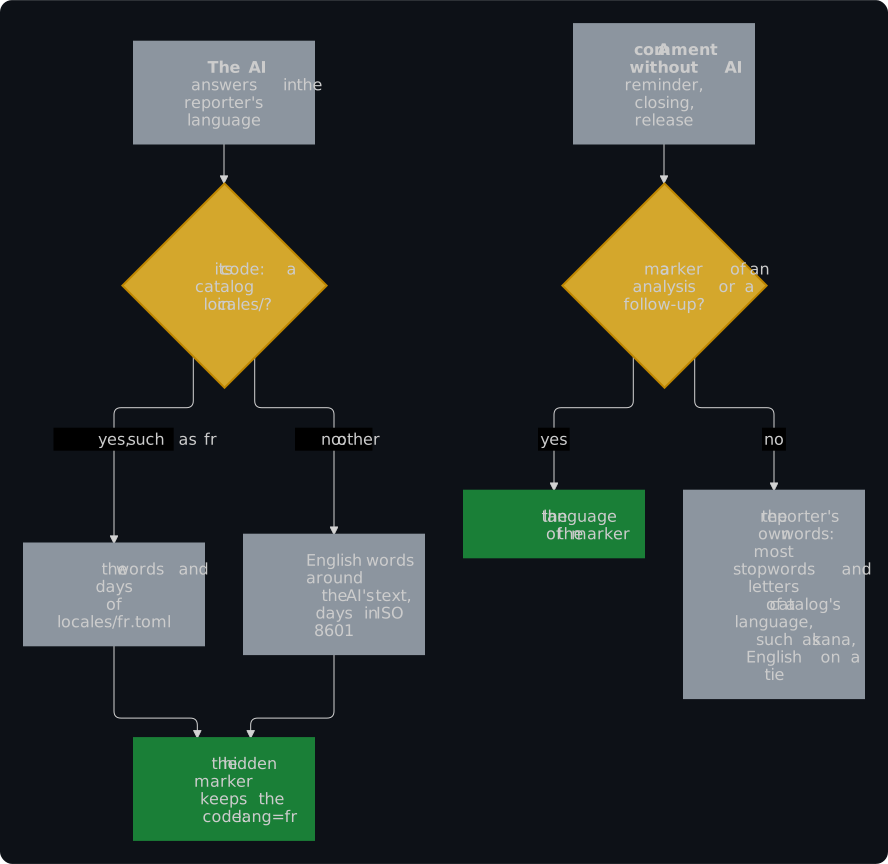
The assistant answers every reporter in their language. Its own words, from the thanks and the headings to the footer, the reminders and the notes of a release, come from a catalog for each language in locales/, which has fourteen:
| Code | Language | Addresses a reporter with | A day |
|---|---|---|---|
de |
German | du | 2. November 2026 |
en |
English | you | November 2, 2026 |
es |
Spanish | tú | 2 de noviembre de 2026 |
fr |
French | vous | 2 novembre 2026 |
it |
Italian | tu | 2 novembre 2026 |
ja |
Japanese | さん | 2026年11月2日 |
ko |
Korean | 님 | 2026년 11월 2일 |
nl |
Dutch | je | 2 november 2026 |
pl |
Polish | ty | 2 listopada 2026 |
pt |
Portuguese | você | 2 de novembro de 2026 |
ru |
Russian | вы | 2 ноября 2026 г. |
tr |
Turkish | siz | 2 Kasım 2026 |
uk |
Ukrainian | ви | 2 листопада 2026 р. |
zh |
Simplified Chinese | 您 | 2026年11月2日 |
- The AI names the language of its answer. The prompt lists the codes of the catalogs, and the schema of the answer takes them and
other. For a language without a catalog, such as Vietnamese, the AI answers withotherand writes in Vietnamese, and the assistant's own words around its text are English, with days in ISO 8601, such as 2026-11-02. - The comments without AI keep it. The hidden marker of an analysis or a follow-up records the language, such as
lang=fr, and the reminder, the closing, the closing of a duplicate and the comment of a release read it there. Before the first analysis, such as on an issue that a maintainer marks as a duplicate, the reporter's own words decide: the language of the catalog whose stopwords they use most, English on a tie or when no other language has at least two. A letter that only one language of the catalogs writes counts for it as a stopword does: Hangul for Korean, kana for Japanese, together with the Chinese characters beside them, Chinese characters without kana for Chinese, and ё, ъ, ы and э for Russian, ґ, є, і and ї for Ukrainian. Chinese and Japanese leave no space between their words, so their catalogs have no stopwords, and a Chinese issue gets a Chinese reminder, also with an English log in it. - Each catalog is complete. The tests hold every catalog to English: the same texts, the same placeholders in braces, twelve months and stopwords that no other catalog has. A text that a catalog still lacks comes from English, so that a comment never fails for want of one. The English and German texts are written by hand; the French, Spanish, Portuguese, Italian, Dutch, Polish, Turkish, Russian, Ukrainian, Chinese, Japanese and Korean ones are machine drafts, which native speakers are welcome to improve. Russian and Ukrainian name a number of days in three forms, as in 1 день, 2 дня and 5 дней, by the rules of the Unicode CLDR: their catalogs have
days.fewbesidedays.oneanddays.other. The section What happens with your issue thatinstallwrites comes in English and German.
A summary for the maintainers. The maintainers may not read the reporter's language. [maintainers] language of config.toml names theirs, as the code of a catalog, en if left out. When the AI answers in another language, in a first analysis, a follow-up or a first answer in Discussions, it also writes a summary for them in theirs: the key facts of the issue in a faithful translation, such as the versions, the error and what the reporter tried, and the gist of its answer, in at most 700 characters. So a maintainer who reads only English can triage an issue in Japanese and check what the AI claims, without a translator and without a second comment, which a translating action would post.
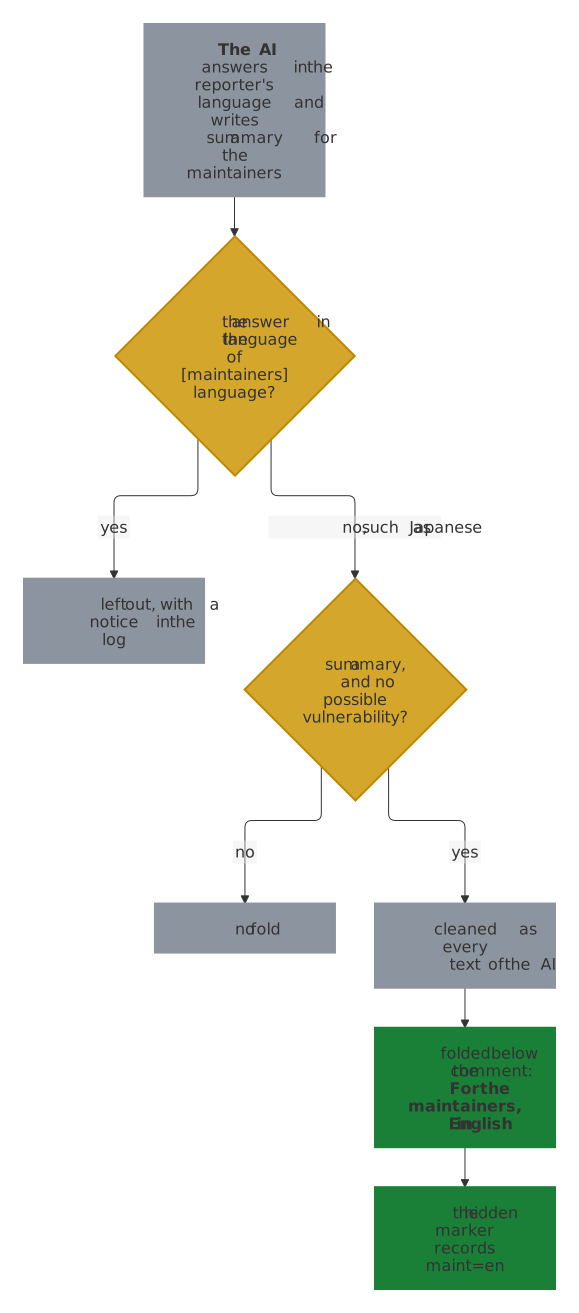
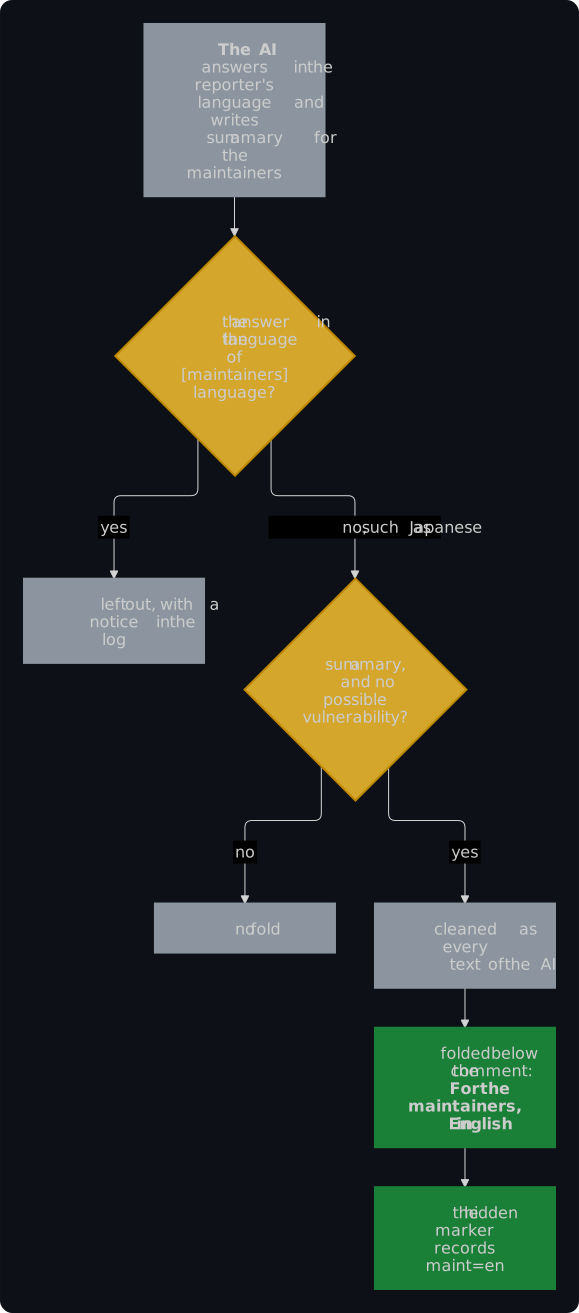
- It stays out of the reporter's way. The comment folds the summary below its text, under a line from the maintainers' catalog, such as For the maintainers, in English, so the reporter sees one short, labelled line. The summary is cleaned as every text of the AI, and the hidden marker of the comment records its language, such as
maint=en. - Only where it helps. In the maintainers' own language a summary would only repeat the answer: the apply job leaves it out and says so in the log, as it leaves out an empty one. The comment on a possible vulnerability has none, because it repeats nothing of the issue. The page What reporters see of the website shows one, for maintainers who read English and for those who read German.
- A code without a catalog, such as
svorpt-BR, makescheckfail with the code that it probably means, such aspt; until then the other commands write the summary in English.
To add a language, copy locales/en.toml to locales/<code>.toml, named after the code of the language in ISO 639-1, such as sv.toml. Translate each text and keep its placeholders, such as {author}, and set the name of the language in English, how it addresses a reporter, how it writes a day, its twelve months and at least twenty stopwords: frequent words of the language that no other catalog has. A language that leaves no space between its words, such as Thai, has no stopwords; its letters go into OWN_LETTERS of issue_assistant.py instead. A language whose word for a number of days has more forms than one for 1 and one for the rest, such as Czech, needs its rule in plural_form too. Nothing else changes: the prompt, the schema of the answer and the guess of a reporter's language take the new file. bash scripts/check.sh runs the tests that check it.