How the assistant is tested
How the requests to GitHub are tested
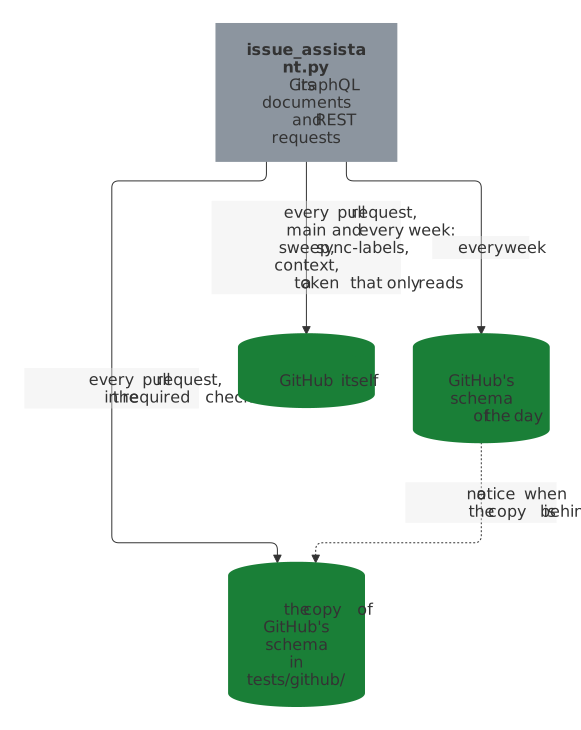
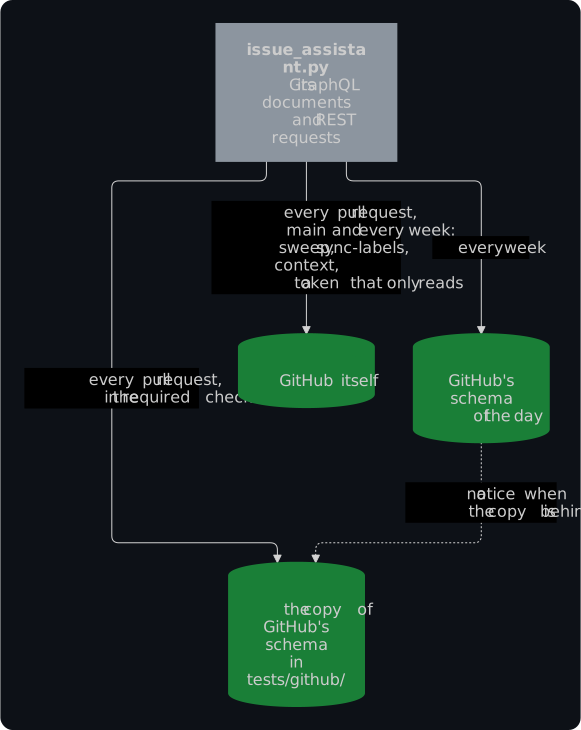
Most tests replace GitHub with the fake in tests/support.py, which answers the calls of the script from the issues, comments and pull requests that a test sets up, as the end of this part shows. The fake knows a GraphQL query by its words, so it can't tell a misspelt field from a right one, or a field that GitHub renamed last week. The script, for its part, falls back where one of GitHub's newer fields fails: labels go without their rationale, and an issue closes through REST, without the link to its original. Such a mistake would show only as a notice in the log of a repository that uses the action, so three checks look for it before a release:
- Every GraphQL document meets GitHub's schema.
tests/test_graphql_contract.pyruns each method of the classGitHubthat sends GraphQL, catches what it hands toghand checks it against GitHub's public schema, whose copy istests/github/schema.docs.graphql: every field and argument must exist and none may be deprecated, and every variable must fit its type, such as the reason for closing an issue. The answer is worked out from the schema as well, so it holds only the fields that the document asks for, and the method can read no other. A document that the test doesn't know fails it, so a new one comes with its case. - The commands that read run against GitHub. The job
egressof the Action test runs the action of the pull request as dry runs ofsweepandsync-labelson this repository, andcontextfor a closed issue of HomeDarts for Autodarts, a public repository that uses the action, with its comments, the other issues and the discussions. Its token can only read, so a write that a dry run let through would fail too. - Every week, the schema of the day. GitHub changes its API without a release of the action. The job
schemaof the Action test checks the documents every week against the schema that GitHub publishes that day. GitHub deprecates a field, an argument or a value of an enum months before it removes it, and says when, so the run turns red as soon as the script uses something deprecated, while it still works. When the copy intests/github/is behind, a notice says so, and a pull request refreshes it with the command intests/test_graphql_contract.py.
The fake itself is as strict as GitHub, so that what it lets through works on GitHub too:
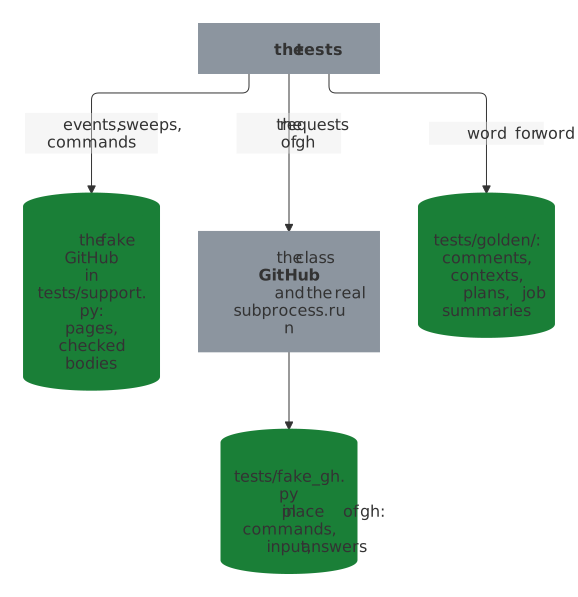
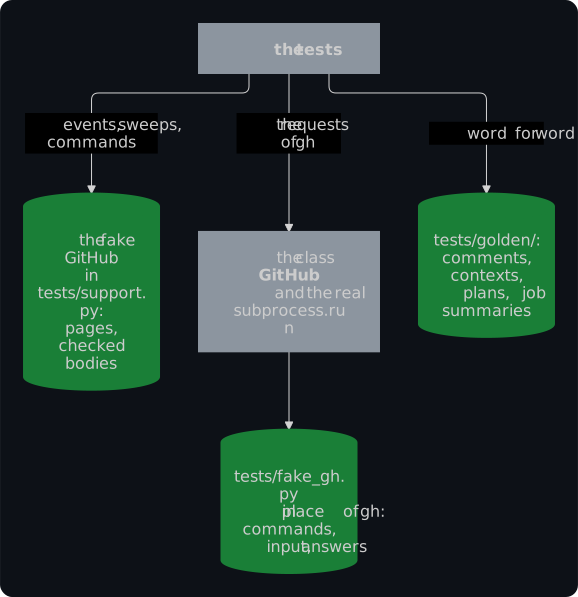
- Long lists come in pages. The fake gives every list of the REST API in pages, of 30 items unless the request asks for up to 100. A reader that pages gets every item, and one that forgets to gets the first page alone, as from GitHub. Tests with 150 comments, events, reactions, issues, labels, milestones and alerts show that every reader reaches the last page, also in a sweep and in an event of an issue whose reporter answered in its 140th comment.
- Every write has the body that GitHub reads. The fake refuses a write whose body lacks a key that GitHub needs or has one that GitHub ignores, and a reaction, a colour or a reason for closing that GitHub doesn't know.
- gh runs for real, with a stand-in. The tests of the class
GitHub, which builds the commands ofgh, run Python's realsubprocess.runwith the options of the script. In place ofgh, it startstests/fake_gh.py, which writes down its arguments and what it read, and answers as the test asks, also with an error. So the tests see whole commands and the JSON that a write sends, and that a failingghends in the error that the script handles, never in an exception that it doesn't expect. - What the assistant writes is pinned word for word. Golden files in
tests/golden/hold every comment in English and in German, the files of the context of each task, the plan and the requests of each kind of event, and the job summaries. A change of a text, of its Markdown or of the schema of an answer failstests/test_golden.pyuntil its golden file shows it, so the pull request shows what readers will see differently.tests/README.mdsays how to write them anew.
How the names of the engines are checked
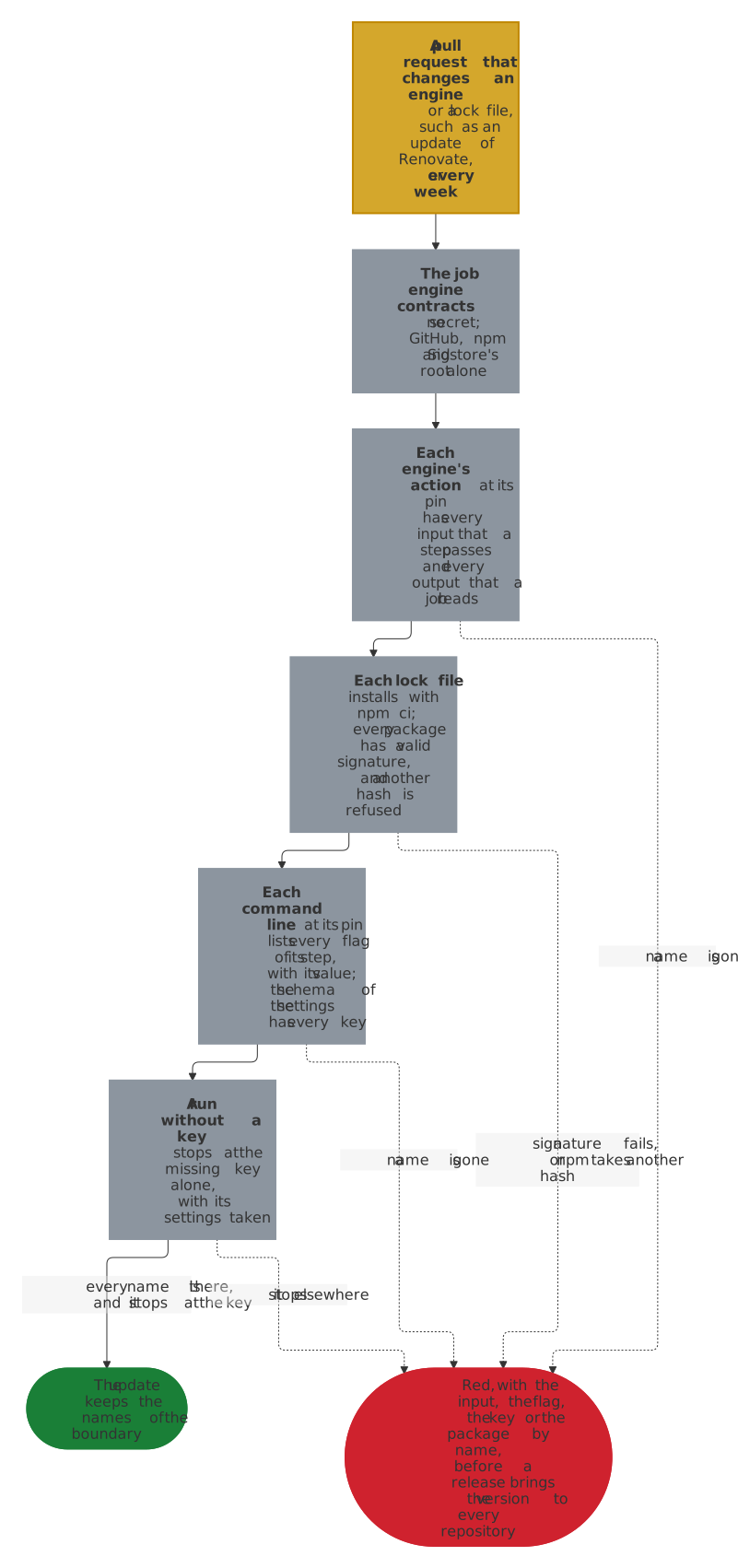
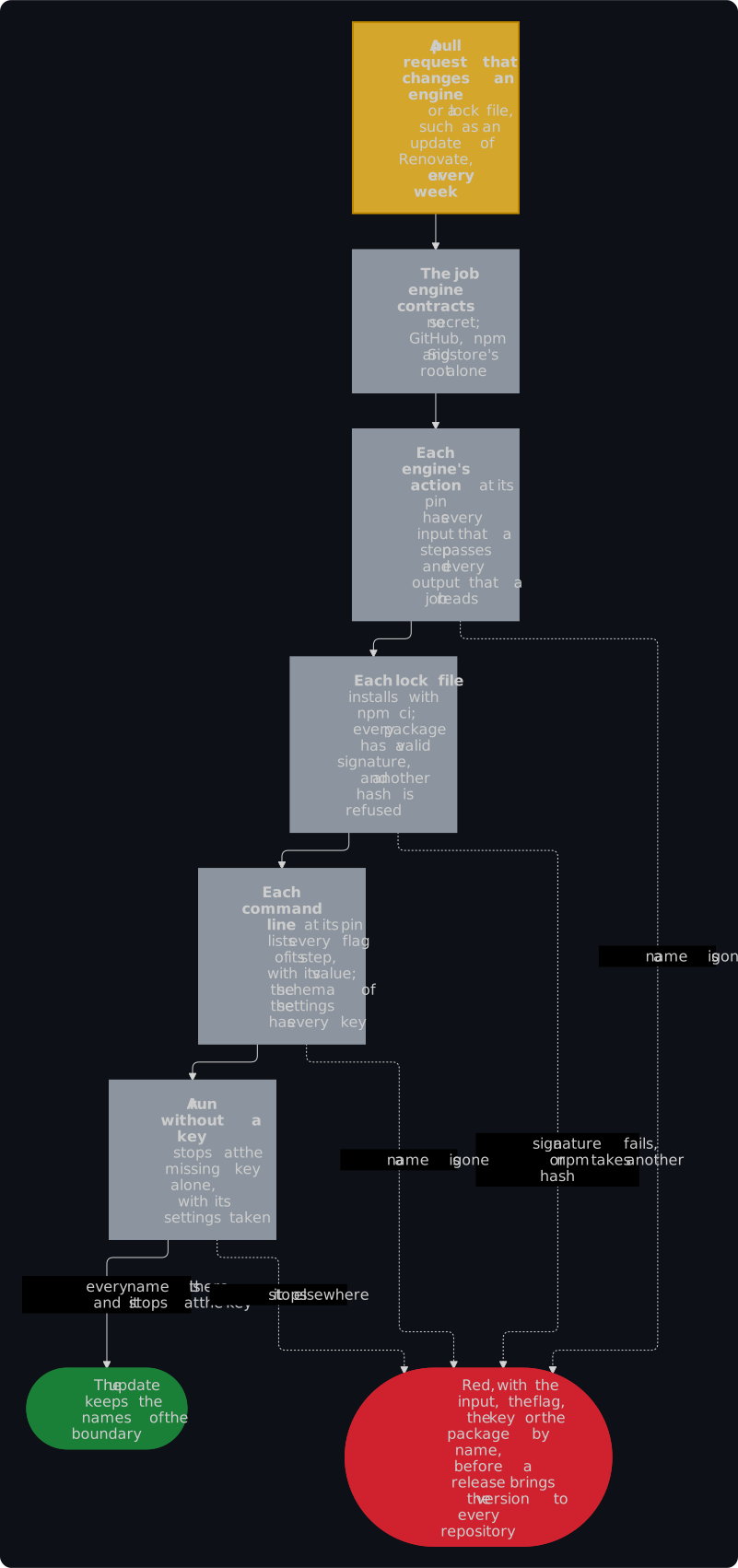
What keeps each engine to reading rests on names that its vendor owns: the inputs of the Codex action that choose its sandbox, the keys of the settings that leave the Gemini CLI only its tools that read, the flags that do so for the Copilot CLI, and the outputs that hold the answer. tests/test_templates.py and tests/test_engines.py check our side of these names. The other side changes with a release of the engine, and nothing would fail: GitHub only warns about an input that an action doesn't have and runs the step without it, the Gemini CLI ignores a key of its settings that it doesn't know, and so does Codex with a key of its configuration. No check of a pull request runs an engine with its secret, and the Canary runs Claude alone, so the job engine contracts of the Action test runs the pinned versions without one:
- The actions.
scripts/engine_contract.py actionsfinds every step whose id is the key of an engine in the workflows of.github/workflows/, and reads theaction.ymlof its action at the commit that the step pins through GitHub's API. Every input that the step passes must be there and not deprecated, every input that the action requires must be passed, and every output of the step that its job reads, such asstructured_outputorfinal-message, must be there. The Codex action must still say that it handspermission-profileto Codex asdefault_permissionsof its configuration, which the next step checks. - The command lines.
clisinstalls Codex at the version ofcodex-version, without the scripts of its packages, as its action does, and the Gemini CLI and the Copilot CLI from their lock files inengines/withnpm ci, asanalyzedoes. For those two,npm audit signaturesmust verify the signature of npm's registry of every package that npm installed from the lock file on GitHub's Ubuntu x64 runner, which is every package thatanalyzeinstalls, and the attestations of the provenance of those that have them, andnpm cimust refuse a copy of the lock file with another hash of the command line, withEINTEGRITY: a lock file that npm installed anyway would no longer bindanalyzeto the packages that this check verified. Every flag of the command line thatanalyzeor the action builds must be in the--helpof that version, with each value that the step gives it among those that the help lists, such as each level of effort. Every key of the Gemini CLI's settings must be in the JSON schema of the settings at the tag of that version, in the repository that its package names; without a schema, the check fails. - A run without a key. The Gemini CLI and the Copilot CLI run as
analyzeruns them, with a home of their own in a folder of the runner's temporary folder and their settings whereanalyzewrites them, and must stop asking for their secret, never at an argument, and without naming the file of their settings: the Gemini CLI names it only to refuse it or to say that it skips it, as it does for system settings that root doesn't own. The first run of this check found that it did so on GitHub's runners, soanalyzenow writes them with sudo into a folder of root's below/etc/issue-assistant. Codex checks its key only at OpenAI, whose host the block stops, so it runs with--strict-config, which fails on a key of its configuration that it doesn't know, and passes when it starts its turn.
The job runs on a pull request that changes a workflow with the step of an engine, a lock file of engines/, issue_assistant.py, action.yml, the script, the Action test or .github/renovate.json5, so on every update of an engine that Renovate opens, every Thursday, by the schedule of the Action test, and by hand. Its block lets through api.github.com, github.com, registry.npmjs.org and tuf-repo-cdn.sigstore.dev, Sigstore's root of trust, which npm reads for the attestations, alone, and no command line sees the token of the job. A part that fails names the workflow, the step and the input, or the version and the flag or the key, and the PR coach explains it from .github/checks.project.toml. It is a required check, and it reports on every pull request: on one that changes no engine and nothing that it reads, it passes without running. So Renovate merges a patch version of an engine on its own once it passed, in a pull request of its own, while a minor or major version waits for the maintainer, as decision 0020 says. What the check can't see is the behaviour behind a name that stays: the pull request of Renovate still asks to read the release notes before the next release, as the security design says.
How the mutation tests test the tests
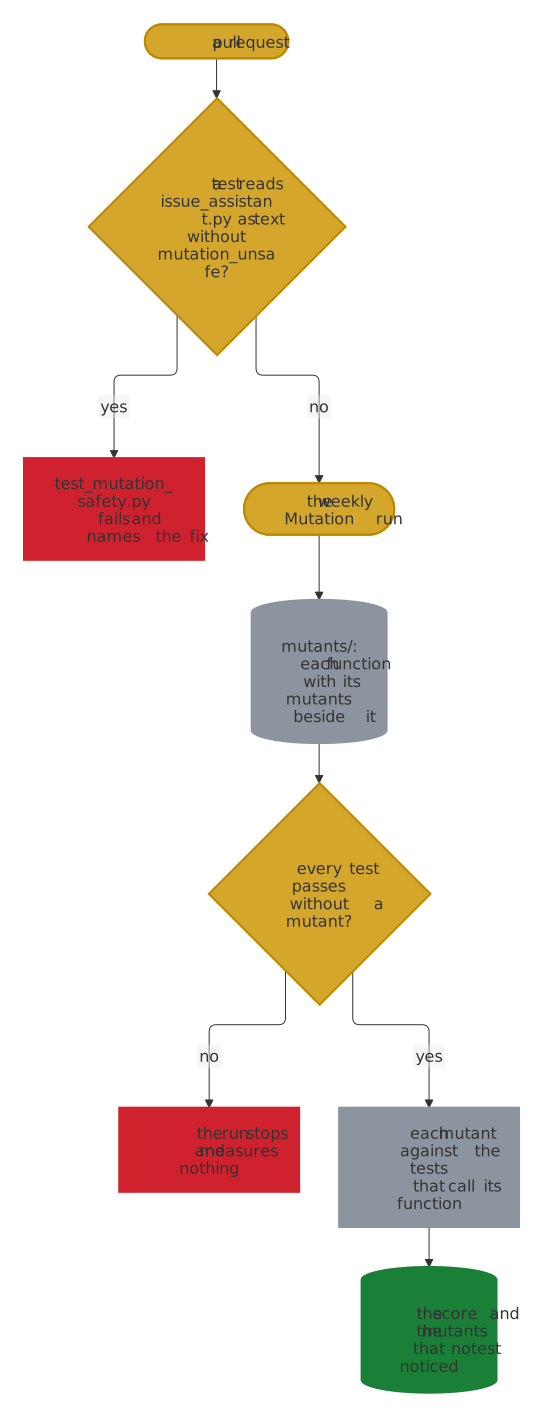
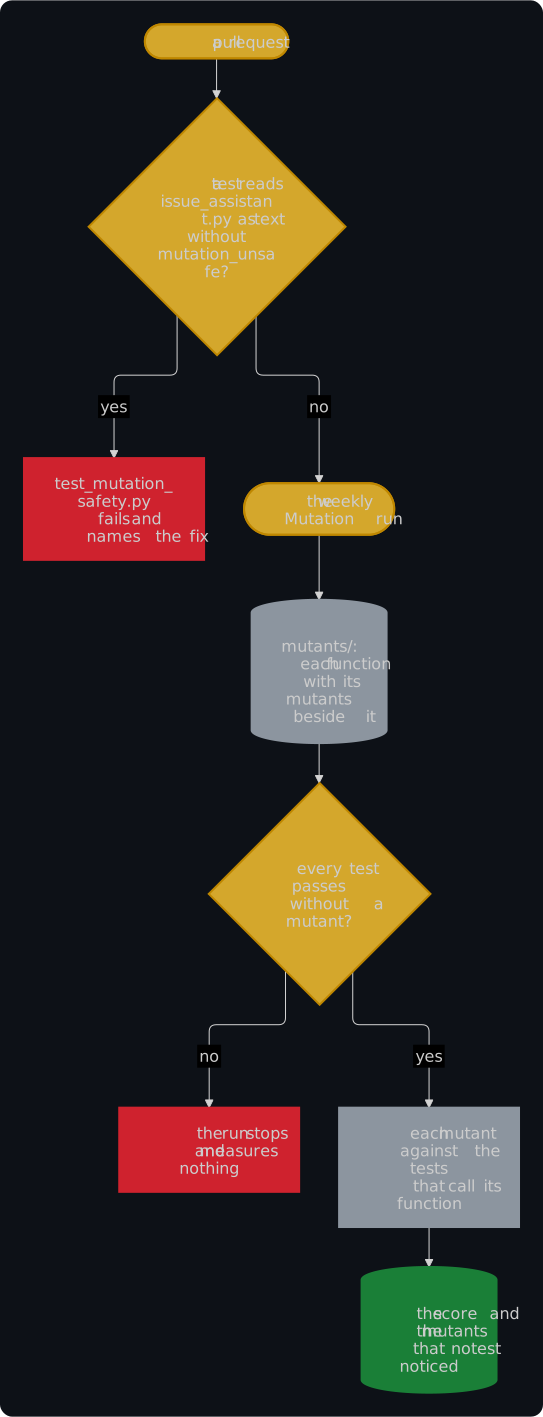
A test that runs a line doesn't yet check it. Every Saturday the Mutation workflow changes issue_assistant.py in thousands of small ways, each a mutant, such as < for <= or another string, and runs the tests that call the changed function against each: a mutant that no test notices shows a line that the tests run but don't check. mutmut does this in a copy of the repository, mutants/, in which each function of the script has every one of its mutants beside it.
- The tests pass in the copy first. Before any mutant, the run takes every test in
mutants/once, with-m "not mutation_unsafe"; a test that fails there stops the whole run, which then measures nothing. A test that reads the script as text, such as the one that collects every GraphQL document of the script, sees each mutant in that copy, whichever one runs, so it can't notice one and fails without any. It carries@pytest.mark.mutation_unsafe, and a check of behaviour that it makes as well is a test of its own, which the mutants run against. - A guard finds an unmarked one in every pull request.
tests/test_mutation_safety.pyreads every test with Python'sastand fails for one that readsissue_assistant.pywithread_text(),open()orinspect.getsource(), itself or through a helper, a fixture or a constant of the same module, without the marker, and names the fix. It doesn't follow the shared helpers ofconftest.pyandsupport.py, so these never read the script as text. So the weekly run doesn't learn of it days later. - The mutants change logic, not help. mutmut leaves the constants of a module alone and copies a whole function for each of its mutants. The commands of the script and the help of each command and option are the tables
SCRIPT_COMMANDSandSCRIPT_OPTIONS, from whichcommand_line()builds the parser, andmain()hands each command to a function of its own, such asapply_command(). A mutant ofmain()is a copy of 66 lines, not of 333, whose 949 mutants made almost a third of the 43 MB of the copy, and none changes a text of the help, which no test needs to check.
When a check of this project fails
The checks of this project alone, the three jobs of the Action test, the check of the Workflow test and the fuzzing of fuzz/, explain themselves as the checks of the blueprint do. Each job of the Action test is made of parts, such as the workflows of the templates, their security and the set-ups of the sample repository and of this repository, and each part runs also when one before it failed, so that the check reports every failure at once. Its last step, Explain the failure, writes the explanation of each part that failed, from .github/checks.project.toml, into the summary of the check and as its annotation: what is wrong, why it matters, how to fix it, and the commands that run the part on your machine. After the checks, the PR coach of the blueprint keeps one comment on the pull request with these explanations, also on a pull request from a fork, whose own runs can't write to it.
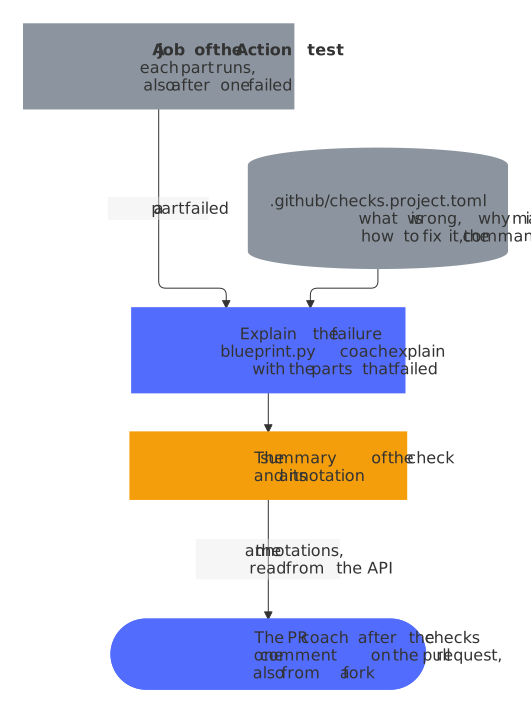
No command can fix what these checks find on its own: a template, a request to GitHub or an input that fuzzing found needs a person, so each explanation says why in its autofix, and the fix bot leaves the check alone. tests/test_coach.py keeps the explanations true to the workflow: every job ends with that step, every step after the checkout belongs to one part, every job and every part has its explanation, and the commands of a part are those that its steps run.