Skip to content

Related repositories

← All features

Projects that share their users, such as an app and its server, get reports in the wrong repository. [related] repositories in config.toml names up to 5 public repositories that share users and topics with this one, and a first analysis searches their issues as well:
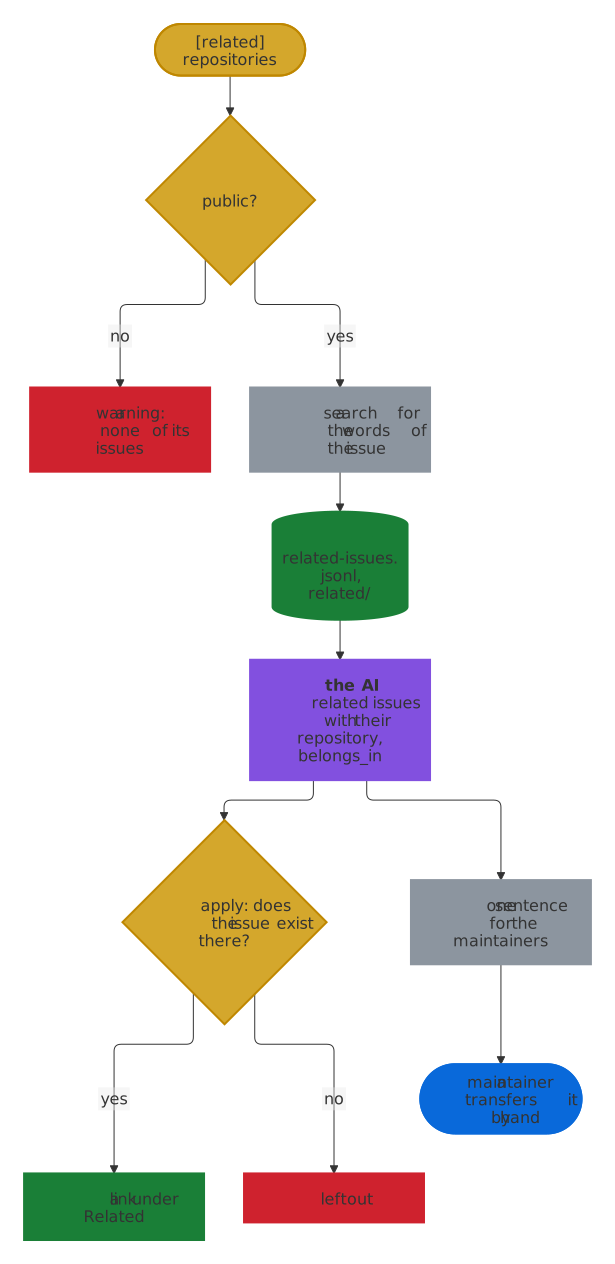
How a first analysis uses the related repositories: The context step asks GitHub whether each repository of [related] is public; one that isn't, or doesn't exist, is left out with a warning. It searches each public one for the words of the new issue and writes what it finds to related-issues.jsonl, each issue with its repository, and the whole texts to related/. The AI may name those issues as related, never as duplicates, and may say in belongs_in that the issue belongs in one of the related repositories. The apply job links only issues that exist in a public related repository and leaves out the rest, and belongs_in becomes one sentence for the maintainers. Nothing moves or closes on its own: a maintainer transfers the issue by hand.How a first analysis uses the related repositories: The context step asks GitHub whether each repository of [related] is public; one that isn't, or doesn't exist, is left out with a warning. It searches each public one for the words of the new issue and writes what it finds to related-issues.jsonl, each issue with its repository, and the whole texts to related/. The AI may name those issues as related, never as duplicates, and may say in belongs_in that the issue belongs in one of the related repositories. The apply job links only issues that exist in a public related repository and leaves out the rest, and belongs_in becomes one sentence for the maintainers. Nothing moves or closes on its own: a maintainer transfers the issue by hand.

  • The AI reads what a search finds there. Up to 30 issues of each repository that GitHub's search finds for the words of the new issue go into related-issues.jsonl, each with its repository, and their whole texts into related/<owner>/<name>/<number>.md. A repository that isn't public, or that GitHub fails to search, is a warning and adds nothing.
  • Their issues can be related, never duplicates. The comment links an issue of a related repository under Related, as owner/name#123, once apply found it in a public related repository; any other reference to another repository stays code. A duplicate is always an issue of this repository, so nothing closes because of an issue elsewhere.
  • One sentence says where an issue may belong. When the issue is about the code or the documentation of a related repository, the analysis says so in a sentence for the maintainers, and the summary of the job names the repository. Nothing moves the issue: a maintainer transfers it with Transfer issue in its sidebar.

The issues of a related repository become links in a public comment and their texts part of the log of the run, so a private one stays out: the assistant asks GitHub whether each is public before it reads any of its issues.