A major update merges by itself once every check passes
- Status: accepted
- Date: 2026-11-13
Context
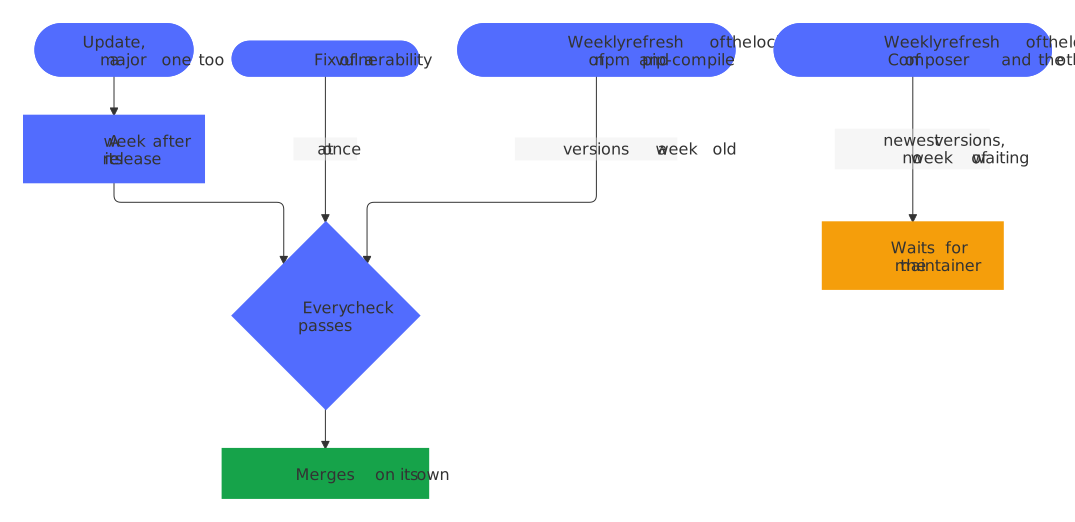
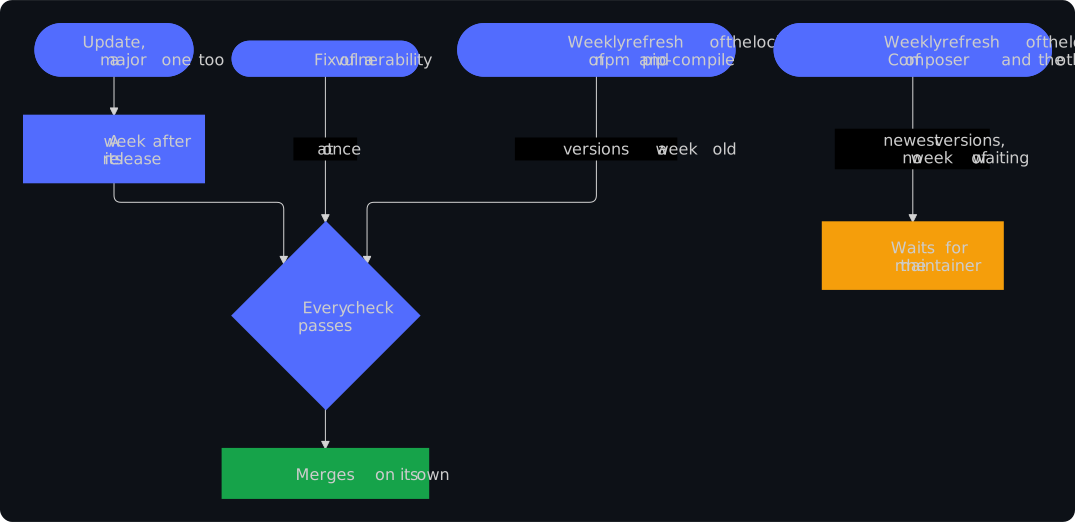
The pull requests of Renovate and of Dependabot merge by themselves once every required check passes: the checks are the gate, not a review. A major update was the exception. The first rule of .github/renovate-blueprint.json5 turned auto-merge on for the update types minor, patch, digest, pin and pinDigest alone, and the merge bot of Dependabot in .github/workflows/dependabot-automerge.yml for version-update:semver-patch and version-update:semver-minor alone, so a major update, and one of Dependabot whose metadata names no type, waited for the maintainer, as 0057 and the picture of 0012 said. The update of vimeo/psalm to version 7 waited that way from 2026-11-09 in three repositories, with every check green (issue 838). The owner of the blueprint wants nothing to wait for him that the checks can decide.
Options
- Keep the wait: a person reads the notes of every new major version first.
- Let a major update merge by itself once every required check passes, as every other update does, after the same week of waiting.
- Let a major update merge by itself only for the tools of the tests, and keep the wait for what the users run.
Decision
Option 2. The first rule of the Renovate rules merges every update type, major included, and the merge bot of Dependabot turns auto-merge on for every update of Dependabot, whatever its metadata names. A major update still waits its week after its release, as 0005 wants against a version published from a hijacked account, and it merges only once every required check passes: one whose checks fail stays open and shows the failure, which is the signal that it needs work, and the PR coach explains each check that failed.
The refresh of the lock files of a package manager that can't keep to versions a week old, such as Composer, stays the one exception and waits for the maintainer on its branch renovate/review-… (0137): it brings versions younger than a week, which a major update doesn't, so its reason is the age of the versions, not their kind. Rules of a project that hold a dependency back, such as a major version of Nextcloud beyond the max-version of an app, stay: they keep the update from coming at all.
Consequences
- A major update that passes every check reaches
mainwithout a person, and the release bot sums it up in the next release. A breaking change that no check covers reaches the users as well: the tests of a repository are its gate, and a gap in them shows as a bug after the release instead of as a pull request that waits. - A major update whose checks fail stays open with the failure, as the update of psalm 7 would, until a person or an agent fixes the code on its branch.
- The repositories get the rules with the next release of the blueprint; a major update that is open already merges at the next run of Renovate or of the branch bot once its checks pass.