Settings as code
The settings of a repository as a file that a pull request changes.
The settings of the repository as code: merges, rulesets, security, Actions, environments, variables, labels, GitHub Pages, and every file of the community standards of GitHub; the settings bot applies them after every change and every week.
How: .github/repository.toml and blueprint.py.
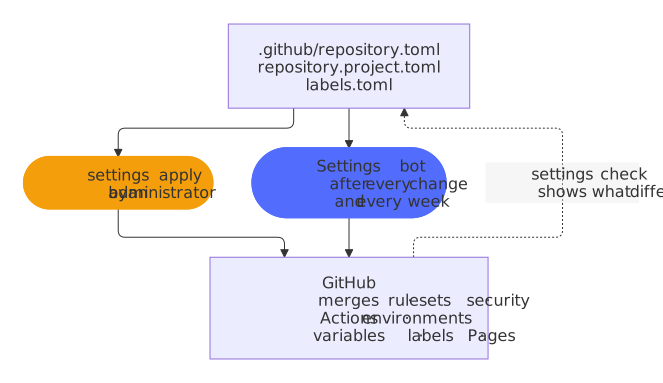
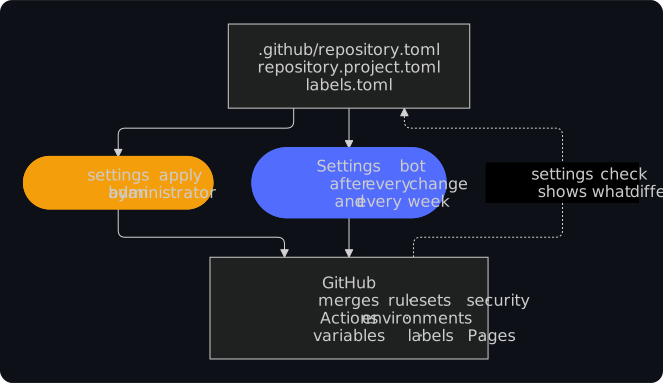
.github/repository.toml holds the settings of a repository; blueprint.py settings check compares them with GitHub and settings apply makes GitHub match:
- Repository: squash merges with the title of the pull request, auto-merge, branch updates, deleted branches, signed-off web commits, no wiki or projects.
- Security: immutable releases, private vulnerability reporting, Dependabot alerts with the security updates of Renovate, secret scanning with push protection and with the generic patterns of private keys, connection strings and passwords.
- Actions: read-only tokens by default, no approvals by workflows, actions pinned to commit hashes, only the actions of GitHub and those of the list in
[actions.selected], approval for the workflows of every outside contributor.settings checkfollows every action that a workflow runs, also inside a composite action or a reusable workflow, and names each one that the list lacks; until it is listed,settings applyonly adds to the list on GitHub, so no workflow stops. The check lint of every pull request follows them the same way, from the files alone, withsettings actionsand the token of the pull request: an update of an action that runs a new one in turn fails its pull request with the pattern to add, not the workflows after the merge, and the Variants check every kind of project before a release. A step that runs an image withdocker://is an action too, which no pattern allows:settings checknames it with thedocker runthat replaces it. - Rulesets: Protect main (pull requests only, squashed, linear history, every required check, no new alert of CodeQL of high or critical severity and none of zizmor, no deletion or force push), Release tags (
v*.*.*never moves) and Release tag creation (only the release app, whose App IDRELEASE_AUTOMATION_APP_IDnames, creates av*.*.*tag, which the release workflow signs). - Variables and environments:
PUBLISH_TO, the release app (RELEASE_APP,RELEASE_AUTOMATION_CLIENT_IDandRELEASE_AUTOMATION_APP_ID), and environments that onlymainmay use, whose rules bind the administrators too, with the secrets they need. - Pages: GitHub Pages publishes the website that the Docs workflow builds.
blueprint.py needs Python 3.12 and GitHub CLI 2.48 or later, signed in as an administrator, and nothing else. It never reads or prints the value of a secret. Every repository has a copy in .github/blueprint.py and .github/blueprint/, and the settings bot (settings.yml) compares its settings with the settings as code every week, after every change of them and after every update of its own code, so that no repository drifts. A change that GitHub refuses fails the run, which names the part and the permission of the release app that it needs; after a gateway that timed out or a rate limit, a request tries once more, after the wait that GitHub asks for (decision 0036 of the decisions). A switch of the security that GitHub doesn't offer for the repository, or that it accepts and keeps off, as it does with the generic patterns of secret scanning on a repository of a user, fails nothing: the run names it with the line of .github/repository.project.toml that stops asking for it, and asks again every time, so that a repository whose plan gains the switch gets it (decision 0055).