Cloudflare Worker template with tests in workerd and deploys without a key in GitHub
A Cloudflare Worker in TypeScript on Node 24, whose tests run in workerd, the runtime of Cloudflare Workers, and which Cloudflare deploys from each release by itself, with no key of Cloudflare stored in GitHub.
Start one
uvx --from copier==9.19.1 copier copy --data project_type=cloudflare-worker gh:Dennis-Otto/repo-blueprint my-worker
cd my-worker
python3 .github/blueprint.py create
With uv and the GitHub CLI, as the quick start shows. Copier asks for the name, the owner and the other answers, and create makes the repository on GitHub, applies the settings as code and prints the checklist.
What you get
- The example: a Worker in
src/index.ts, which answersGET /?name=Adawith a greeting in JSON and refuses every other path and method, the code that it calls insrc/greet.ts, and its tests intest/.wrangler.jsoncholds the name of the Worker, its main module, its compatibility date and its bindings. Replace it with the real Worker; its tests show how. - Tests in the runtime of Cloudflare: Vitest runs them in workerd with the bindings of
wrangler.jsonc, through the Vitest integration of Cloudflare, and each request reaches the Worker as one from the internet would. A secret lives only in Cloudflare, so a test that needs one calls the Worker ofsrc/index.tswith anenvof its own:worker.fetch(request, { ...env, TOKEN: "test" }, createExecutionContext()), withenvandcreateExecutionContextfromcloudflare:test.npm run devruns it on your machine. - The steps of
scripts/check.shfor this kind, the same on your machine and in the CI: the lock file, Biome, tsc on the types that Wrangler writes fromwrangler.jsonc, the tests with every line, branch and function covered, and then Worker, which bundles the Worker with Wrangler as Cloudflare does, without an upload or a sign-in. - Workflows of this kind: the newest Node on
main(newest-node.yml); Cloudflare builds and deploys the Worker itself, so no workflow holds a key of Cloudflare. - The steps of every kind: the text files, the diagrams, the pages in one column, the files of the project, the fragments of the changelog, the accepted advisories, the lock files, the version, the Git hooks, ShellCheck for the shell scripts and the strict build of the website.
- Everything that every repository gets: the PR coach and the fix bot, the release bot, Renovate, the settings as code, the issue assistant, the website in English and German, the security checks and the blueprint bot, as the guide lists them.
The checks that a pull request needs
The ruleset Protect main of .github/repository.toml lets a pull request merge once these checks pass:
check (node):scripts/check.shwith the tools of Node, the tests in workerd and the bundle of the Worker.lint,diagrams,docs,conventional title,codeql,dependency-reviewandgitleaks, which every kind needs: every linter in one job, the pictures of the diagrams, the strict build of the website, the title of the pull request with its entry in the changelog, CodeQL, the review of new dependencies and the secret scan.
Delivery
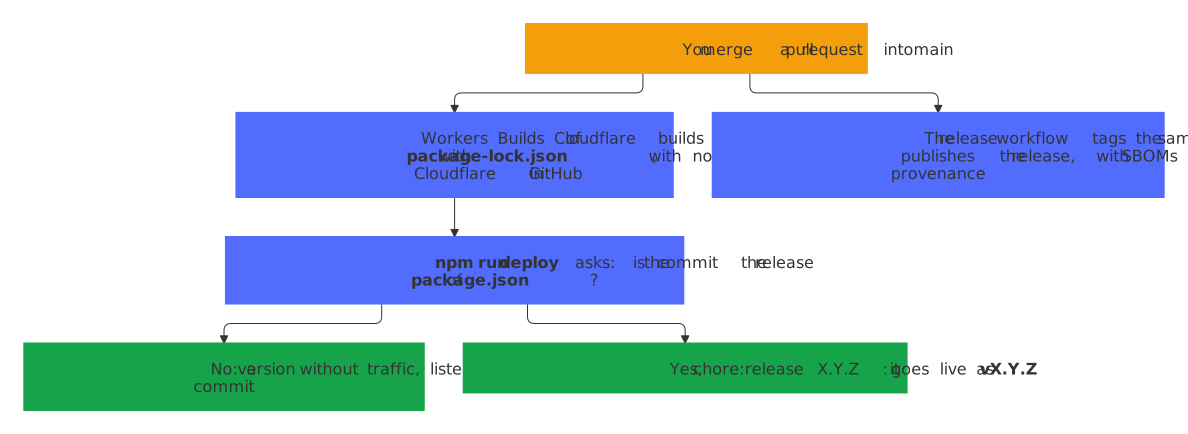
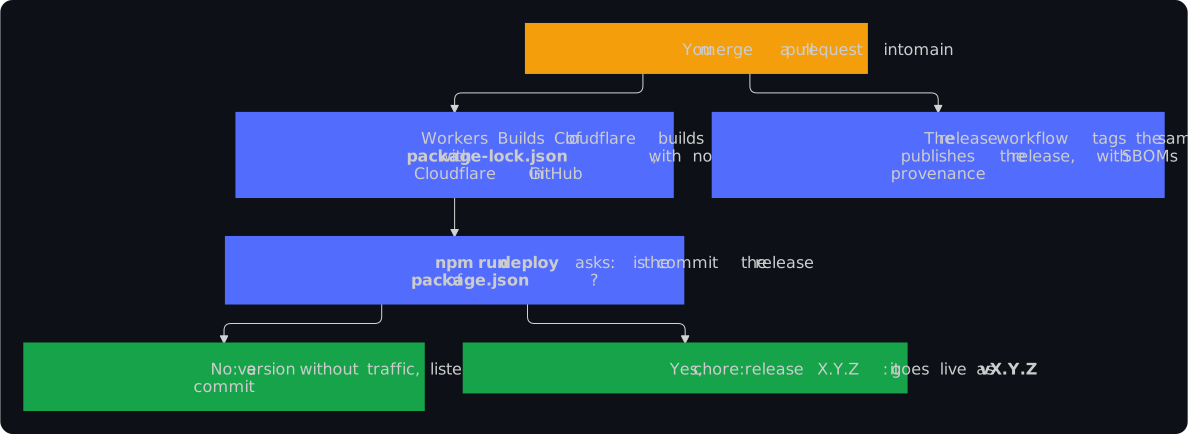
Workers Builds, the integration of Cloudflare with GitHub, builds every commit of main on Cloudflare and runs npm run deploy. Its script, scripts/deploy-worker.sh, deploys only the merge of the release pull request, chore: release X.Y.Z, as the version vX.Y.Z; every other commit becomes a version without traffic, which the dashboard lists. The release workflow tags the same commit and publishes the release with its SBOMs and the signed provenance of its isolated build, so the Worker that runs is the code of the latest release.
No key of Cloudflare is stored in GitHub: an API token of Cloudflare can't be limited to one Worker, and Workers Builds needs none. The secrets of the Worker live in Cloudflare, set with npx wrangler secret put. Decision 0115 records why.
Once by hand
python3 .github/blueprint.py checklist ticks off each step that it can see and names the rest, each with its link: the release app of the owner with its private key, as your own account shows, the token of the issue assistant unless its AI is off, OpenSSF Best Practices, the REUSE API and the social preview.
This kind adds these steps:
- Create the Worker with its first deployment from your machine,
npx wrangler loginandnpx wrangler deploy, which keeps the sign-in there. - Connect the repository in the dashboard of Cloudflare, under Settings and Builds of the Worker, with the app of Cloudflare installed for this repository only, the build command
npm ci --ignore-scripts, the build variableSKIP_DEPENDENCY_INSTALLset to1, so that Cloudflare runs no install script of a package, and the deploy commandnpm run deploy. - Put each secret of the Worker into Cloudflare with
npx wrangler secret put NAME.
They happen in Cloudflare, so the checklist names the first two as one step that it can't tick off.
docs/releases.md of the new repository describes each step, how to roll a release back, and what to do when a build fails.
A real repository
No public repository of this kind follows the blueprint yet. The Variants workflow of the blueprint makes one from every change of its files and runs its checks with their real tools, and updates one from the latest release as its blueprint bot would.
How the blueprint compares with other templates: the comparison.