Games and rules
Your Autodarts board plays games in Home Assistant itself: X01 from 101 to 1001, four Cricket games, six party games and eight training games, alone, as a match of up to four players, a party game of up to eight or a tournament of up to eight. Home Assistant counts every dart the board detects, recognizes busts, shows the checkout route and keeps the game through restarts. No Autodarts account, no cloud and no browser tab are needed.

On this page: All games at a glance · Start a game · At the board · Corrections and darts entered by hand · Matches, legs and sets · Match summary · Teams · Start scores (handicap) · Bull-off · Playing against the bot · Tournaments · X01 · Cricket games · Party games · Training games · Statistics
All games at a glance
| Game | Players | Goal |
|---|---|---|
| X01: 101, 301, 501, 701, 901, 1001 | 1–4, or two teams of two | Count down to exactly zero, by default on a double |
| Cricket | 1–4, or two teams of two | Close 20 to 15 and the bull, and score on the numbers the others still have open |
| Cut-Throat Cricket | 1–4, or two teams of two | Close everything with the fewest points: your points go to the others |
| Tactics | 1–4, or two teams of two | Cricket on 20 to 10 and the bull |
| Wild Mouse | 1–4, or two teams of two | Cricket plus three doubles, three triples and three darts in one bed |
| Shanghai | 1–8 | Score on the numbers 1 to 7; single, double and triple in one visit win at once |
| Halve-It | 1–8 | Hit the target of the round, or your points are halved |
| Killer | 2–8 | Win your number, become a killer and take the others' lives |
| Golf | 1–8 | Nine or 18 holes in the fewest strokes |
| Baseball | 1–8 | Score the most runs in nine innings |
| Count-Up | 1–8 | Score the most points in 1 to 20 rounds |
| Around the Clock | 1 | 1 to 20 and the bull in the fewest darts |
| Doubles training | 1 | D1 to D20 and the bullseye in the fewest darts |
| Checkout training | 1 | Random finishes from 2 to 170 within three visits |
| Bob's 27 | 1 | One visit at every double, without dropping to zero |
| 121 checkout | 1 | Check out 121 in nine darts, and climb |
| Catch 40 | 1 | Check out 61 to 100, the faster the more points |
| JDC Challenge | 1 | The 57-dart routine of the Junior Darts Corporation |
| Singles training | 1 | One visit at each number, points per mark |
| Tournament | 3–8 | A round robin or a knockout of X01 or Cricket matches, one at a time |
Start a game
There are four ways to start a game. All of them end in the same place: the Practice game of your board, which the live card, the scoreboard and the board events follow.
- On the screen at the board. Tap New game on the scoreboard, choose the game, the players and the format, and tap Start. The screen also opens by itself a few seconds after a game ends, ready for a rematch. Tournament on the same screen starts a tournament.
- On the dashboard. The Live view of the automatic dashboard has the practice controls: Practice game, the number of players, their names and start scores, legs, sets and the rules. Choosing a game starts it.
- In an automation or script with the action
autodarts.start_game, which sets everything in one call:
action: autodarts.start_game
data:
  game: "501"
  players: [Alex, Sam]
  legs: 3
- By voice with Assist: "Start Cricket for Alex and Sam". The automation guide has the automation.
To end a game, choose Off in Practice game, or tap End game on the new game screen. New practice leg starts the leg again, and what that leg added to the match averages and the match summary counts no more; New practice match starts the match from zero legs and sets.
Player names cannot contain curly brackets, the percent sign, the number sign (#) or control characters, because Home Assistant would read them as a template where a name goes into a message or a file name. The name entities and the actions refuse such a name.
At the board
- A visit ends when you pull the darts. The practice game books it with the takeout. Darts that are already in the board when a game starts do not count.
- Three darts per visit. A fourth dart before the takeout does not count. Darts the board does not detect, such as bounce-outs, count as not thrown.
- Corrections count. When you correct a dart in Autodarts or on the scoreboard before the takeout, the game follows the correction; see corrections and darts entered by hand.
- The turn passes with the takeout, also after a bust. The live card and the scoreboard outline the player at the board.
- What the cards show: the remaining score and the checkout route, the Cricket chalkboard, the round and the target of a party game or the target of a training game. The board outlines the bed to aim at. Live card, scoreboard.
- Events for your automations:
bust,leg_won,match_won,turn_changed,bull_off_won,drill_finished,checkout_attempt,achievement_unlockedand the tournament events arrive the moment they happen, for callers and light shows. - Training sessions keep counting. The practice game and the training session are independent; a dart counts in both.
Corrections and darts entered by hand

A dart the board read wrong, a dart it missed, or the visits of a player without cameras: Home Assistant puts the visit right before it counts.
- Correct a dart: tap the dart on the scoreboard and choose the right bed, or use
autodarts.correct_dart. The remaining score, a bust or a win, the Cricket marks and the statistics follow at once. The board keeps its own reading; when it corrects the dart itself later, its reading counts again. Tap the spot on the pad's board, and the dart also counts where it really is for the dart positions. - Enter a dart: with Practice manual entry on, the scoreboard's keypad or
autodarts.throw_dartadds a dart as if the board had detected it. This works with the detection stopped too, so a player without cameras can play along. - Next player: ends the visit without pulling the darts; the darts in the board count for nobody until they are pulled. Without darts, the player at the board passes in X01, the Cricket and the party games; in a party game the pass counts as a visit of three misses, so Halve-It halves the points and Golf scores 5 strokes, and a pass that ends the last round counts the leg and the match like a visit with darts. A training game, a bull-off and Killer while the numbers are chosen do not pass.
- Undo the last visit: when a wrong reading is noticed after the takeout, a tap on the last visit beside the darts of the scoreboard or
autodarts.undo_visittakes the visit back, also after a won leg: its darts become the current visit again, to correct them, and Next player ends it. This works while no dart is in the board and the game has not changed since, but not after a visit that decided a tournament match. The statistics, the personal bests, the players' progress with their achievements, the weekly report and the training calendar go back with the visit, so it counts once when it is booked again. - Marked: darts entered or corrected in Home Assistant carry
manual, so automations can tell them apart. The exact rules.
Matches, legs and sets

- Players: set Practice players to 2, 3 or 4, or choose them on the new game screen. After every visit the next player throws; a bust passes the turn too.
- Legs and sets: the first player to win Practice legs per set legs wins the set; there is no tie-break and no need for two clear legs. The first player to win Practice sets to win sets wins the match. With one set to win, a match is simply the first to that many legs. With one player, legs just count up.
- Throwing first: as in PDC set play, the first throw passes to the next player every leg within a set, and every new set starts with the player after the one who started the previous set. With two players, player 1 starts sets 1, 3 and 5 and player 2 sets 2 and 4. The first leg of a match starts with player 1, or with the winner of the bull-off.
- Result: the result stays on the cards until the next dart, which starts a new match. The winner keeps the legs of the deciding set, so a first-to-3 match ends 3–2 on the scoreboard.
match_won, the match history and the player profiles keep every player's legs and sets;match_legscounts the legs of the whole match. - Averages: each player's average and marks per round cover the whole match.
Match summary
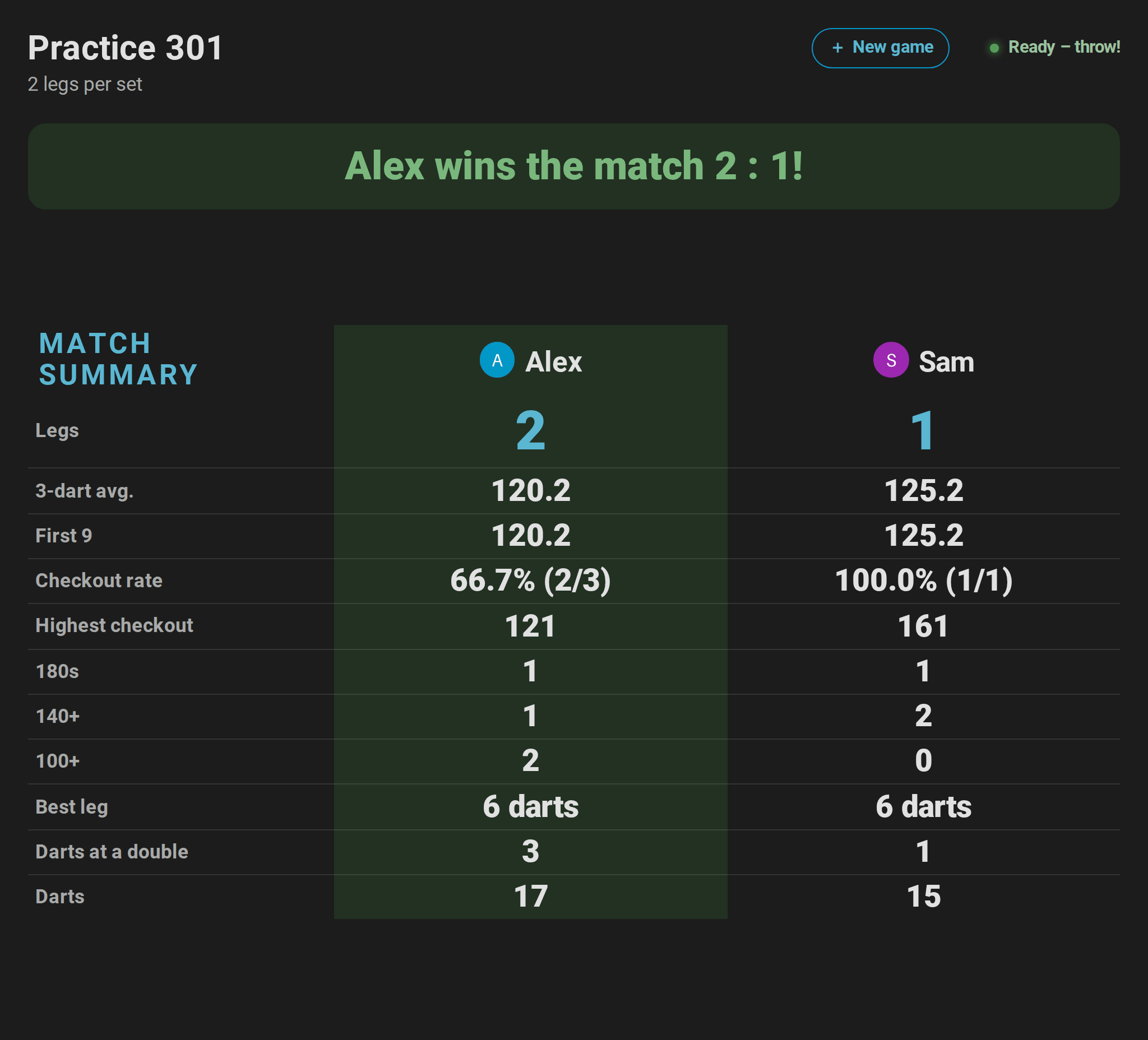
When an X01 or Cricket match of several players ends, the scoreboard and the live card sum it up: a column for every player, the winner's highlighted, with the result in the first row. The winner's banner names the result too, for example Alex wins the match 3 : 2!
- X01: legs and sets, 3-dart and first-9 average, the checkout rate with the legs checked out and the darts at a double, the highest checkout, 180s, 140+ and 100+ visits, the best leg in darts and all darts. Without double out, the checkout rate and the darts at a double are left out.
- Cricket: legs and sets, marks per round, marks, the best leg in darts and all darts.
- Party games keep their scores on the screen.
- How long: until the first dart of the next game, or for
summary_secondsof the card.match_woncarries the numbers for your automations, for example to send them to your phone. How they are counted.
Teams
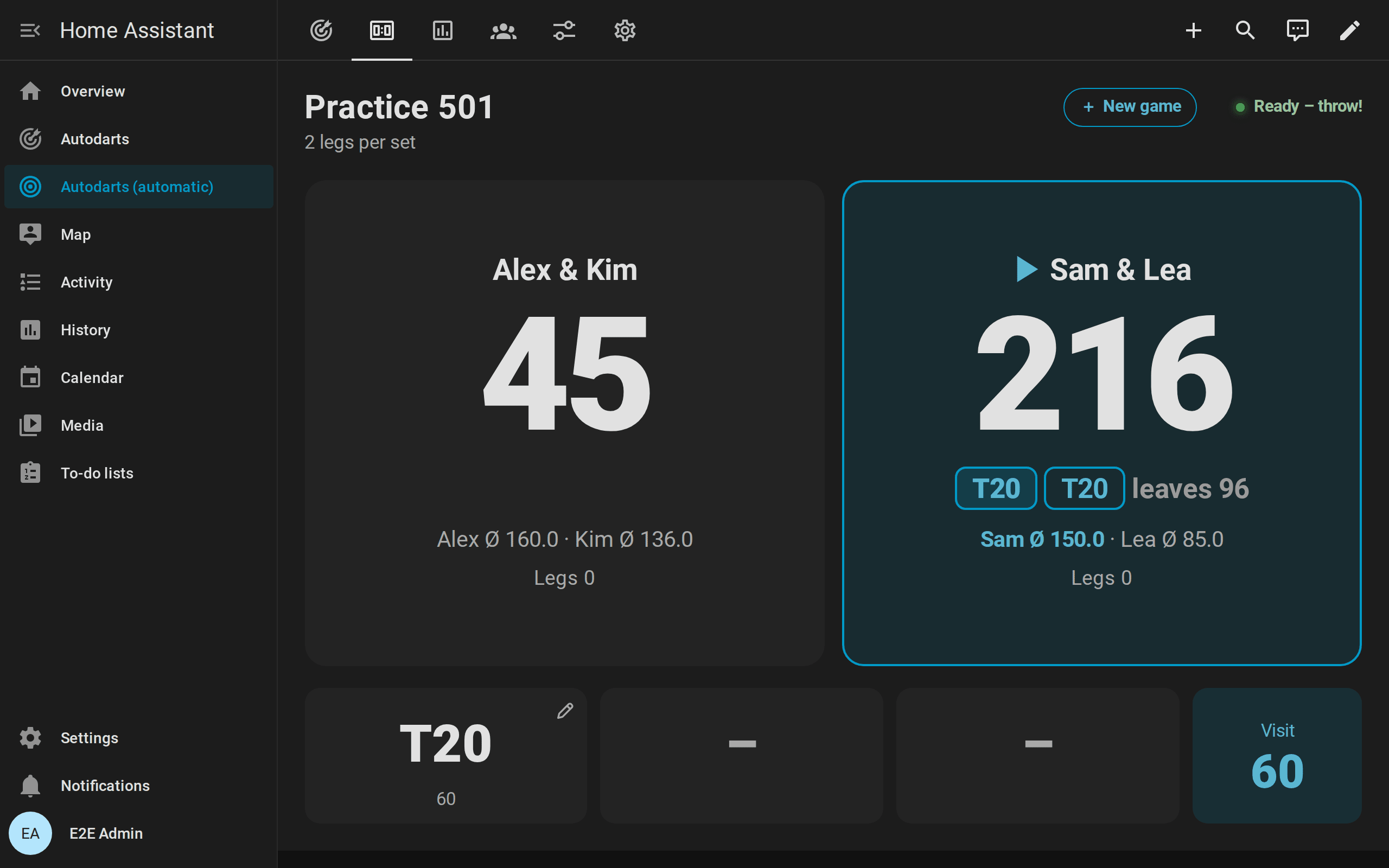
- Two teams of two: turn on Practice teams (on the new game screen: Teams) and play X01 or a Cricket game with four players. Players 1 and 3 play against players 2 and 4. The throwing order is the seat order, so the teams alternate: A1, B1, A2, B2. With fewer or more than four players, and in party and training games, everybody plays alone.
- One score per team: partners share the remaining score, the opening double with double in, and in the Cricket games the marks and points. A team plays from the start score of its first player.
- Throwing first passes to the next seat every leg, as in any match of four, so the teams take turns.
- Winning: both partners win the leg and the match. The scoreboard names the winning team, and
leg_wonandmatch_wonaddteamandteam_name, for example Alex & Kim. A team without a name for both players, and a team with the bot, has noteam_name. - Statistics per person: the first nine, the checkout rate, the averages and the marks per round stay with the player who threw the darts. The player profiles count the leg and the match for both partners, and each of them beats both opponents in the head-to-head records; partners play no head-to-head. A team leg sets no fewest-darts and no marks-per-round personal best; a checkout still counts for the player who threw it.
Start scores (handicap)
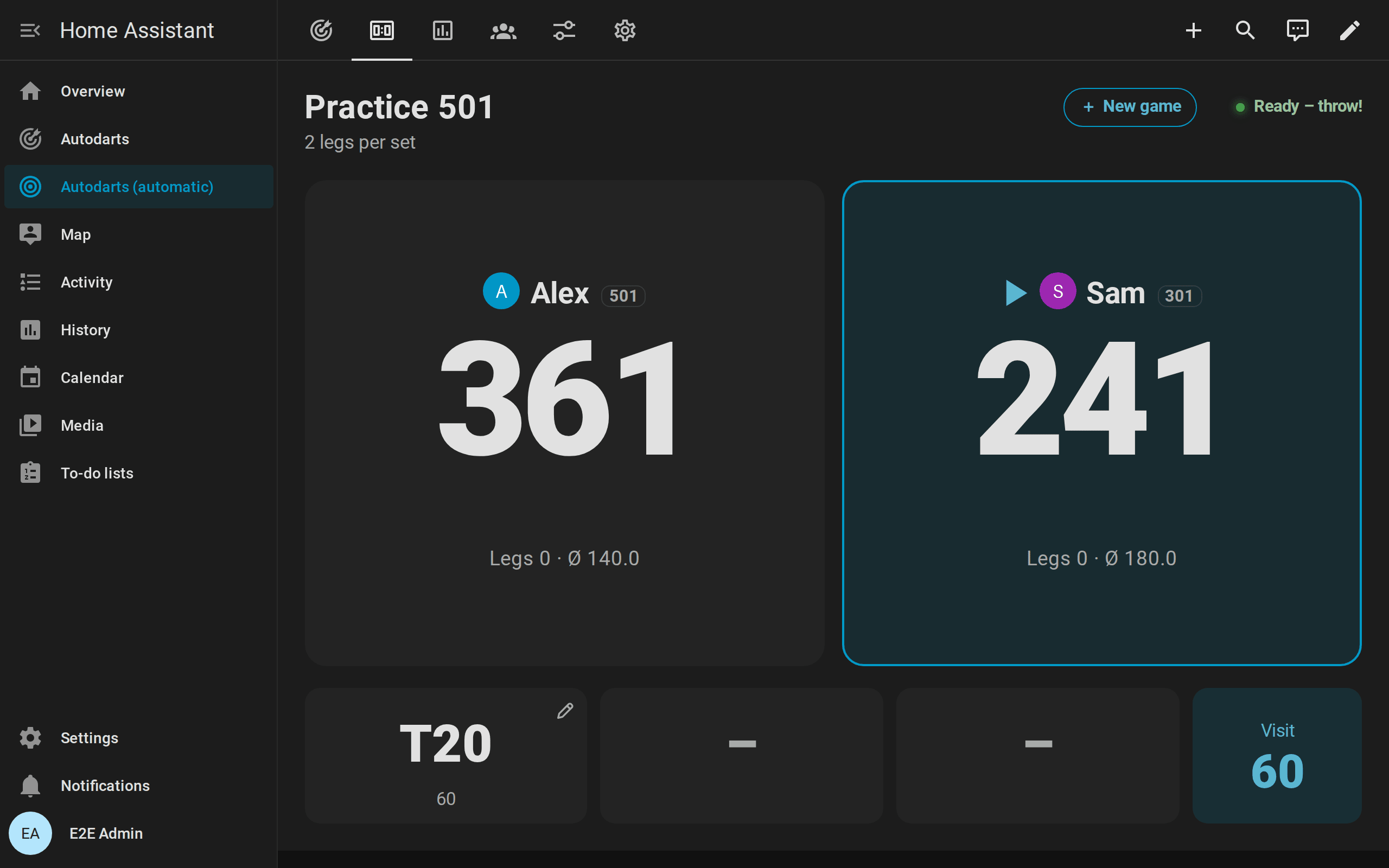
- For a fair match between players of different strength, every player can start X01 from a score of their own, from 2 to 1001: set Practice start score player N, use − and + beside the player on the new game screen, or pass
start_scorestoautodarts.start_game. 0plays the game's start score. All other rules stay the same; the average counts from the player's own start, andleg_wonnames it instart.- The scoreboard and the live card show every start score of its own beside the name.
- A leg counts for the fewest-darts personal best of the score it really started from: a leg from 301 for
fewest_darts_301, a leg from 401 for none, because 401 is no X01 game.
Bull-off

- With Practice bull-off (on the new game screen: Bull-off) and two or more players, a match starts with one dart per player at the bull, in seat order. Only the first dart of each visit counts. The scoreboard shows the bed of every dart and its distance from the center, marks the dart that leads, and says Tie – throw again when a tie throws again.
- As the WDF and PDC rules want, the bullseye beats the outer bull, which beats every other bed. Two or more darts in the same bull bed tie: those players throw again, the last of them first.
- Outside the bull, the dart closer to the center wins. The distance comes from the position the board reports, measured against the outer edge of the double ring (170 mm). Any bed of the board beats a dart off the board; when all darts miss the board, everybody throws again.
- With Practice bull-off by distance, the measured distance also decides between two darts in the same bull bed; darts equally close to 0.1 mm throw again.
- A dart without a position, such as one entered by hand, cannot be measured. Outside the bull, a measured dart beats it, and two darts without a position throw again. In the same bull bed, a dart without a position ties, also by distance, and those players throw again.
- The dart at the bull scores nothing in the game: the remaining score, the marks and the averages start with the first visit of the match.
- The bull-off only decides who starts. With three or four players, the others follow in seat order.
bull_off_wonannounces the winner, for example for the practice caller.
Playing against the bot

Nobody to play with? X01 and the Cricket games can be played against the bot, a computer player of the strength you choose.
- Seat the bot: tap + Bot on the new game screen, set Practice bot level, or start a game with
bot_level. The level is the 3-dart average the bot plays, from 20 for a beginner to 120, above any professional's season average.0plays without the bot. There is no level from 1 to 19: in Practice bot level, a step up from 0 seats the bot at 20, and a step down from 20 sends it home. - In the Cricket games, the level plays the marks per round of a player with that average, about a 24th of it: 2.5 at level 60, 3.3 at 80, 4.2 at 100 and 5 at 120.
- Its seat: after the players. With the bot, up to three players play, also as the fourth player of two teams; such a team has no team name. Choosing X01 or a Cricket game for four players while a bot level is set asks you to make room first.
- Changing the level during a match lets the bot play the new level from its next dart. Seating the bot, or sending it home with
0, starts a new match; in party and training games, where it does not play, a new level changes nothing until the next X01 or Cricket game. - Its turn: when your darts are pulled, the bot throws its three darts one by one, with the pause of Practice bot delay (2 seconds) before each, and they appear on the cards where they landed. Throw while it is at the board, and it throws the rest of its visit at once.
- How it plays: like a player: at the triple 20 to score, along the checkout route to finish and at a setup where no route exists; in Cricket it closes the numbers and scores while it is behind. With double in, it opens with a double that wins or leaves a finish for its darts, otherwise with the double 20, or with a smaller double where the double 20 would bust; with master in, it opens with the triple 20 where it does not bust. It plays the out mode and the bull mode of the leg. Without double out and without a finish, it takes the biggest bed that does not bust. It always aims at the usual checkout routes, also with Practice personal checkout routes, and the cards show those routes for its turn. Its darts scatter as much as those of a player of its level. How the bot plays.
- What counts: the bot's darts count for nobody's statistics, personal bests or achievements; the result of the match counts in your player profile. Party games, training games and tournaments are played without the bot; after a tournament, the bot comes back with the other practice settings.
Tournaments

A tournament for three to eight named players at one board, one match at a time: a round robin, in which everyone plays everyone once and a table ranks the players, or a knockout, in which the winners go on through a bracket until the final. Every match is an X01 match, with start scores for a handicap if you like, or a Cricket game, with the legs, sets and rules of the tournament. The results go into the player profiles and the head-to-head records like every match.
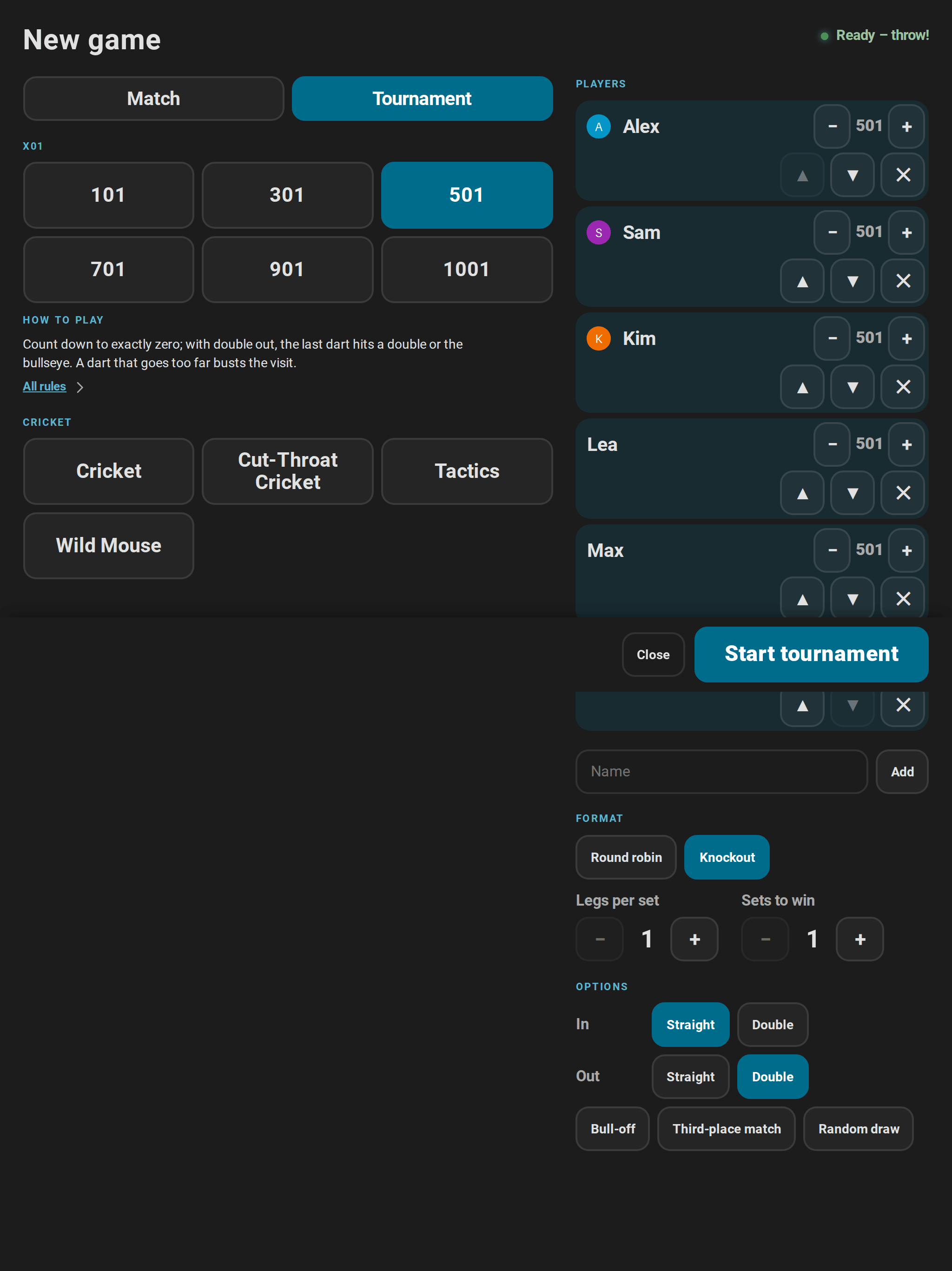
- Start: tap New game on the scoreboard, then Tournament. Choose the players, round robin or knockout, the game, the legs and sets and the rules, and tap Start tournament. Or start it from an automation:
action: autodarts.start_tournament
data:
  players: [Alex, Sam, Kim, Lea]
  format: round_robin
  game: "501"
  legs: 2
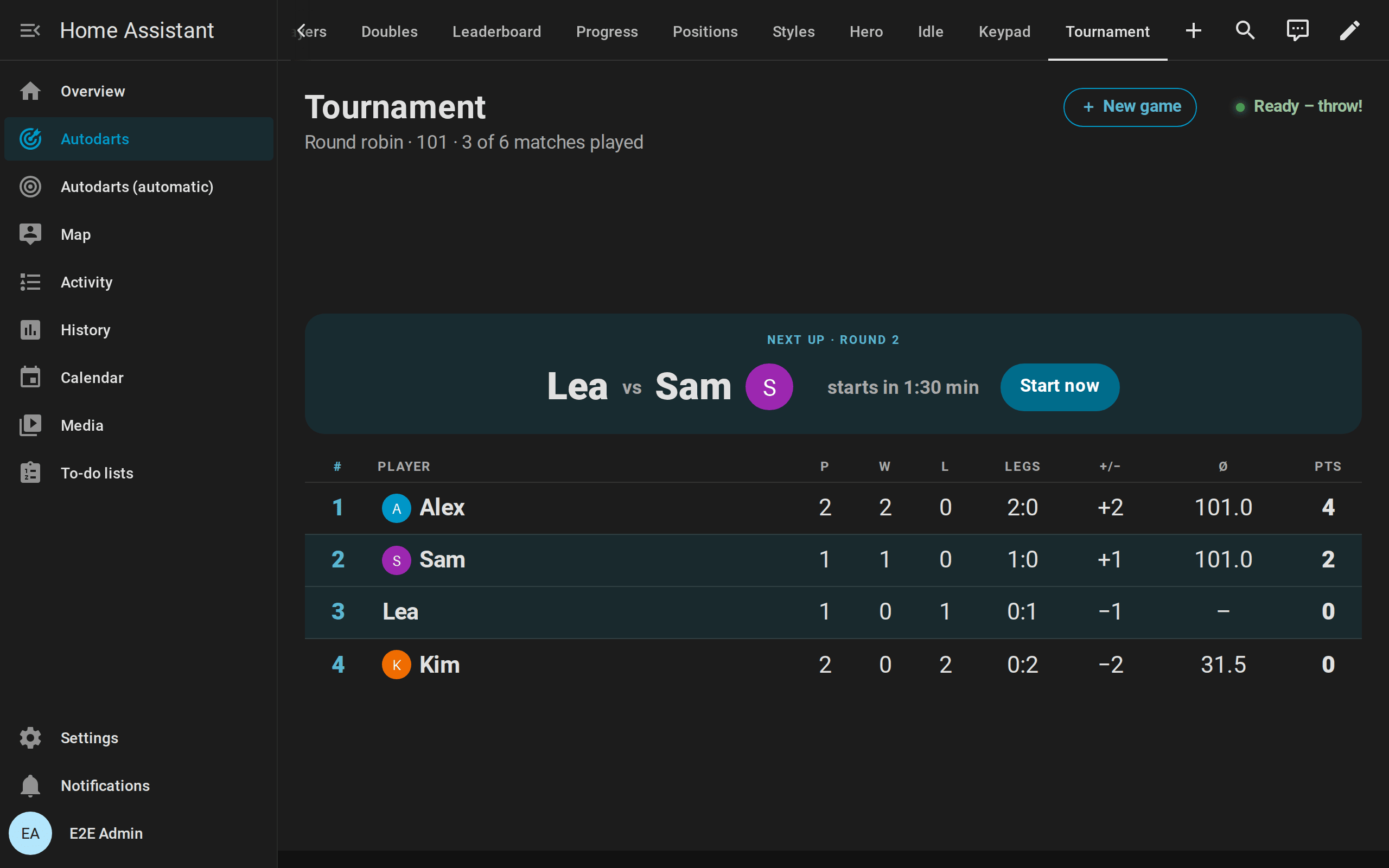
- Play: the first match starts at once, and the title line of the scoreboard names the round and the match. When a match is decided and the darts are pulled, the scoreboard shows its summary, then the table or the bracket with the next match and a countdown. The next match starts by itself; Start now skips the wait.
- Winner: after the last match, a banner names the winner, and the table or the bracket stays until a new match begins.
tournament_finishedcan start the light show or announce the results. - Afterwards: the practice game goes back to the players, names, start scores, legs, sets, rules and bot level it had before the tournament, with the first dart of the next match or the first change of a practice setting. After Stop tournament, a match being played is played to its end first. A new tournament starts only when none is being played: stop the one being played first.
Tournament on the new game screen of the scoreboard sets up the players, the game, the format and the rules:
Between two matches, the scoreboard shows the next match with its countdown, and the table of a round robin:
The entity reference lists the tournament's settings, buttons and actions, and the scoreboard guide what the screen shows.
Tournament rules
- Players: three to eight players with a name each, eight at most also in Tournament players. A name is the same player regardless of upper and lower case, as in the player profiles. A player of the tournament being played cannot be deleted; a deleted player leaves the list for the next tournament.
- Draw: the order of the names, or a random order with Tournament random draw or a
seed. The same seed always draws the same order; a random draw without a seed picks one and shows it in theseedattribute of Tournament. - Round robin: everyone plays everyone once, in rounds by the circle method: three or four players play 3 rounds, five or six play 5, seven or eight play 7. With an odd number of players, one player sits out every round. Within a round, a player of the round's last match opens the next round only when no other match can, and the first throw goes to the player of a match who had it less often.
- Points: a won match is worth 2 points, as in the Premier League, a lost one none. A match cannot end in a draw.
- Tie-breakers: players level on points are ranked by
- the points they won in the matches among themselves,
- the leg difference: legs won minus legs lost over all their matches, every leg of a match with sets included,
- the 3-dart average over all their matches (Cricket: the marks per round),
- the order of the draw.
So of two players level on points, the one who won their match goes first; of three players who beat each other in turn, the leg difference decides. - Knockout: a bracket of 4 places for three or four players and of 8 places for five to eight. The first player of the draw is seed 1, the second seed 2, and so on, placed as in professional draws: seed 1 meets the last seed first, seeds 1 and 2 can meet in the final at the earliest, and seeds 1 to 4 not before the semi-finals. Places the players do not fill are byes for the top seeds, who go straight into the next round. The rounds are the quarter-finals, the semi-finals and the final. - Third place: with Tournament third-place match and four players or more, the losers of the semi-finals play for third place, before the final. Without it, a knockout has no third place. - Order of play: one match at a time, round by round. A knockout plays the matches of a round from the top of the bracket down, and the match for third place before the final. - Matches: every match is a match of two players, with the legs per set, sets to win, double out, double in and bull-off of the tournament. Rules the tournament does not set come from the practice game as you set them, also an out mode that waits for the next leg. A tournament plays straight or double in and out, with master coming as double, the bull 25/50 and no round limit; after it, the practice game has its own rules again. In X01, a player with a start score of their own starts every leg of the tournament from it, a handicap; the other one from the game's. The first named player throws first, unless the bull-off decides. - Changed matches: a match whose legs, sets, start scores or rules are changed while it is played is no tournament match any more, and its result does not count; Next tournament match sets the tournament match up again. A setting changed during the pause starts the match of the last two players anew: until its first dart, it makes way for the next match when the pause is over. - Averages: a player's average counts the points and darts of all their tournament matches; the darts of a bust visit count, its points do not. - Winner: the winner of the final, or the player at the top of the table after the last match. After it, Next tournament match says that the tournament is over: stop it, or start a new one.
X01

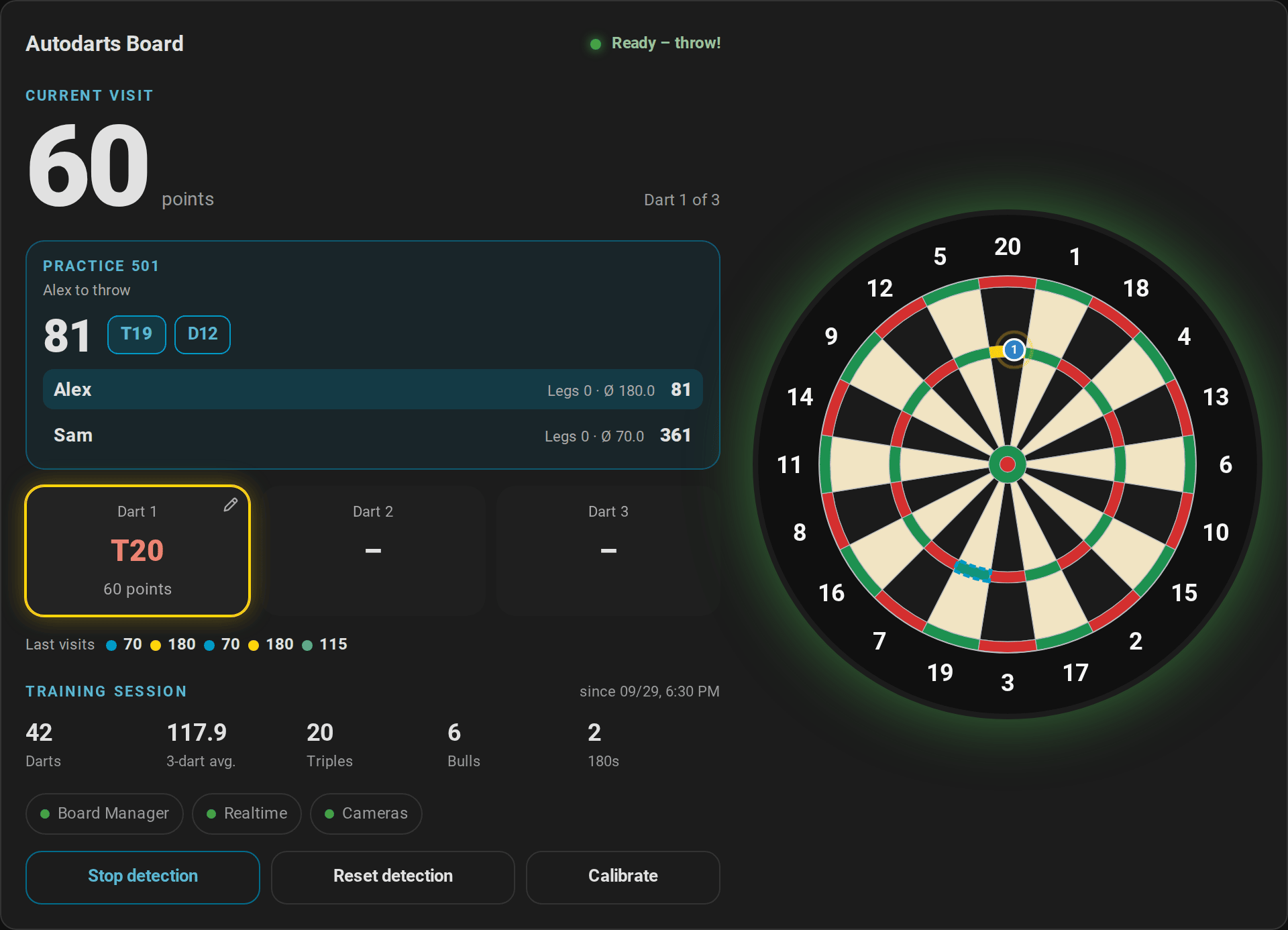
- Counting down: the score starts at 101, 301, 501, 701, 901 or 1001, and every dart subtracts its score.
- In and out: as on play.autodarts.io, Practice in mode and Practice out mode set how a leg opens and ends: Straight with any dart, Double with a double or the bullseye, Master with a double, a triple or the bullseye. A leg starts straight and ends on a double unless you choose otherwise, on the new game screen of the scoreboard too.
- Double out (the default): the last dart of a leg must hit a double or the bullseye. Master out takes a triple as well: the route finishes on one only where it saves a dart, such as
T20for 60, and keeps the checkout chart's double otherwise. Straight out finishes on any bed. - Double in and master in (off by default): a player's score starts with the first double or bullseye of the leg, with master in also a triple; darts before it score nothing. The cards ask for it and outline the double ring. A bust takes the opening dart back. With double or master in and out, a start score of 3 cannot be won, since D1 leaves 1 and T1 ends on a triple; only master in and master out win it, with T1. Such a start score is refused.
- Changing the out mode: a leg keeps the rules it started with. Changing the out mode during a leg, once a dart counted, applies from the next leg; before the first dart of a leg, between matches and in the other games it applies at once. So no leg becomes unwinnable: a player who stands on 1 in a leg without double out can still finish it with a single 1 when double out comes on. Another in mode, bull mode or round limit starts a new match.
- Bull mode: with Practice bull mode 25/50, the outer bull scores 25 and the bullseye 50; with 50/50, the whole bull scores 50. Only the bullseye is a double, so with double out 50 still finishes on the bullseye, but on the way the route aims at the bull for 50:
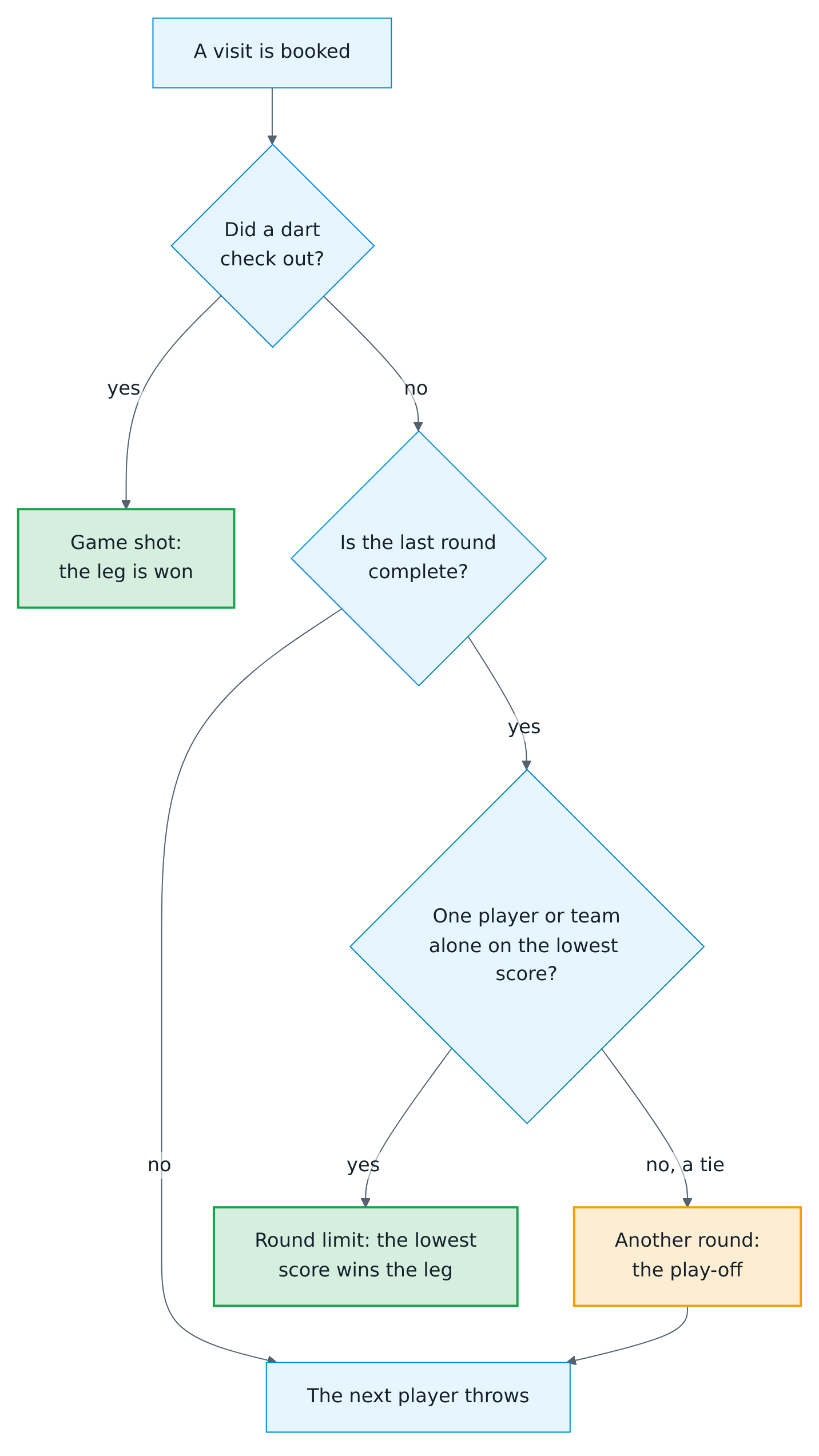
BULL D20for 90, where 25/50 playsT18 D18. - Round limit: with Practice max rounds, from 1 to 50, a leg ends after its last round: when every player has thrown that many visits without a checkout, the lowest score wins the leg, and the callers name the winner. Partners of a team share their score. On a tie for the lowest score the leg goes on, round by round, until one player or team alone has it or somebody checks out. The scoreboard shows the round, such as Round 3/10, and Play-off for the extra rounds.
0, the default, plays without a limit. - Bust: a dart that goes below zero, leaves 1 with double or master out, or reaches 0 with a dart the out mode does not take busts the visit. The score returns to the start of the visit. The dart that busts counts as thrown; later darts of the visit do not.
- Game shot: a dart that reaches exactly 0 wins the leg.
leg_wonis announced at once; the leg is booked when you pull the darts, so a correction before that still counts. Darts after the winning dart do not count. - Checkout route: whenever a score can be finished, the cards show the route for the darts left in the visit, for example
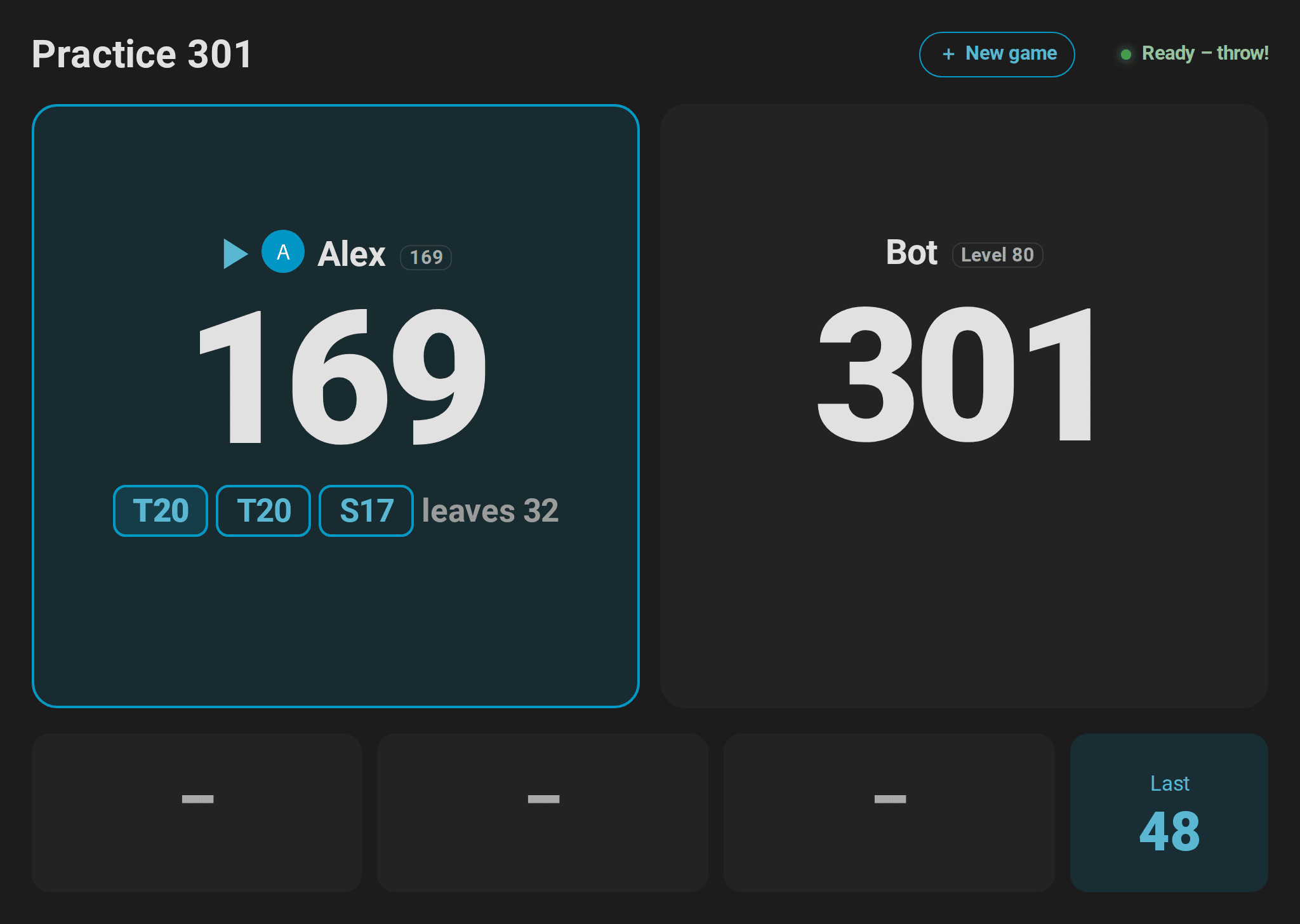
T20 T20 BULLfor 170, and outline the next bed on the board. "No checkout possible" appears only for a score that one visit could finish: up to 170 with double out, up to 180 without. The route follows the professional checkout charts; with Practice personal checkout routes, it prefers your strongest doubles: those with at least 10 darts that you hit at least as often as all your doubles together, never one you have not hit yet. On the way to a double, the outer bull counts as an easy single, as in the charts'25 D18for 61; a setup for the next visit avoids it, because a miss next to it leaves no finish. How the route is chosen. - Setup: where the darts left cannot check out, at 169, above 170 or at 100 with one dart, the cards show a setup instead, for example T20 T20 S17 leaves 32: darts that leave a good double for the next visit, preferably 32, 40, 36 or 16. The caller says Leave yourself 32. How the setup is chosen.
- Average: points scored per three darts of the leg. Darts of a bust visit count, their points do not.
- Records: checkouts, the checkout rate, the doubles and the personal bests count legs with double out that a dart checked out. A leg that the round limit decided counts for the legs and sets of the match, and sets no checkout, best leg or record.

Cricket games

The live card and the scoreboard show a chalkboard with the marks of every player or team (/, X, Ⓧ), the points and the marks per round (MPR). Numbers everybody has closed are dimmed, and the board outlines the next open number, from 20 down to the bull. Once you have closed everything but the points are not yet enough to win, it outlines the highest number an opponent still has open, to score on; in Cut-Throat, one that a player with the fewest points has open. Screen readers read the marks as words.
In a match, the column of the player at the board helps like a dart machine: a green frame where a dart scores, because you have closed the number and somebody still needs it, and an amber frame where somebody else has closed it and scores on you, so you had better close it. A dart of the visit that counted nothing, on a number nobody needs any more or on none of the game, is struck through. A mouse over a frame or a struck-through dart, or a tap on it, says what it means.

Cricket
- Marks: only 20 to 15 and the bull count. A single is one mark, a double two, a triple three; the outer bull is one mark, the bullseye two. Three marks close a number.
- Points: further marks on a closed number score its value (25 for the bull) as long as another player still has it open.
- Win: close every number with at least as many points as everybody else. The win is checked after every dart, so a closing dart wins at once when the points are enough, and later darts of the visit do not count. Alone, closing every number wins the leg.
- Marks per round: the marks that closed a number or scored, per three darts actually thrown. Marks on a number nobody needs any more do not count.
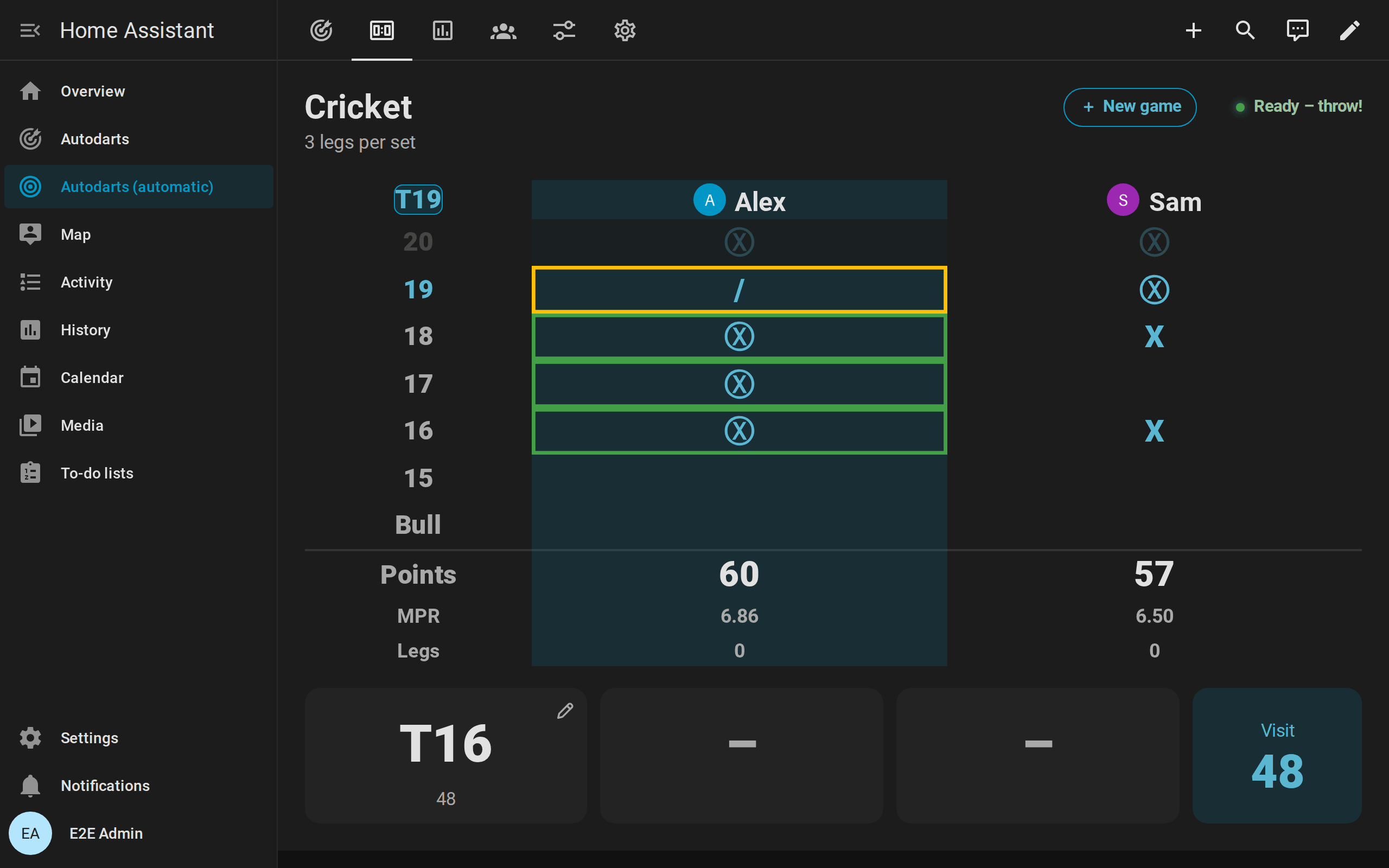
Cut-Throat Cricket
- Marks: as in Cricket, on 20 to 15 and the bull.
- Points go to the others: further marks on a closed number give its value to every other player who still has it open; the player who threw them scores nothing.
- Win: close every number with no more points than anybody else: the fewest points win. The win is checked after every dart, also for the others: when the points of a dart leave another player who has closed everything with the fewest points, that player wins at once, and the later darts of the visit do not count. Alone, closing every number wins. The scoreboard reminds everybody that the fewest points win.
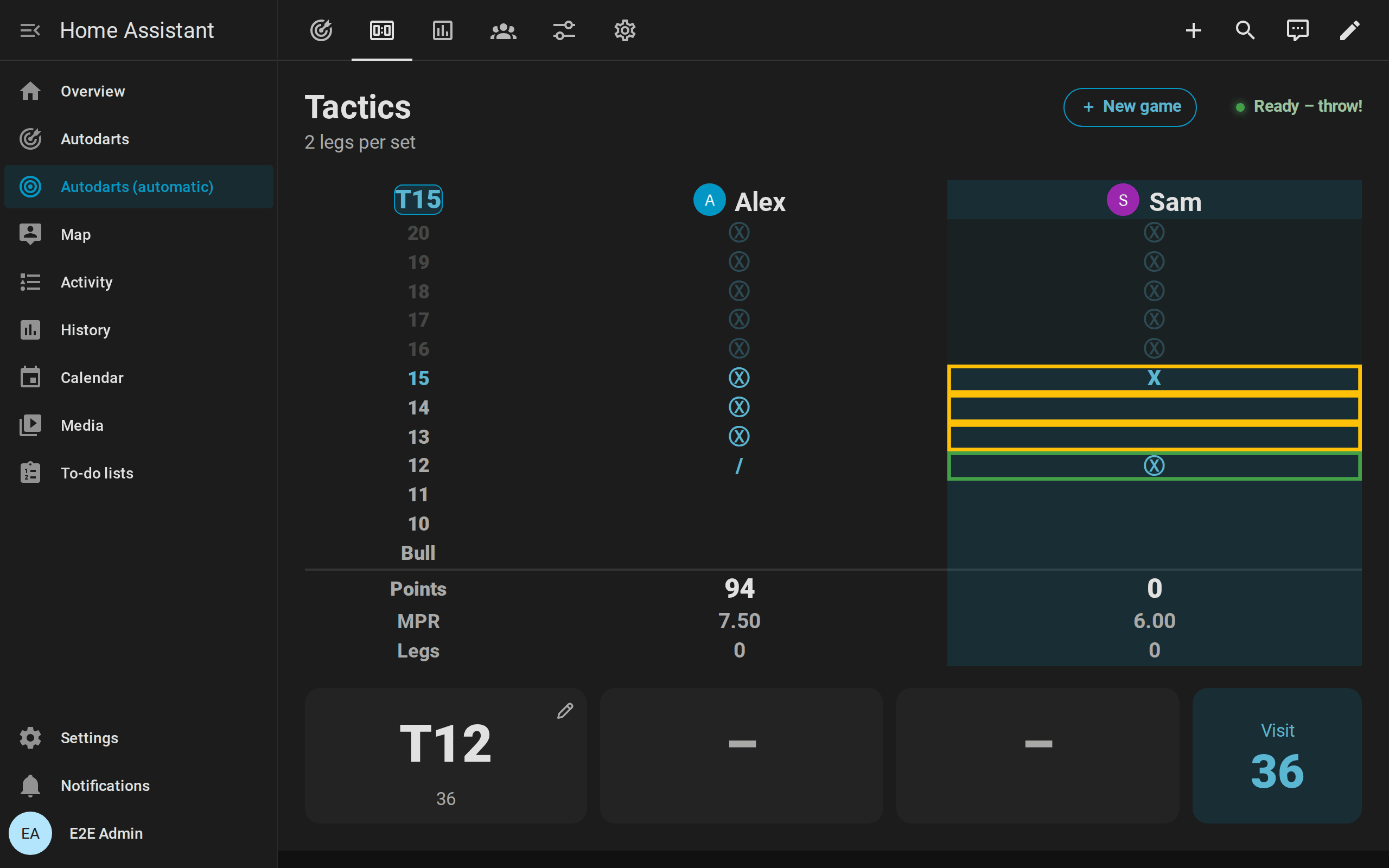
Tactics
- Cricket on the numbers 20 to 10 and the bull, twelve numbers in all. Marks, points and the win follow the rules of Cricket.
Wild Mouse
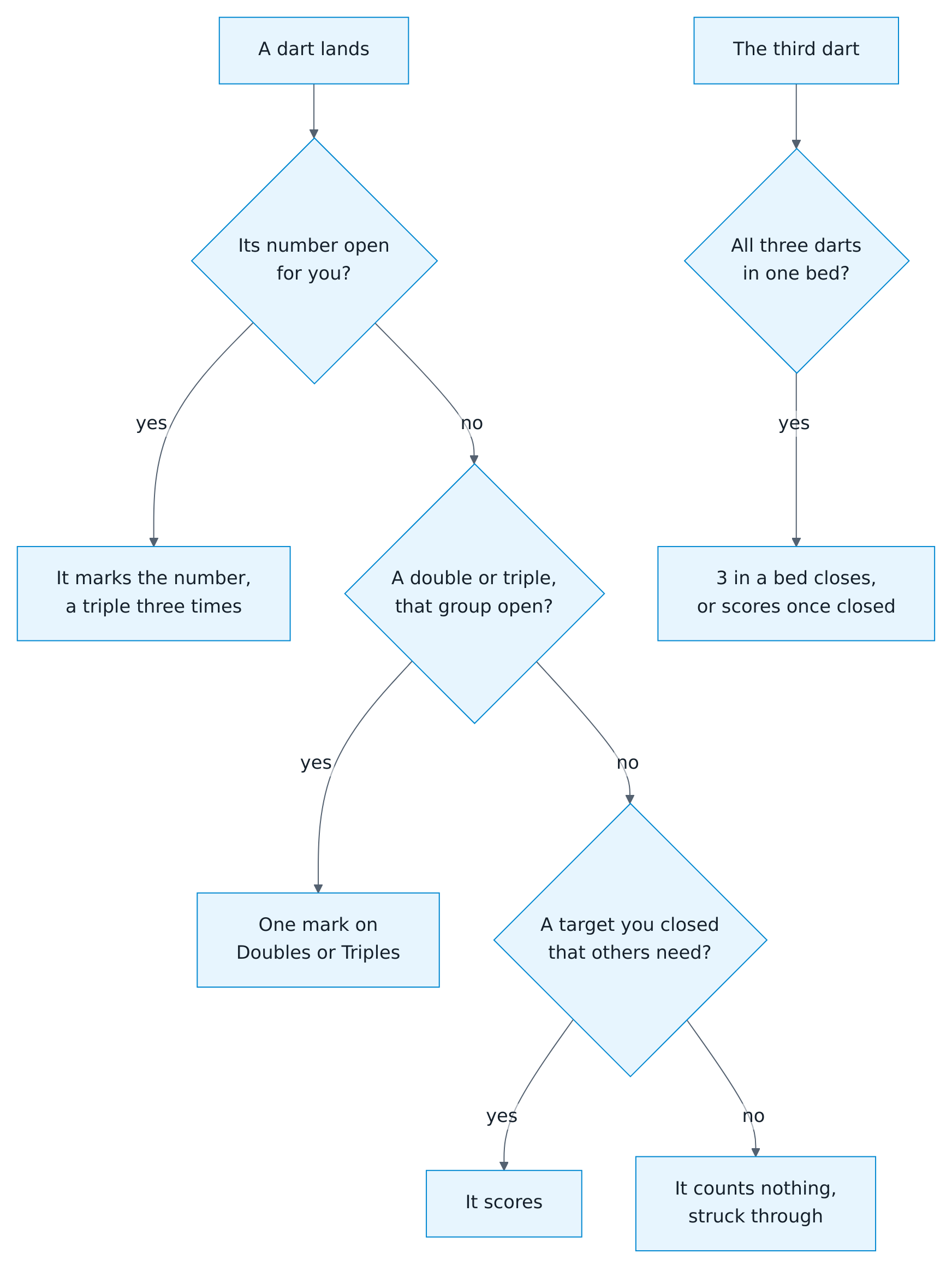
Also known as Minnesota Cricket. Besides 20 to 15 and the bull, every player closes three more targets: Doubles, Triples and 3 in a bed. The chalkboard has a row for each.

- Every dart counts once: a dart marks its number while you still have it open, as in Cricket: a T20 is three marks on the 20. Otherwise a double is one mark on Doubles and a triple one mark on Triples, on any number and with the bullseye as a double. Three marks close Doubles and Triples.
- 3 in a bed: three darts of a visit in the same bed, such as three single 18s or three T20s, close it at once; the darts count for their targets as well. To play without it, as casual players often do, switch off Three in a bed on the new game screen or Practice Wild Mouse three in a bed; a change starts the game anew.
- Points: a target you have closed scores while another player still has it open: a number its value per mark, as in Cricket, Doubles and Triples the dart's whole score (32 points for a D16), and 3 in a bed the three darts together (180 for three T20s).
- Win: close every target with at least as many points as everybody else, as in Cricket.
- Target: the board outlines the next open target: 20 down to 15, then any double, any triple, for 3 in a bed the single 20 and after the first dart its bed, and the bull last.
- Marks per round: every mark that closed or scored counts, on the numbers as on Doubles and Triples; 3 in a bed counts one.

Party games
Six pub classics for one to eight players, a whole party; Killer needs two. With five to eight, the scoreboard shows two rows of four tiles.
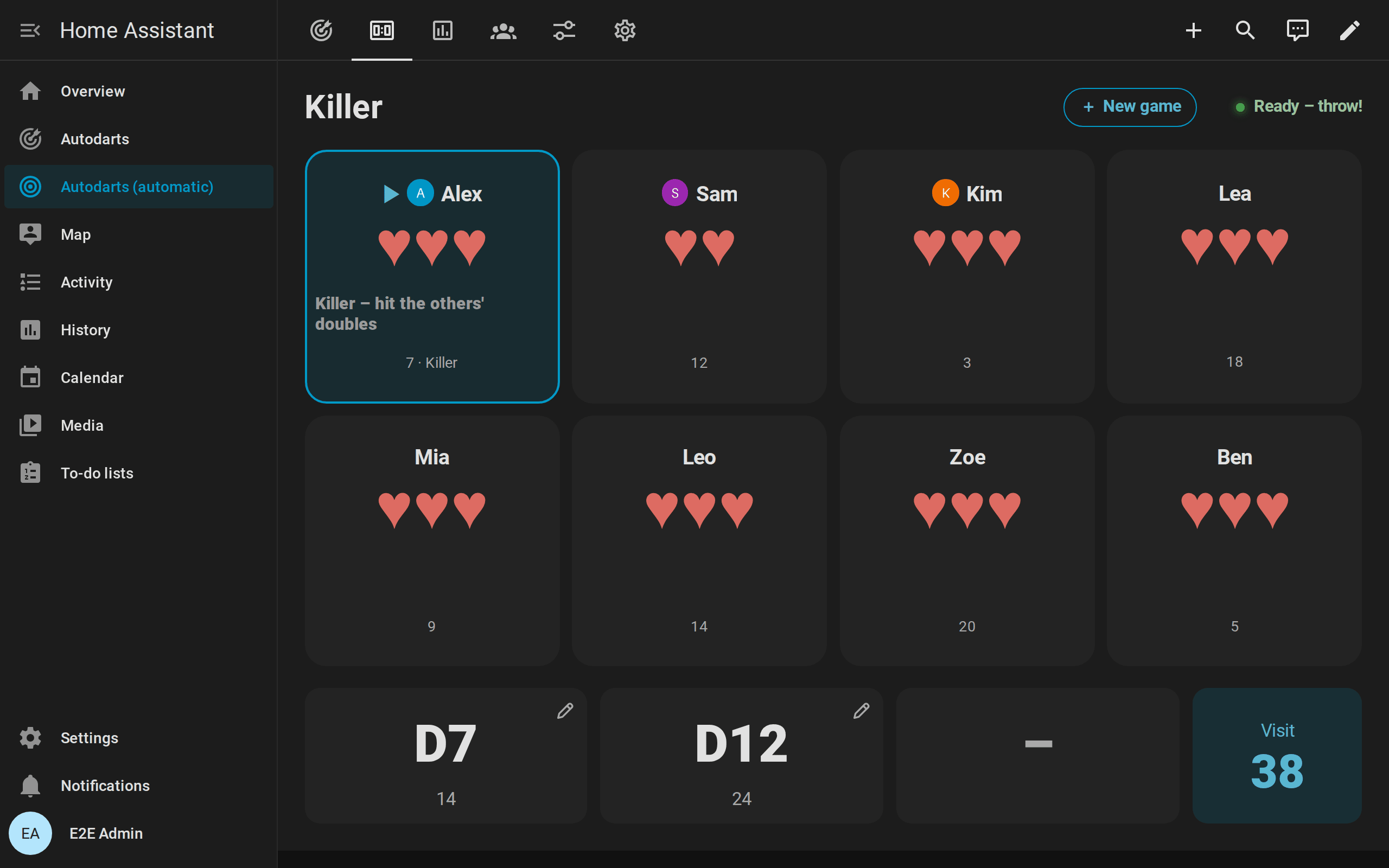 They book a visit when you pull the darts and win legs and sets like any match. The cards show the round, the target and every player's points or lives, and outline the beds to aim at. Party games do not count for the X01 statistics.
Shanghai

- Seven rounds at the numbers 1 to 7; the traditional pub game plays 1 to 20 or nine rounds.
- Every dart in any bed of the round's number scores its value. A miss next to the number counts nothing.
- A single, a double and a triple of the number in one visit, a Shanghai, win the leg at once; later darts of the visit do not count.
- After seven rounds, the most points win. A tie in points goes to the player with more hits; with equal hits, the leg is played again and the next player starts it.
Halve-It

- Everybody starts with 40 points. The nine rounds aim at 15, 16, any double, 17, 18, any triple, 19, 20 and the bull, shown as Bull (25/50).
- Hits add their score. Any double includes the bullseye. In the bull round, the outer bull scores 25 and the bullseye 50.
- A visit without a hit on the target halves the points, rounded down, also when fewer than three darts were thrown.
- The most points after nine rounds win; ties are decided as in Shanghai.
Killer

- Two to four players with 3 lives each.
- First, everybody throws one dart for a number of their own: any bed of 1 to 20 that nobody has yet. A miss, the bull or a number already taken means throwing again.
- Only doubles count after that. Hitting the double of your own number makes you a killer for the rest of the leg. Before that, the doubles of the others do nothing.
- A killer takes a life with every hit on another player's double and loses one with every hit on their own, also with a second own double in the visit that made them a killer.
- A player without lives is out: the rest of the visit does nothing, and the turn skips them from then on.
- The last player with a life left wins at once; later darts of the visit do not count.
- Killer keeps no points:
turn_changedandleg_woncarry the player'slivesand whether they are akillerinstead.
Golf

- Nine or 18 holes, set in Practice Golf holes; hole n is played on the number n.
- A player throws up to three darts per hole and may stop after any dart by pulling the darts: the last dart thrown counts.
- Strokes: a double is a hole in one, 1 stroke; a triple 2, an inner single 3, an outer single 4, anything else 5, also a visit passed without a dart. Whether a single is inner or outer comes from the position the board reports, split in the middle of the treble ring; a single without a position counts as an outer single.
- The fewest strokes after the last hole win. A tie at the top plays extra holes among the tied players, in their throwing order, on the next numbers (after 20 from 1 again), until one of them has fewer strokes after a hole. The scoreboard keeps a scorecard of every hole and shows the extra holes as a play-off.
Baseball
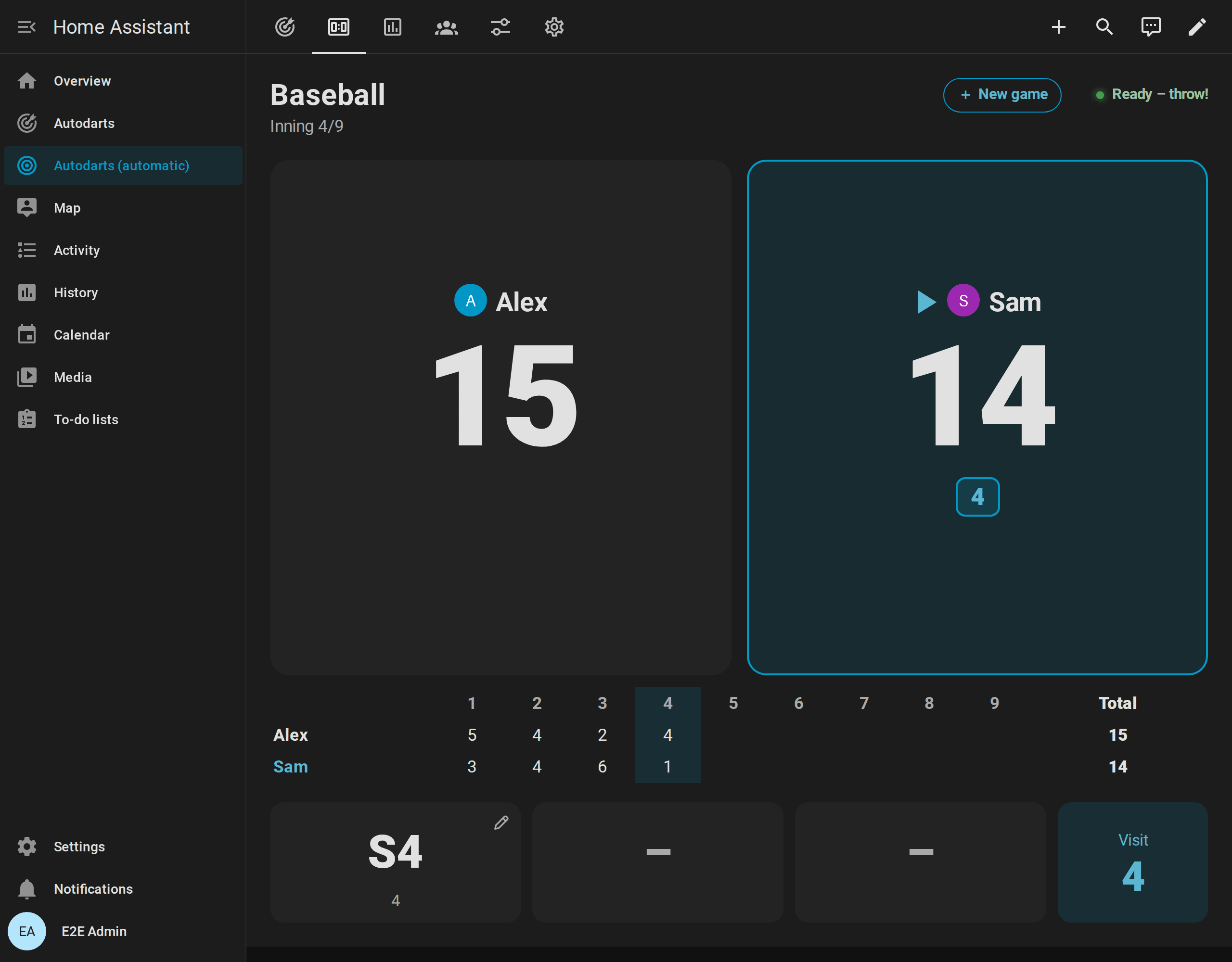
- Nine innings; inning n is played on the number n, with one visit of three darts.
- Every dart in a bed of the inning's number scores runs: a single 1, a double 2, a triple 3. The bull scores nothing.
- The most runs after nine innings win. A tie at the top plays extra innings among the tied players on 10, 11 and so on, until one of them leads after an inning.
Count-Up
- 1 to 20 rounds, set in Practice Count-Up rounds, 8 by default. Every dart scores its value.
- The most points win. A tie at the top plays extra rounds among the tied players until one of them leads after a round.
Training games
Eight classic drills for one player. Each follows the darts of the current visit, books the visit when you pull the darts and outlines its target on the board. A finished game stays on the cards until the next dart starts it again; New practice leg starts it again at once. Every game keeps its last 10 results, and its best result is a personal best. drill_finished and checkout_attempt announce the results. In the checkout training, 121 and Catch 40, as in X01, every dart at a score that one double finishes counts for your doubles analysis.
Around the Clock

- 1 to 20, then the bull, in order, with any bed of the number. The bull target reads Bull (25/50) on the cards,
25in the attributes: the outer bull and the bullseye both count, and both are outlined. Fewer darts are better.
Doubles training
- D1 to D20, then the bullseye (
BULL); only the double ring and the bullseye count. Fewer darts are better, and every dart counts for your doubles analysis.
Checkout training
- A random score from 2 to 170 that three darts can finish, checked out on a double within three visits. As in X01, a bust voids only its visit: the next visit starts from the score before it. A third visit without the finish, a bust in it included, ends the attempt; the route shows only while the attempt goes on. The checkout rate counts successful attempts.
Bob's 27

- Start with 27 points and throw one visit at each double from D1 to D20 and then at the bullseye. Every hit adds the value of the double; a visit without a hit subtracts it.
- The game is lost as soon as the score reaches zero or less, and completed after the bullseye.
121 checkout

- Check out 121 on a double within three visits, nine darts. As in X01, a bust voids only its visit. A finish raises the target to the next score; three visits without the finish lower it by one, never below 121.
- Every score up to 170 is played, also those one visit cannot finish, such as 159: nine darts can, and the cards show a setup for the next visit instead of a route. 170 is the top. The highest score checked out is the personal best.
Catch 40
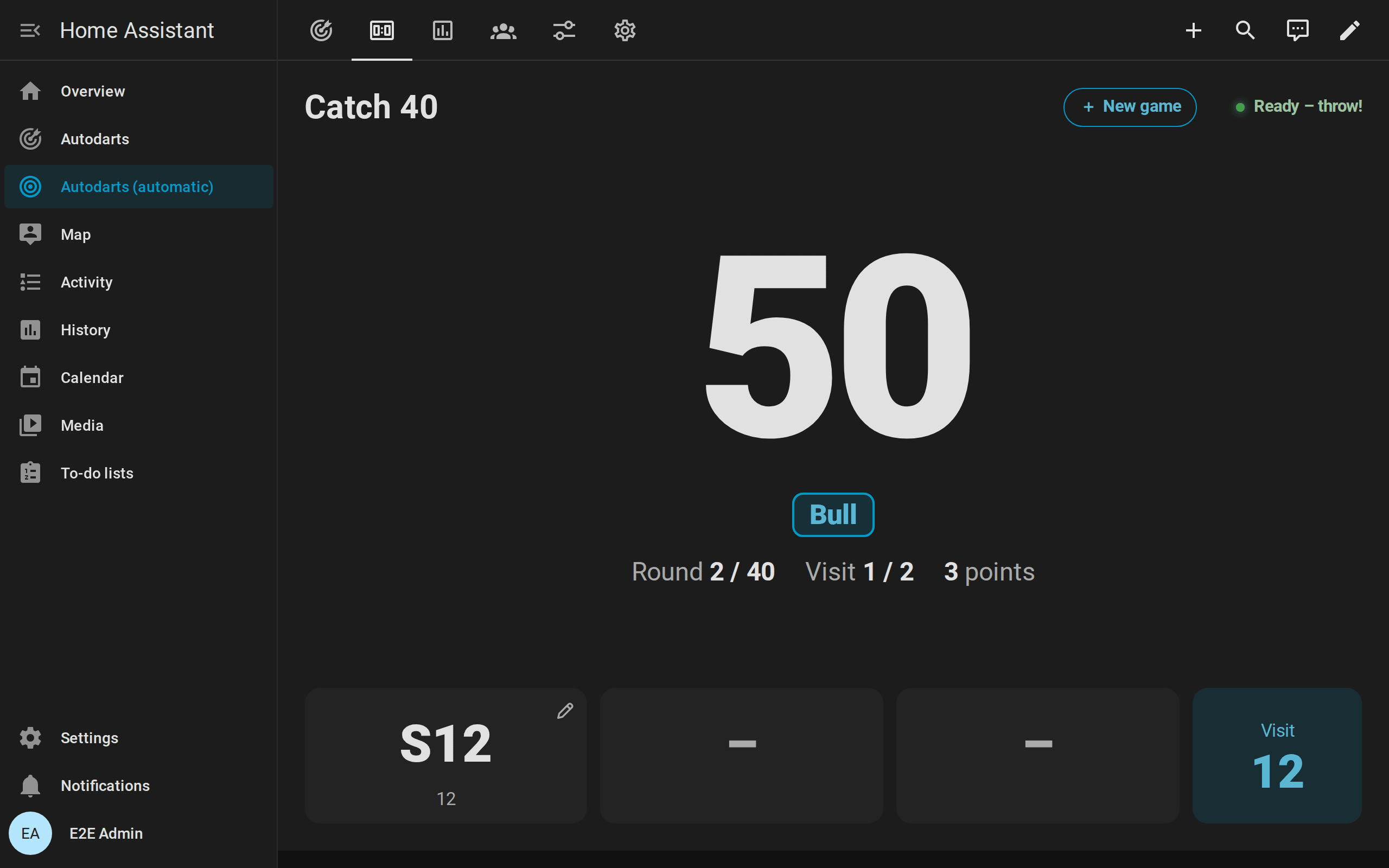
- Check out 61, 62 and so on up to 100, each on a double within two visits, six darts.
- A checkout in two darts scores 3 points, in three darts 2 and in four to six darts 1. No two darts can finish 99, so there three darts score 3 points.
- As in X01, a bust voids only its visit: the second visit starts from the score before it, and a finish then scores 1. Two visits without the finish score nothing, and the next number follows. At most 120 points.
JDC Challenge
- The practice routine of the Junior Darts Corporation, 57 darts, as its academies play it (rules).
- First one visit at each number from 10 to 15: every dart in a bed of the number scores its value, and a single, double and triple of it in the visit add 100 (a Shanghai).
- Then one dart at each double from D1 to D20, 50 points a hit, and one at the bullseye for 100. A dart the board does not detect moves on to the next double with the next detected dart.
- Then one visit at each number from 15 to 20 like the first part. At most 3,380 points.
Singles training
- One visit at each number from 1 to 20 and then at the bull (
25). - Every dart in a bed of the number scores a point per mark: a single 1, a double 2, a triple 3; the outer bull 1 and the bullseye 2. At most 186 points.
Statistics
Every game feeds the statistics: X01 legs the first-9 average, checkout rate and doubles rate; Cricket the marks per round; named players their profiles, head-to-head records, match history, achievements and weekly trends; every dart at a double the doubles analysis. The statistics guide shows all of it, and records and statistics explains exactly which legs count for which record.