Releases
Releases follow the repository blueprint: nobody chooses a version or writes release notes by hand.
The release pull request
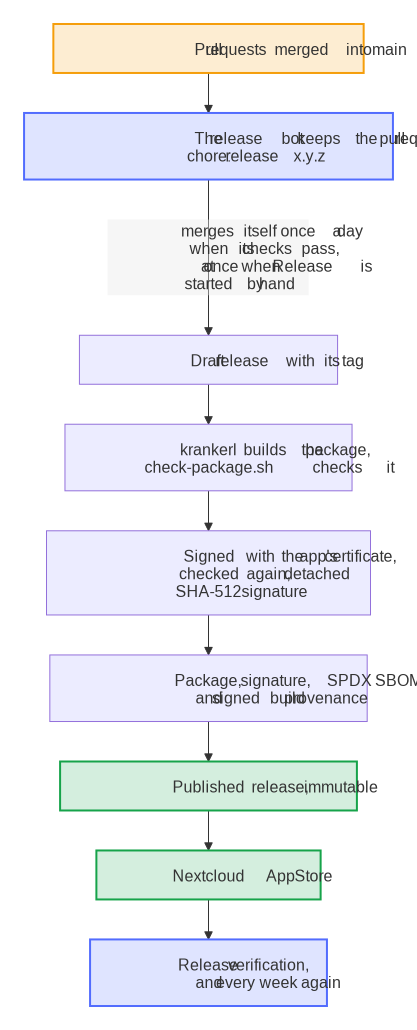
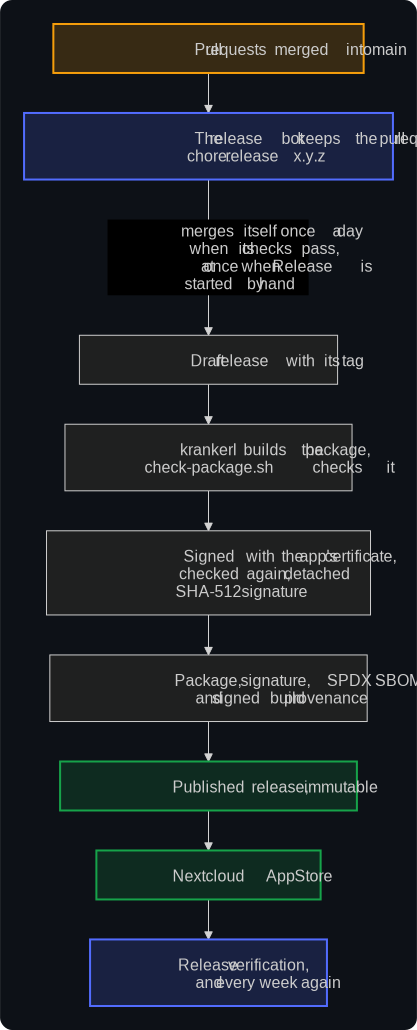
Every pull request that changes something for users describes it in a file of its own in changelog.d/, named after its branch, as CONTRIBUTING.md says. The release bot (.github/workflows/release.yml) keeps a pull request titled chore: release x.y.z up to date with main:
- The version follows from the titles of the pull requests merged since the last release:
fixmakes a patch,feata minor and!orBREAKING CHANGEa major version. Every merge decides it anew. A lineRelease-As: x.y.zin the description of a pull request sets it explicitly. - The changelog: the release takes in the files of
changelog.d/, and their entries become the section of the release; without any, the section lists the pull requests. - The files of the version:
appinfo/info.xml(<version>and the screenshot URLs markedx-release-please-version),version.txtand.release-please-manifest.json.
The pull request needs the same required checks as every other one, the Docker end-to-end tests against every supported Nextcloud version included. Every release merges itself, once a day: the variable RELEASE_MERGE is daily in .github/repository.project.toml, by the maintainer's decision of 2026-11-18, so the release bot merges the release pull request in its daily run at 02:57 UTC once its checks pass, at most one release a day, and a comment in the pull request says when it goes. A merged change thus reaches the Nextcloud App Store within a day, with nobody pressing a button. A fix that can't wait goes at once: the maintainer starts the workflow Release by hand (gh workflow run release.yml), and a release that fixes a vulnerability goes at once by itself.
Publication
Merging the release pull request creates the release as a draft, with its tag, and then:
- krankerl builds the package of the tagged commit;
scripts/check-package.shchecks what it holds. - The package is signed with the app's certificate (
occ integrity:sign-app) and checked again, and a detached SHA-512 signature is made and verified with the public key of the certificate. - The release gets the package
paperless_unified_search.tar.gz, its signaturepaperless_unified_search.tar.gz.sig, the SBOMspaperless-unified-search.spdx.json(SPDX) andpaperless-unified-search.cdx.json(CycloneDX),THIRD_PARTY_NOTICES.mdwith the licenses of the dependencies, and the signed build provenance of every asset (provenance.sigstore.jsonandprovenance.intoto.jsonl). - The complete release is published; GitHub keeps it immutable from then on.
- The same package is submitted to the Nextcloud App Store.
- The release verification (
.github/workflows/verify-release.yml) checks the release as its users can: every attestation, the SBOM, the immutability, the signed commit, and the version in the App Store. It checks the latest release every week as well.
A new version of Nextcloud
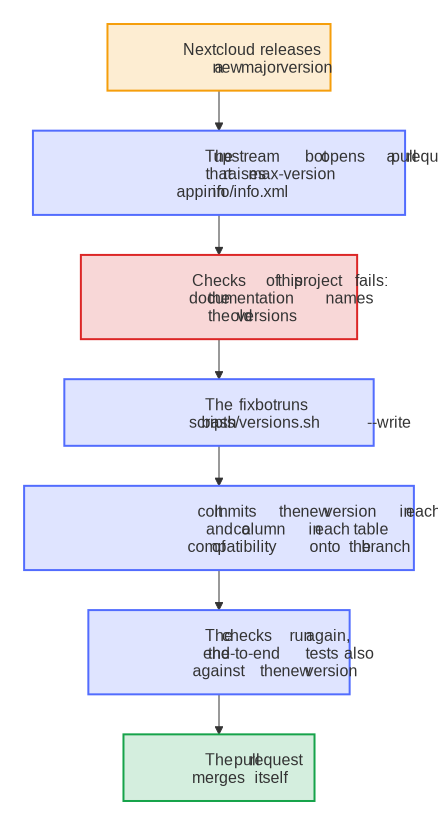
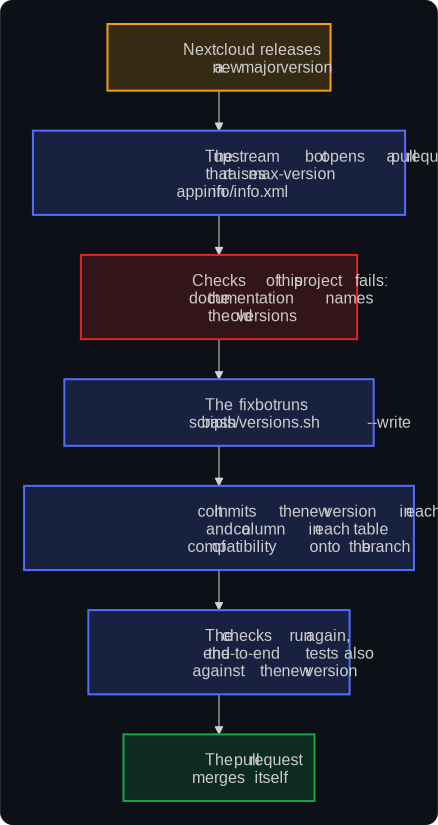
appinfo/info.xml names the versions of Nextcloud that the app installs on, from min-version to max-version, and the end-to-end tests run against each of them. Every Wednesday the upstream bot (.github/workflows/upstream.yml) compares max-version with the newest release of Nextcloud. For a new major version, it opens the pull request feat: support Nextcloud <version>, which raises max-version and adds changelog.d/nextcloud-<version>.md for the release notes.
The READMEs, the pages of the website in English and German and the descriptions of the App Store name the versions too, and the step Checks of this project of scripts/check.sh fails while one of them names others. scripts/versions.sh holds every such place in one list, for the check and for the fix alike. When the step fails, the fix bot runs bash scripts/versions.sh --write and commits what it wrote onto the branch of the pull request; the checks run again, and the pull request merges itself once they pass, unless the repository variable UPSTREAM_AUTOMERGE is off.
A new max-version adds a column to each table of compatibility, with the cells of the newest column. When the oldest version of Nextcloud reaches its end of life, raise min-version yourself: the same command drops its column. It writes a new min-version of PHP the same way. What no command can fix, it names, and it ends with an error: a place that is gone, a row of a table without a cell for each column, or a description of the App Store without the line of its versions.
bash scripts/versions.sh           # check every place, as scripts/check-project.sh does
bash scripts/versions.sh --write   # write the versions of appinfo/info.xml there
Secrets and recovery
The release environment allows only main. It holds APP_PRIVATE_KEY (the key of the app's certificate), APPSTORE_TOKEN and RELEASE_AUTOMATION_PRIVATE_KEY (the release app, whose client ID is the repository variable RELEASE_AUTOMATION_CLIENT_ID). Every token is short-lived and scoped to what its job needs.
If a job fails, re-run the failed jobs of the Release workflow: a draft is completed, and the App Store accepts the same version again without a second release. A published release is never replaced.
Registering the app in the App Store, needed once and again only for a new certificate, is the manual workflow Register app in Nextcloud App Store.