The experimental reading rendered
How the text of an issue reaches the AI cleans the source of each text by hand, a model of what GitHub shows. Way D of #488 has the AI read GitHub's own rendering of each text instead, through the converter of #520, a closed list of what GitHub writes. The input reading of the action, of the reusable workflow and of Evaluate switches it on, #521: cleaned, the default, reads every text as above and asks GitHub for no rendering, and rendered is experimental, for a run by hand, until it has passed Evaluate.
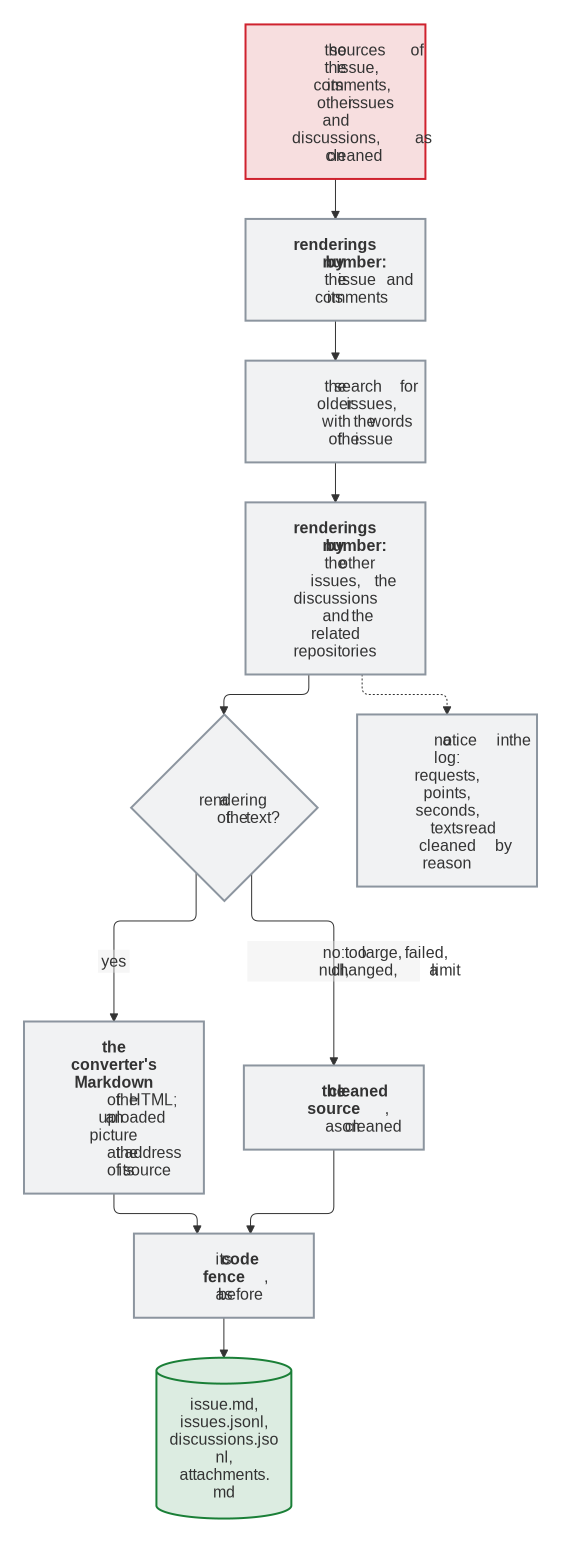
- The sources come first, as on
cleaned. No request of theirs changes. A page of GitHub can't carry renderings, since one text that GitHub can't render in time fails the whole page, so each rendering is read afterwards by its number:issue(number:), windows of the comments of an issue anddiscussion(number:). - A text without a rendering is its cleaned source. Nothing else reaches the AI: a text is either the converter's Markdown of its rendering or its source, cleaned as before. That holds for a text estimated or rendered above 1 MB, one whose request failed also on its own, one that GitHub answered with null for, one edited between the two steps and one that a limit of the command left out. The notice in the log counts each reason, and never a text.
- A comment that GitHub shows collapsed is never asked for, and the AI doesn't read it.
- An uploaded picture keeps the address of its source. A rendering holds a signed address of
private-user-images.githubusercontent.com, valid for minutes and new on every read; its path holds the uuid of the address that the source writes,github.com/user-attachments/assets/<uuid>, which the converter keeps. No signed address reaches the AI orattachments.md. - The attachments follow the text of the AI. The job attachments reads the renderings of the issue and of its reporter's comments, minutes before the job of the AI reads them again.
attachments.mdnames each attachment that the AI's own text shows; one that the job didn't download is "Not read: it wasn't downloaded for this run.", and one that only the job's text showed isn't named. A notice counts both. - The words that the assistant decides from are the converter's on
rendered, with a space for each note: the search for older issues reads the issue's rendering, which is why the issue and its comments are read right after their sources. - Evaluate reads each rendering once for all its replays. It asks first for the renderings of the issue and the comments of every sample, packed with the other issues and the discussions, and keeps each by its repository, kind and number or comment, with its source. A replay then asks only for what it doesn't hold yet, such as the results of its own search, within one budget for all replays. A text held without a rendering is counted again for its reason, but never asked for again. A replay's notice counts the renderings it read itself apart from those held from an earlier replay.
- The discussion assistant reads
cleanedin this step, whatever the switch says, with a notice: no run in this repository could try it yet.