From the fix to the release
Apps and integrations reach their users with a release, not with a merge. So an issue stays open until the fix is released.
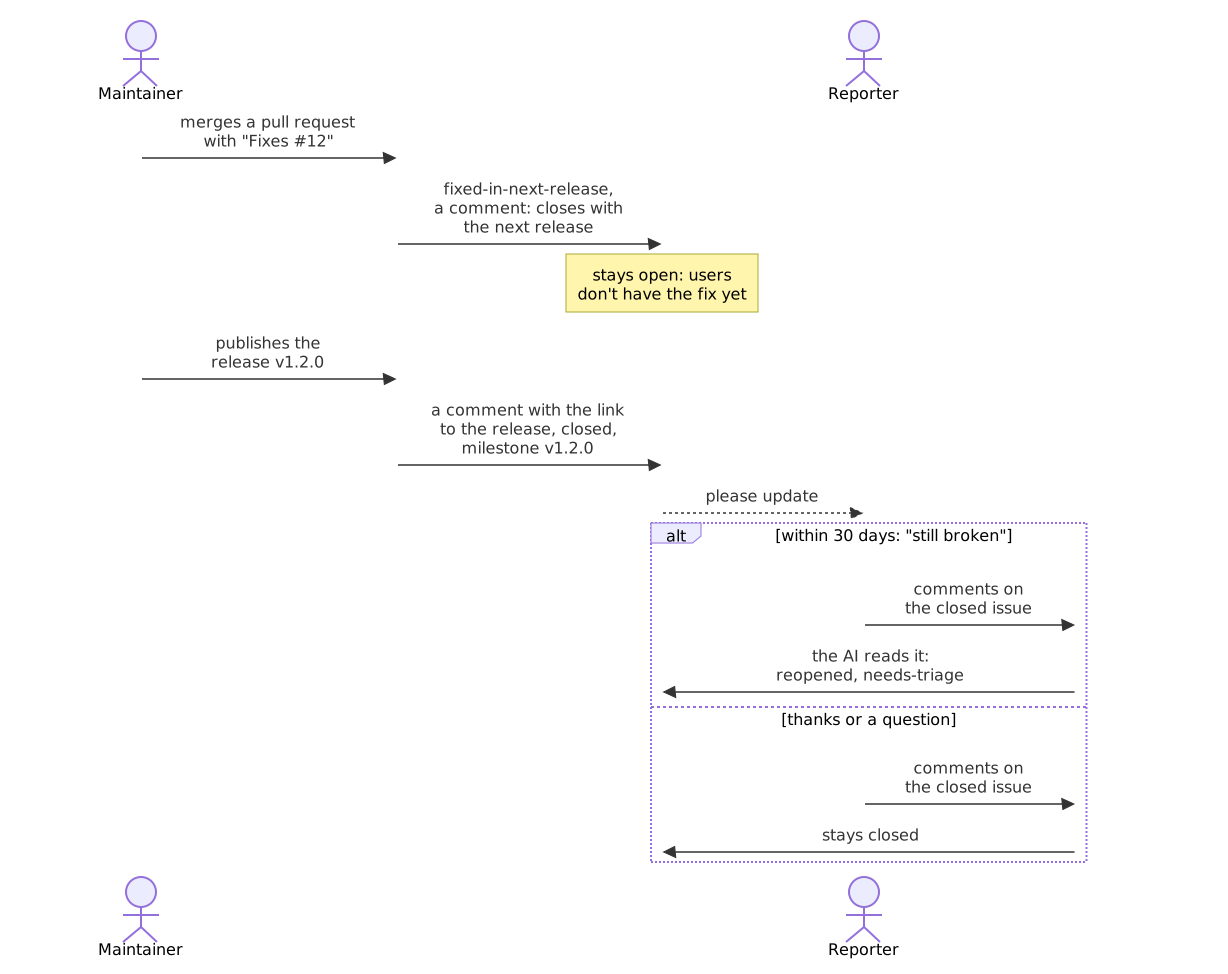
- A pull request names the issue it fixes with
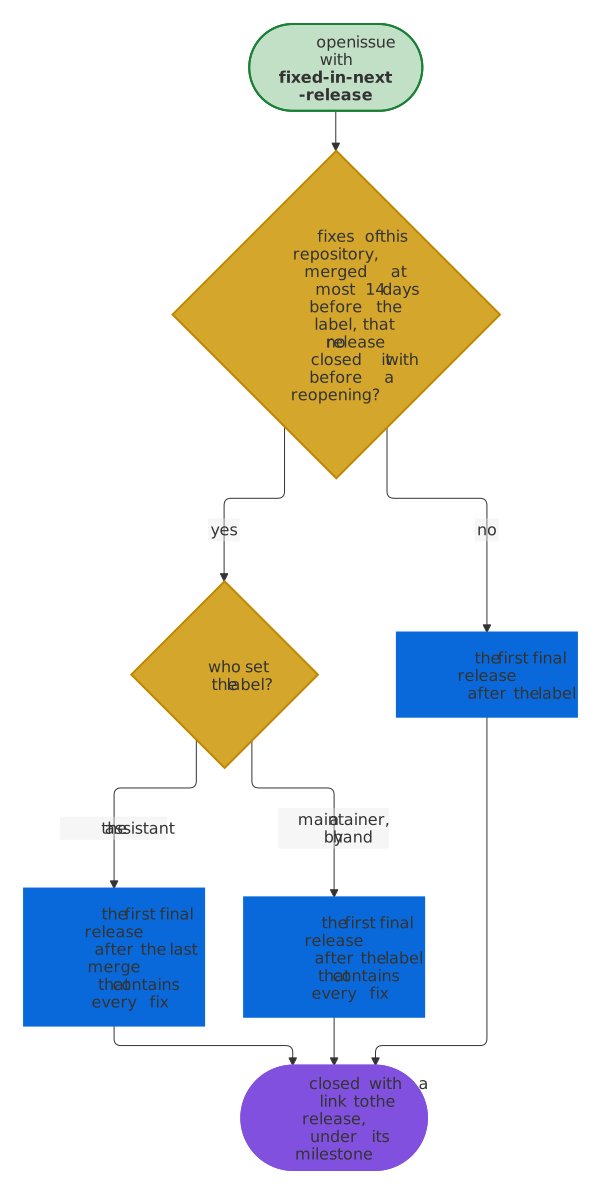
Fixes #12, as usual. When it is merged into the default branch, the issue gets the labelfixed-in-next-releaseand a comment: fixed by the pull request, closes with the next release. Only a closing keyword of GitHub fixes an issue:Fixes,ClosesorResolvesin any of their forms, before#12,owner/project#12or the address of the issue, or a link that a maintainer makes by hand in the box Development of the pull request. An issue that the pull request only refers to, withRefs #12,See #12or a link, keeps its labels and stays open, and so does one that the description names after words that say otherwise, such asThis doesn't close #12orPartly fixes #12, which GitHub links all the same: a negation such as not, never or doesn't, or partly or partially, that governs the keyword: right before it, or with only yet, fully, completely, entirely, totally, quite, really, actually, necessarily, alone, by itself or on its own in between, as indoes not yet fully resolve #12, or through an infinitive of an intent or an ability, as inis not meant to close #12,doesn't try to fix #12orwill not be able to resolve #12. Any other word, a dash or a comma in between ends the negation, so a description of the bug before the fix still fixes it, as inThe cache didn't refresh and this fixes #12orSo it doesn't crash anymore - fixes #12, and so does a negation as an emphasis, as inNot only fixes #12. The summary and the log of the sweep name each issue that stays open so. A maintainer can also set the label by hand, for a fix without a pull request. The morning sweep catches a merge whose run failed, up to 14 days later and however many pull requests the repository merged since; if a release ships the fix by then, the issue closes with it at once, without the comment. - When a release is published, every issue with the label whose fix it contains closes as completed. A comment links the release and asks the reporter to update. It is the first final release, no draft or pre-release, that was published after the last fix was merged and contains every fix, so an issue that got its label late still closes with the release that shipped its fix. A label that a maintainer set by hand, for a fix without a pull request or after one that fell short, waits for the next release after it. Only this repository's pull requests count: one of another repository that names the issue with
Fixes owner/project#12neither keeps it open nor appears in the comment. The issue is filed under the milestone of the release, such asv1.2.0, which the assistant creates, closed, when it is missing; its page lists everything that the release fixed. - If the reporter comments within 30 days that the problem persists after the update, the AI reads the comment and the issue reopens. Thanks or questions keep it closed. The AI reads up to two comments of the reporter after each release, as
release_repliesinconfig.tomlsays; a maintainer reads the rest. The comment of the release names the days ofreopen_after_release_days, so that it promises only what happens. On a muted issue no AI reads the comment: the comment of the release asks the reporter to write for the maintainers instead, and a comment of theirs, at any time, gives the issueneeds-triage, so that the digest lists it under Waiting on the maintainers and the sweep doesn't lock it until a maintainer answers.
A feature request had no problem to fix, so its comments say what was implemented: Implemented by #43, at the merge, and update to this version to use it. If something is missing, write a comment here, at the release. An issue is a feature request when it has the label enhancement or the issue type Feature, and not the label bug; every other issue, also one without a kind, hears of a fix. The gallery of the comments shows both in every language. The AI that reads the reporter's comment after the release reopens a feature request when what it asked for is still missing or doesn't work, and keeps it closed for wishes beyond it, which belong in a new issue.
The fixes of an issue are the pull requests of the repository that close it, as step 1 says, and were merged into the default branch at most 14 days before its label, the longest that the sweep takes to set it, and an hour more for the run of the sweep. A fix that a release closed the issue with before it was reopened didn't help, so neither that release nor the fix counts again; any other reopening, such as of an issue that GitHub closed at the merge, keeps the fixes:
GitHub closes linked issues when a pull request is merged unless the repository turns this off: under Settings → General → Issues, clear Auto-close issues with merged linked pull requests. A repository without releases sets close_with_release = false in config.toml.