Configuration
A repository sets up the issue assistant in three files of .github/, which install writes as starters when they are missing: the labels, the settings, and the findings of code scanning that it accepts. They change through pull requests like the code, and check makes sure of them in the CI.
Settings
.github/labels.toml
[[label]]
name = "area: cards"
color = "bfdadc"
description = "Dashboard cards"          # at most 100 characters
group = "area"                            # type, area, topic, priority, lifecycle, decision, contribution, release or dependabot
form_options = ["Live card", "Training card"]   # answers of the Area field that choose it
owners = ["octocat"]                      # optional: assigned to its issues while nobody is

[[label]]
name = "enhancement"
color = "a2eeef"
description = "New feature or improvement"
group = "type"
ask = false                               # never ask reporters of this kind for information
issue_type = "Feature"                    # optional: the issue type of the organization for this kind

[[label]]
name = "priority: high"
color = "b60205"
description = "Breaks the project for many users or loses data, without a workaround"
group = "priority"                        # optional: the AI gives one to an issue without a priority
.github/issue-assistant/config.toml
[engine]
name = "claude"                 # claude, codex, gemini or copilot, as Engines compares them
# model = "claude-opus-5-5"     # the engine's default model if left out; a letter or digit, then letters, digits and ._:@/[]- only
# light_model = "claude-sonnet-5-5"  # the replies to one comment, yes or no; model if left out
# effort = "medium"             # low, medium, high, xhigh or max, for the models that take it; their default if left out
max_turns = 40                  # turns of an analysis and a question; a follow-up gets half, a reply a tenth, each at least 4; 1 to 200
max_budget_usd = 1.00           # the dollars at which one run stops; more than 0, at most 100
max_per_day = 20                # analyses, follow-ups and replies after a release in 24 hours; 0: only maintainers, by hand
max_per_author_per_day = 3      # analyses of one reporter's new issues in 24 hours
release_replies = 2             # comments of the reporter after each release that the AI reads
backlog_per_run = 20            # open issues that a maintainer's run on the backlog analyzes at most, the oldest first; 0 to 256

[context]
max_issues = 1000               # closed issues that an analysis reads besides every open one: those that changed last
max_discussions = 1000          # discussions that an analysis reads: those that changed last
max_analyzed = 30               # issues analyzed last whose corrections by the maintainers a first analysis learns from; 0: none

[related]
repositories = ["owner/server"] # public repositories whose issues a first analysis searches too, up to 5

[discussions]
answer_categories = ["Q&A"]     # categories whose new discussions get a first answer; [] if left out: none

[maintainers]
language = "en"                 # the language the maintainers read, a code of locales/; a comment in another one folds a summary for them

[links]
hosts = ["docs.example.com"]    # besides this repository

[forms]
area_field = "Area"
unmapped_options = ["Other"]
opt_out_field = "Automated analysis"   # the box with which a reporter keeps the AI out of their issue

[transparency]
files = ["SUPPORT.md"]
credit = true                   # false: the footers of the AI's comments don't link the project

[releases]
close_with_release = true       # false: fixed issues don't wait for a release

[lifecycle]
remind_after_days = 15          # the reminder after the last question without an answer
close_after_days = 30           # the closing, on the day that the reminder names; more than remind_after_days
duplicate_grace_days = 3        # a sure duplicate closes this long after the notice
reopen_after_release_days = 30  # the reporter's comment after a release reopens the issue this long
max_follow_ups = 2              # follow-ups of the AI on the reporter's answers; 0: none
exempt_labels = ["pinned", "security"]   # never reminded, closed or locked by the sweep
exempt_assignees = false        # true: assigned issues are exempt too
exempt_upvotes = 0              # issues with at least this many 👍 are exempt; 0: off
lock_closed_after_days = 0      # lock issues closed longer, at least reopen_after_release_days; 0: off

[digest]
issue = false                   # true: the morning sweep keeps its digest in one issue too
title = "Triage digest"         # the title of that issue
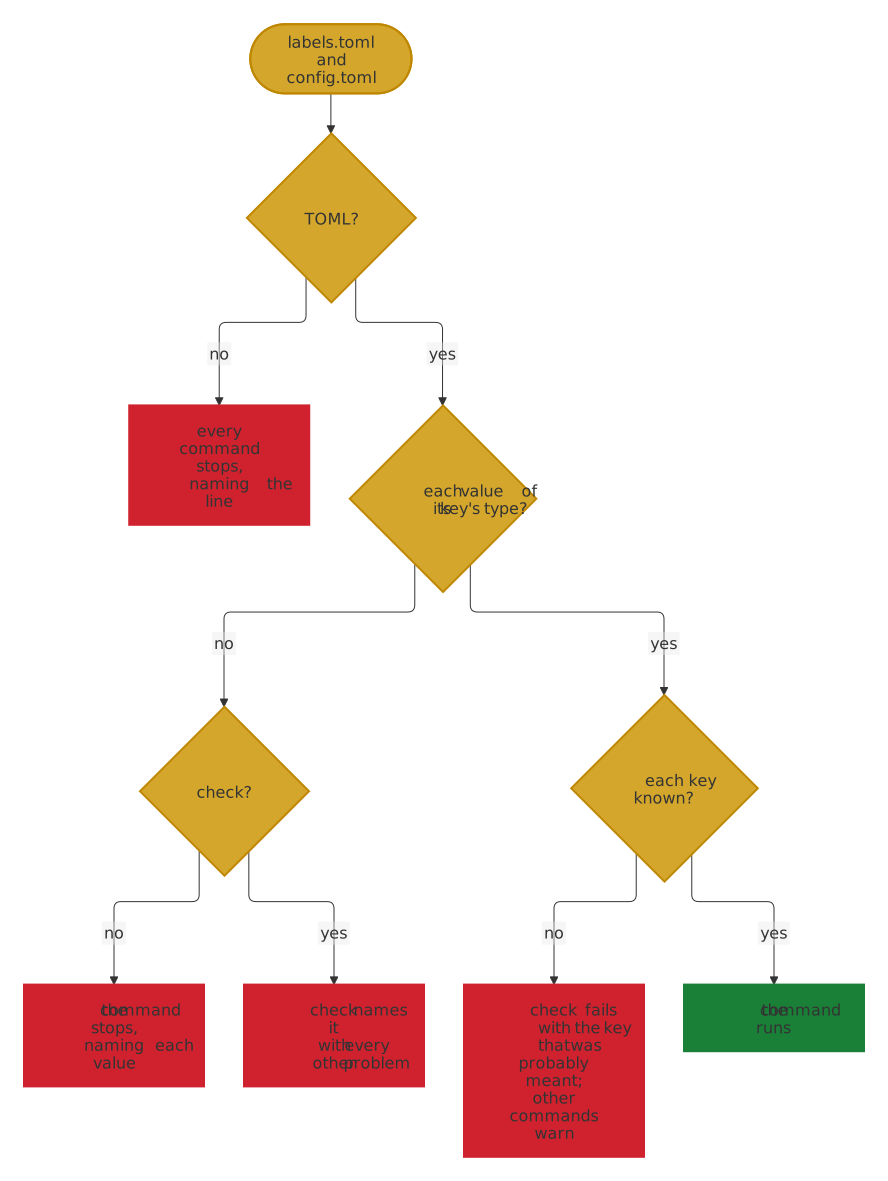
Each key has the type that it has here. A file that isn't TOML, or a value of another type, such as max_per_day = "5", stops every command with an error that names the file and the key. A key that the assistant doesn't know, such as close_with_releases or a section [release], would leave the default in place unnoticed: check fails on it and names the key that was probably meant, and every other command warns of it.
The labels of an issue form may be a list or one text of names separated by commas, as GitHub allows, and the area field may be a dropdown with multiple: true: each option that a reporter chooses adds its label.
Findings
Code scanning reports findings of CodeQL, OpenSSF Scorecard and other tools in the repository's Security tab. Some can't or shouldn't be fixed, such as Scorecard's Code-Review for a project with one maintainer. .github/findings.toml accepts those, each with a reason, in a file that changes only through pull requests:
[[accept]]
tool = "Scorecard"        # the tool as code scanning names it
rule = "CodeReviewID"     # the rule, such as py/unused-import
reason = "won't fix"      # false positive, won't fix or used in tests
comment = "One maintainer: nobody else can approve a pull request."
# path = "tests/"         # optional: only alerts in this file or folder
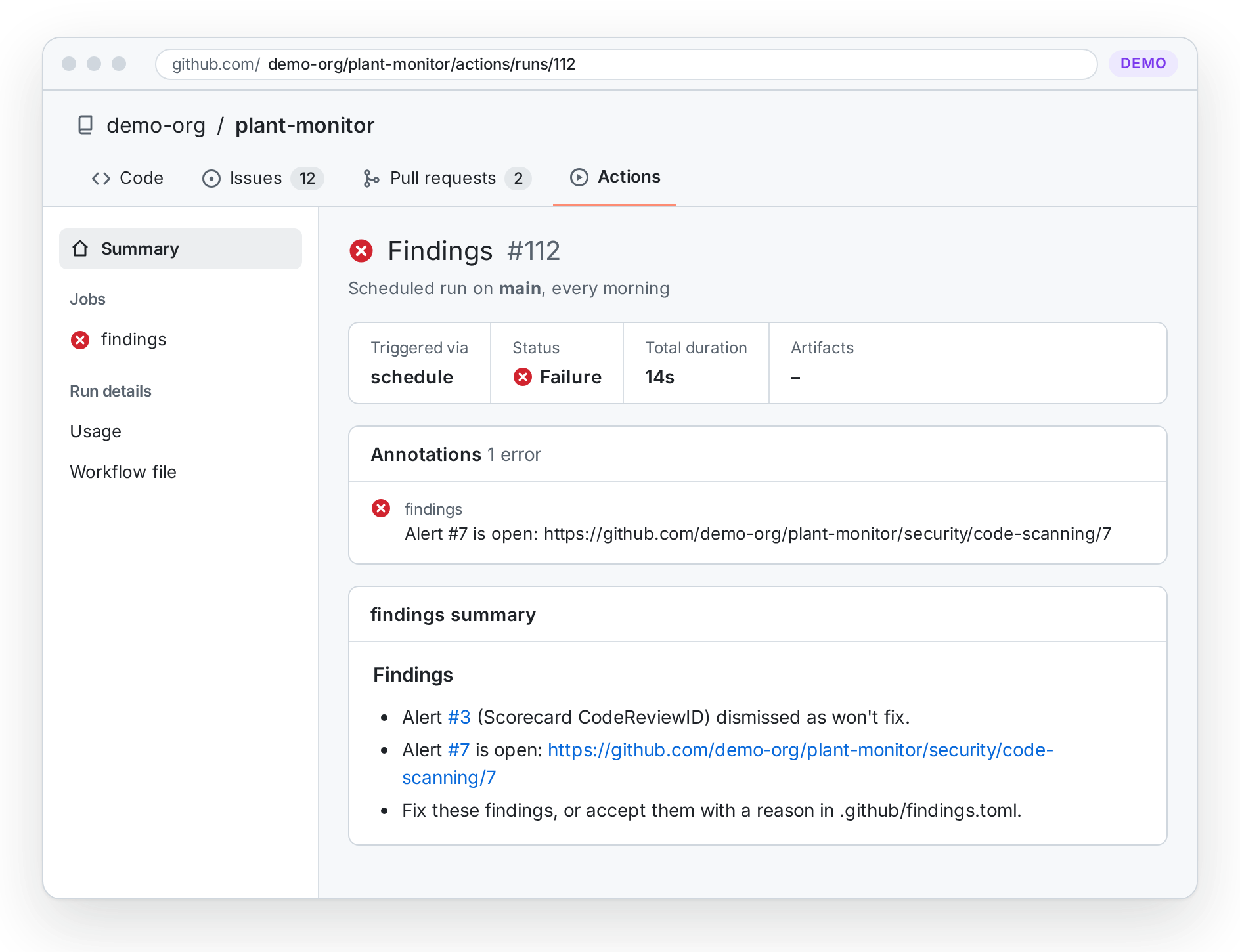
The Findings workflow dismisses every open alert that an entry covers, with the entry's reason and comment, and fails for any other alert once, in the first run that finds it open. GitHub tells the maintainer about the failed run; its summary links the alerts by number. The workflow runs after every scan and every morning, so the runs after it pass and name the alert as still open, with a warning, until it is fixed or accepted; an alert that a scan finds again after its fix opens again and fails a run again. For that the job keeps a record of the alerts that it reported, each with the time that GitHub gives for its opening, in the Actions cache of the default branch, and writes it anew only when an alert opens. The runs after the scans of a push overlap: a run whose turn comes after another run kept a newer record than the one it read fails for none of the alerts that its record lacks, names them with a warning and leaves them to that record, so one new alert fails one run. Without a record, as in its first run or when the cache fails, every open alert counts as new, so a run may fail once more but never hides an alert (decision 0026). check makes sure that every entry has a tool, a rule, one of GitHub's reasons and a comment, and no key that it doesn't know: a typo such as paths would accept the alerts of the rule in every file, so it stops the Findings workflow too. Code scanning needs the workflow's security-events: write; Dependabot's and secret scanning's alerts are out of its reach and stay with Dependabot's own pull requests and notifications.
A pull request gets the same help. GitHub posts each alert that the scan of a pull request finds in its changes as a review thread, and a ruleset that requires every conversation to be resolved blocks the merge until then. A pull request that only moves an accepted finding, such as a false positive on a line that now has another number, makes a new alert, which only its own scans know. So after each scan of a pull request of the repository itself, the Findings workflow dismisses the alerts of the pull request that findings.toml of the default branch accepts, which resolves their threads, and the alerts stay dismissed after the merge. It fails for none of the others there, which the pull request's own check of code scanning shows. An entry that the pull request adds counts once it is merged, and a fork's pull request keeps its threads for a person, since an outsider's code could match an accepted rule with a real finding (decision 0028).
A daily run with one accepted and one open finding, in a demo project: