Architecture
← README · Security design · Roadmap
The issue assistant is a composite GitHub Action. action.yml runs the package issue_assistant/ with the Python 3.12 of GitHub's runners and the standard library alone; the package talks to GitHub through the GitHub CLI. Four workflows in the repository that it looks after call the action, and one step of one job runs the AI engine.
Components
| Component | Files | What it does |
|---|---|---|
| The action | action.yml |
Passes every input through the environment to the package issue_assistant and runs one command of it |
| Commands | main() in issue_assistant/cli.py, which hands each command of SCRIPT_COMMANDS to a function of its own |
event, engine, context, analyze, usage, apply, sweep, sync-labels, findings, check, install, evaluate, which replays closed issues as they were with the class Then, a view of GitHub at a moment, and accuracy-page, which takes the numbers of its report onto the website; the reference names what each does |
| GitHub client | the class GitHub |
Every read and write through gh api, each with the version of GitHub's API that the tests check it against; in a dry run it only records what it would write |
| Settings | load_config, load_labels, load_findings |
Read .github/issue-assistant/config.toml, .github/labels.toml and .github/findings.toml of the repository |
| Events | handle_event, limited, within_limits |
Labels and owners from the issue forms, and the next task of the engine: triage, follow-up, maintainer-reply, release-reply or maintainer-question, never on a muted issue but on a maintainer's command, and within the limits of the AI runs for the tasks that people who don't maintain the repository start |
| Context | write_context |
Writes what the task of the engine reads into .issue-assistant/: the issue with its comments; for an analysis and a follow-up the other issues and discussions of a bounded window and the labels; for a first analysis corrections.md, what the maintainers corrected of the analyses before (learned_corrections, render_learned); for a reply or a maintainer's question the comment of its event; then the prompt and the JSON schema of the answer (what the AI reads); each text is read in linear time |
| Prompts | prompts/ |
The rules of every task, which call the content of the issue data, not instructions |
| Languages | locales/, LOCALES, detect_language, own_letters, issue_language, days, plural_form, maintainers, for_maintainers |
A catalog for each language of the comments, with its texts, how it names a day and its stopwords; the language of an issue from the marker of its last analysis, or else from the reporter's words and the letters that only one language writes, such as Hangul or kana; a number of days in the form that the language asks for; the folded summary for the maintainers in theirs, [maintainers] language, below a comment in another one (languages) |
| Checks of the answer | answer_schema, validate, parse_answer, looks_secret, sanitize |
Check the engine's JSON against its schema, the labels and the issues that exist; refuse anything that looks like a secret; clean the text of mentions, images, HTML and links to other sites |
| Writing | apply_answer and the render_* functions |
Post the comment, set the labels, assign the owners of its areas, set the issue type and mark duplicates, only on the issue of the event; post the first answer to a discussion, only on the discussion of the event |
| Lifecycle | sweep |
Reminders after 15 days, closing after 30 days, closing duplicates after 3 days, marking fixed issues, closing them with the release and filing them under its milestone |
| Labels | sync_labels |
Create and update the labels of labels.toml, never delete one, and warn of owners that can't be assigned and of issue types the repository lacks |
| Findings | watch_findings, accept_in_pull_requests |
Dismiss accepted findings, also in pull requests, and fail once for each other alert |
| Fixture | read_fixture, GitHub.use_fixture |
An issue and its comments, or a discussion, from a JSON file in place of GitHub's, for the canary, the Workflow test and for trying a prompt; context and apply then write nothing |
| Set-up | install, set_up_github, check |
Write the four workflows, the one of the discussions where config.toml names categories, the firewall policy and the starter files of templates/ into a repository, add the notice to reporters and actionlint's ignored queue where they are missing, with --setup also create the environment issue-assistant and have gh ask for the engine's secret, and check that the set-up still fits the templates; only check needs nothing but the checkout, and both name its files with slashes on every system |
The modules of the package
The code is the package issue_assistant/, in layers: each module imports only from those before it. The modules of the package has the map, with what each holds.
The workflows of a repository
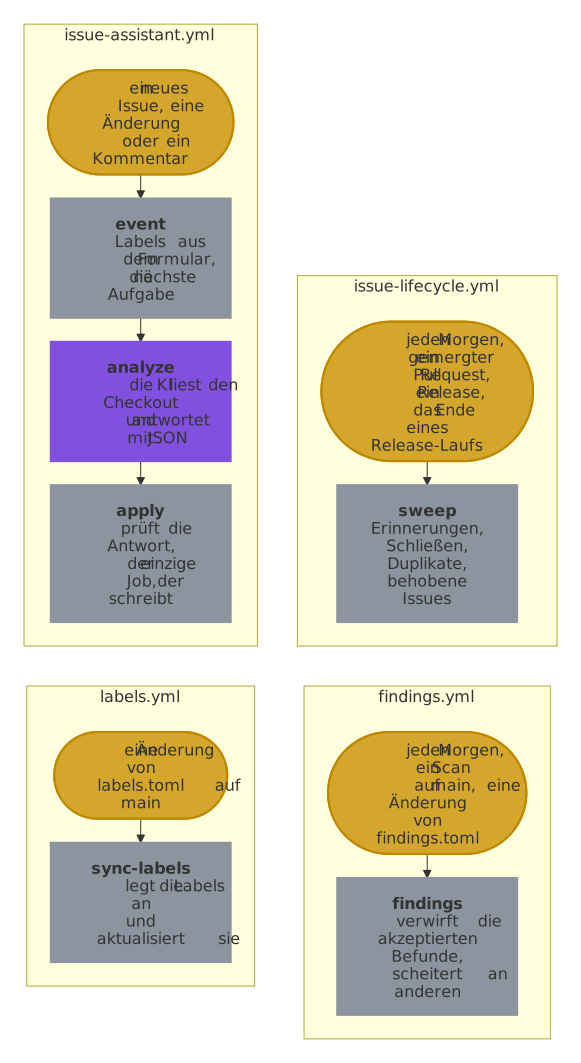
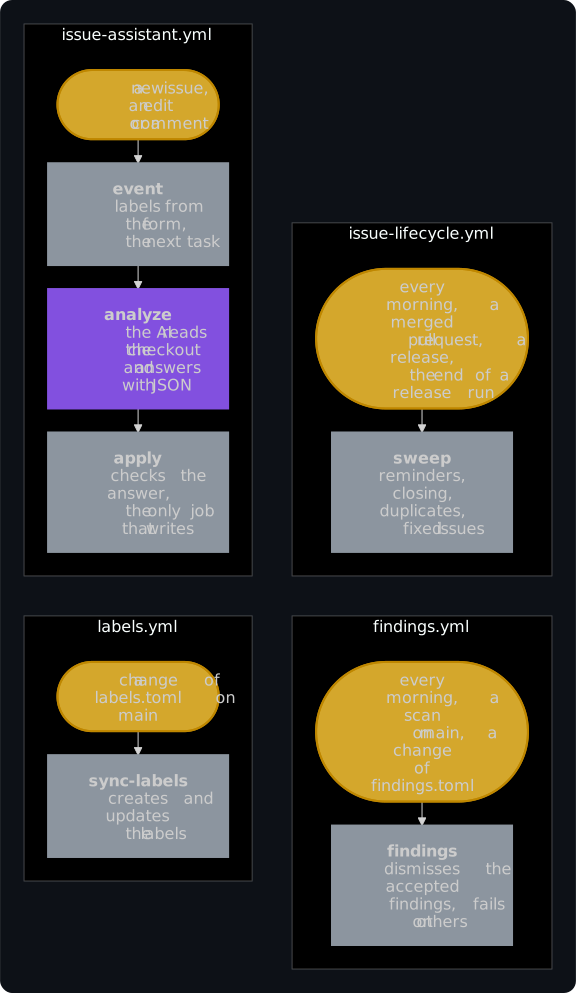
| Workflow | Jobs |
|---|---|
issue-assistant.yml |
event decides the next task; analyze writes the context and runs the engine with a read-only token, on GitHub's egress-firewall runner; apply checks the answer and writes it |
issue-lifecycle.yml |
sweep, every morning, after merged pull requests, published releases and the end of a run of the release workflow that no schedule started |
labels.yml |
sync-labels, when labels.toml changes on the default branch |
findings.yml |
findings, every morning, after each scan of code scanning, also of a pull request, and when findings.toml changes |
One run for a new issue
The three jobs of issue-assistant.yml hand the issue on; only the middle one sees the AI and its secret, and only the last one writes:
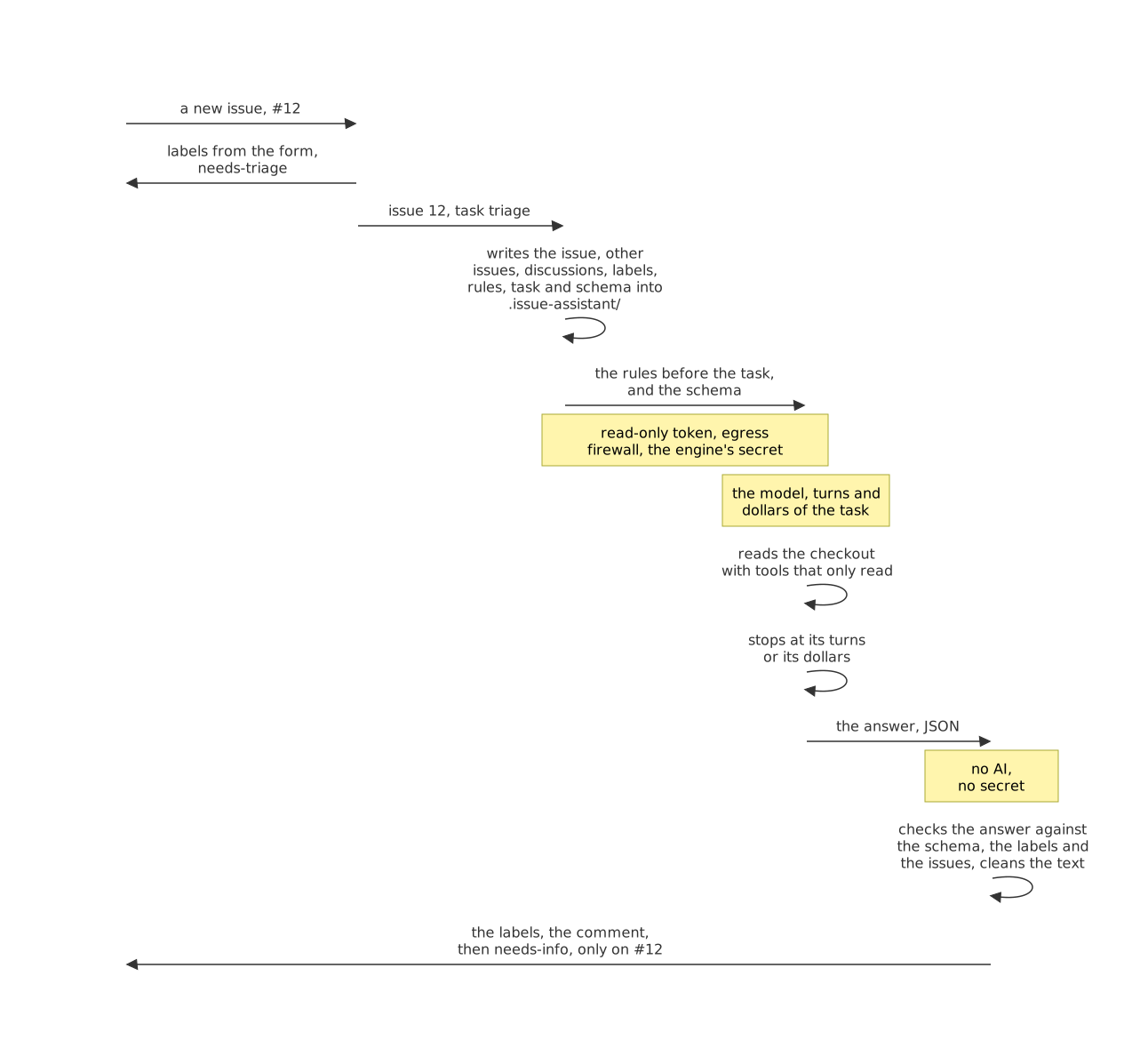
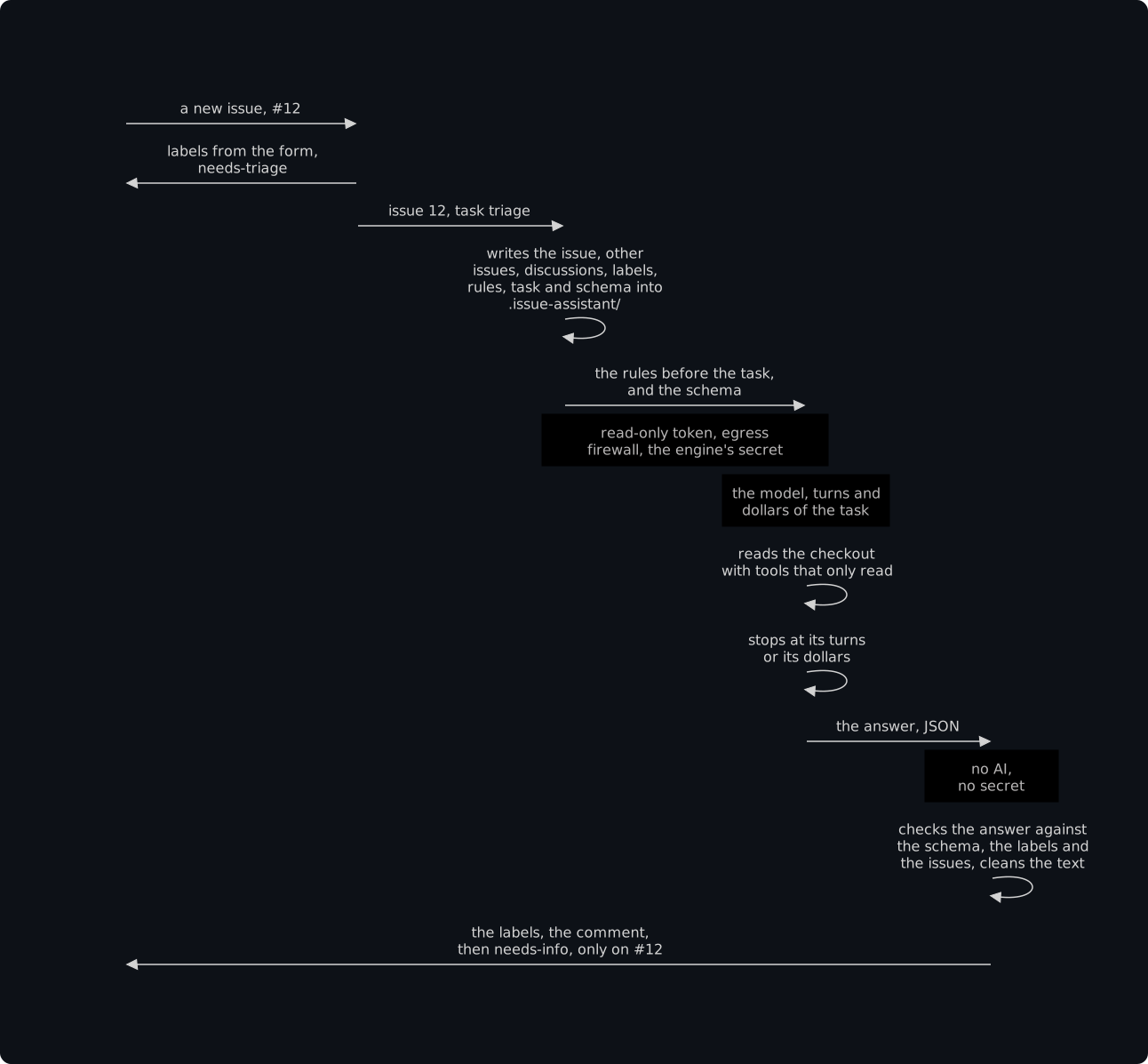
The jobs are in .github/workflows/reusable-issue-assistant.yml, which the template issue-assistant.yml calls at the commit of a release, as each of the other templates calls its own. The template discussion-assistant.yml calls reusable-discussion-assistant.yml, whose jobs give a new discussion its first answer: the same job analyze, which a test keeps equal, between an event job that only reads and the only apply job that may write to discussions. A called workflow that asks for more than its caller grants doesn't start, so the issues keep a workflow that never writes to discussions, for the repositories whose templates grant only reading; decision 0018 says why. install copies the templates of templates/ with the commit hash of the release, and check fails when a repository's copy differs in anything but the commit hashes of its pins. A job of a reusable workflow can't name the action of its own commit with a pin, so each one checks out job.workflow_repository at job.workflow_sha into .issue-assistant/action and runs the action from there: the jobs and the action of one release, always. Decision 0015 explains why, and what a spike found: the job analyze gets the secret of the caller's environment and runs behind the caller's firewall policy.
Waiting, runners and the network
The events of one issue wait in line. The runs of issue-assistant.yml for one issue share the concurrency group issue-assistant-<number> with queue: max: up to 100 runs wait for their turn, first in, first out. An analysis takes about two and a half minutes, and without the queue a group keeps a single waiting run, which the next event cancels. A reporter who answered twice during an analysis then got no follow-up to the first answer, and a "still broken" after a release could stay without effect.
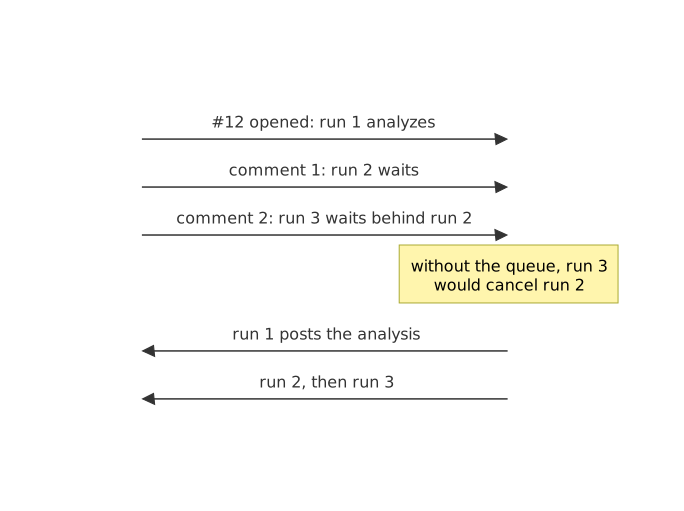
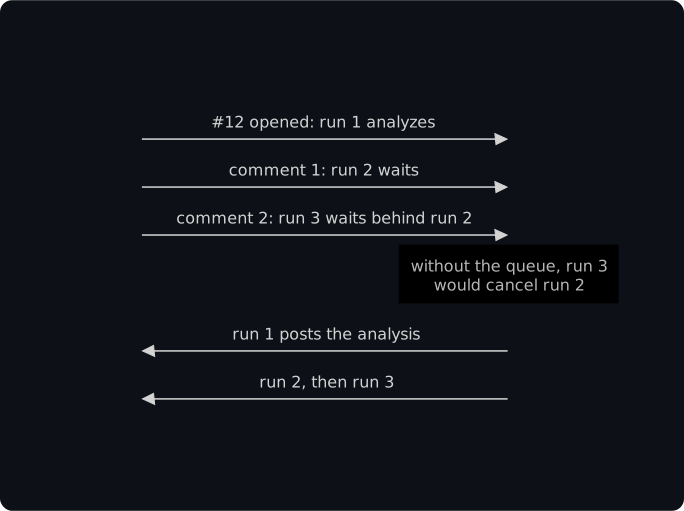
A run with nothing to do takes no runner and no place in a line. The sweep and the findings work on the whole repository, so one waiting run is enough, and their jobs, not their runs, wait in the groups issue-lifecycle and findings. A run waits for the group of its workflow before its jobs check their conditions, so a run that would only skip its job, such as after the scan of a pull request, took the place of a waiting one that had work to do; a skipped job never enters the group of a job. The release workflow of the repository blueprint runs every hour as a safety net and mostly releases nothing: the lifecycle skips the ends of these scheduled runs, and the morning sweep catches a release that one of them made.
The jobs without the AI reach only GitHub. Every job runs on ubuntu-24.04, so a new image behind ubuntu-latest never reaches the repositories untested. The jobs that write start with Harden-Runner in block mode; the AI runs behind GitHub's egress firewall instead. Decision 0008 explains why:
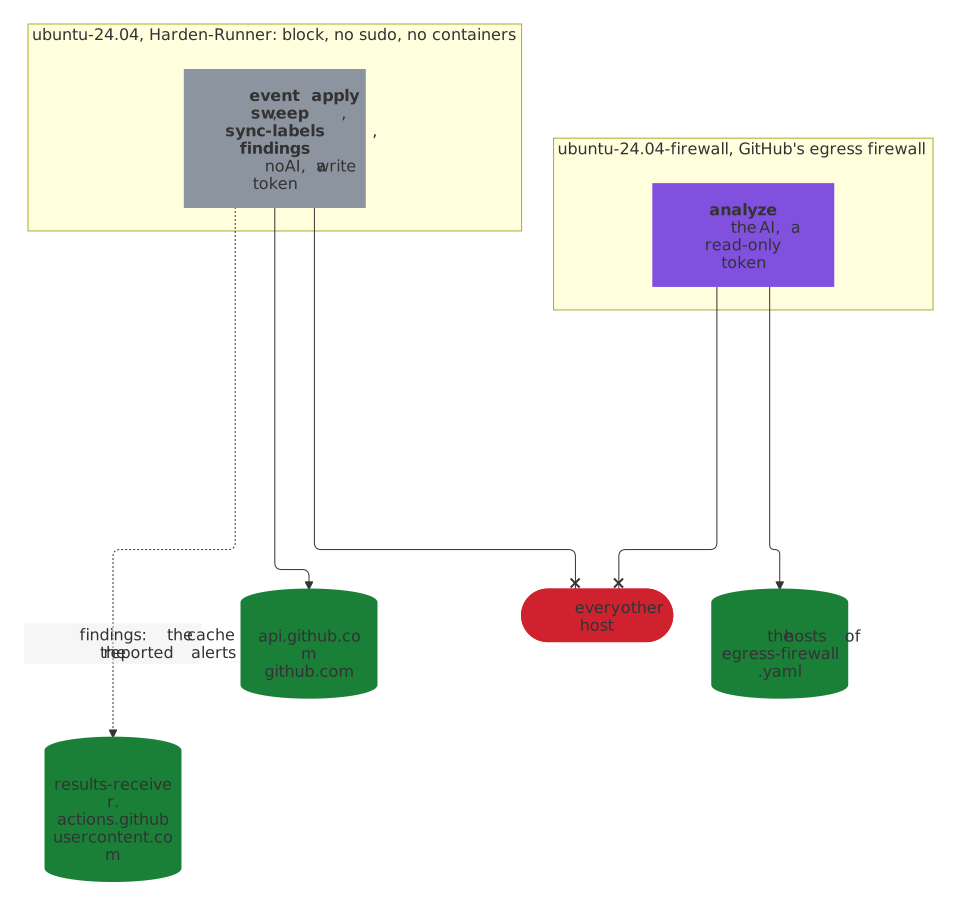
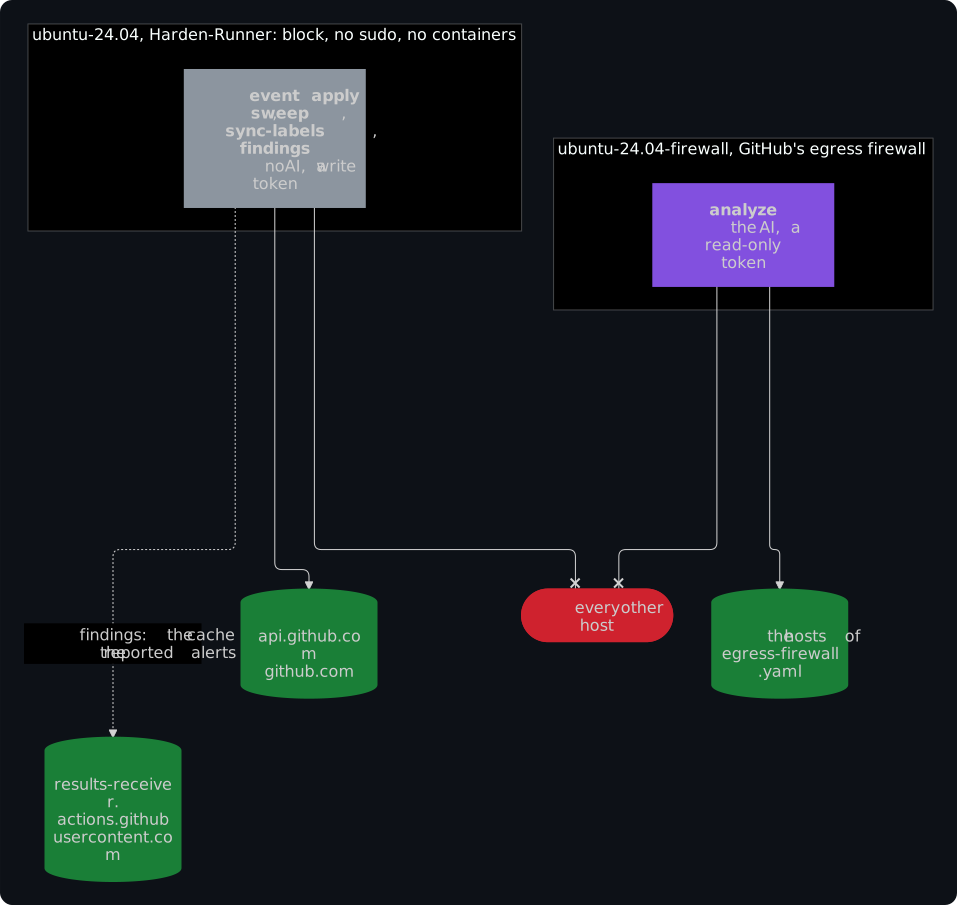
The checkout reaches github.com, the GitHub CLI api.github.com and the cache of the findings GitHub's results service; Harden-Runner allows the hosts of the runner itself, such as those of the logs and the summary. The action turns off the telemetry of the GitHub CLI, which would only knock at a blocked host. The job egress of the Action test runs the action behind the same block, so a host that it starts to need fails there, before a release blocks it in every repository. In a private repository the block needs a subscription or trial of StepSecurity; without one, Harden-Runner lets the job run unblocked, as the security design says among its residual risks.
A job that blocks checks Harden-Runner, then waits for it twice. Right after Harden-Runner, Make sure that Harden-Runner blocks stops the job when Harden-Runner has no agent that blocks. Wait until Harden-Runner lets the hosts through then asks each host of the job until it answers, since Harden-Runner blocks, for up to a minute, an address that systemd-resolved kept from before it. Last in a job without sudo and containers, Wait until Harden-Runner has removed Docker waits for Harden-Runner's background apt-get, since a job that ends first hangs until its timeout. Each waits two minutes at most, then warns; the block stays. A job that keeps sudo first takes GitHub's DNS experiment out of Harden-Runner's way, in Let Harden-Runner see the DNS lookups, never on ubuntu-24.04-firewall. Decisions 0088, 0123 and 0134 of the blueprint and 0029 here give the reasons, and tests/test_templates.py keeps the workflows to these steps. analyze-in-reserve asks only for GitHub's hosts: the firewall policy also names the hosts of engines that the repository may not use, and a mirror of Ubuntu that answers only on port 80, which would hold up the AI for two minutes.
The AI has a runner in reserve. GitHub's egress-firewall runner is a technical preview. Should GitHub rename or end it, analyze would wait in the queue for up to a day, and every later run of its issue behind it. So the repository variable ISSUE_ASSISTANT_AI_RUNNER may name another runner in its place, without a release; decision 0019 explains the trade-off:
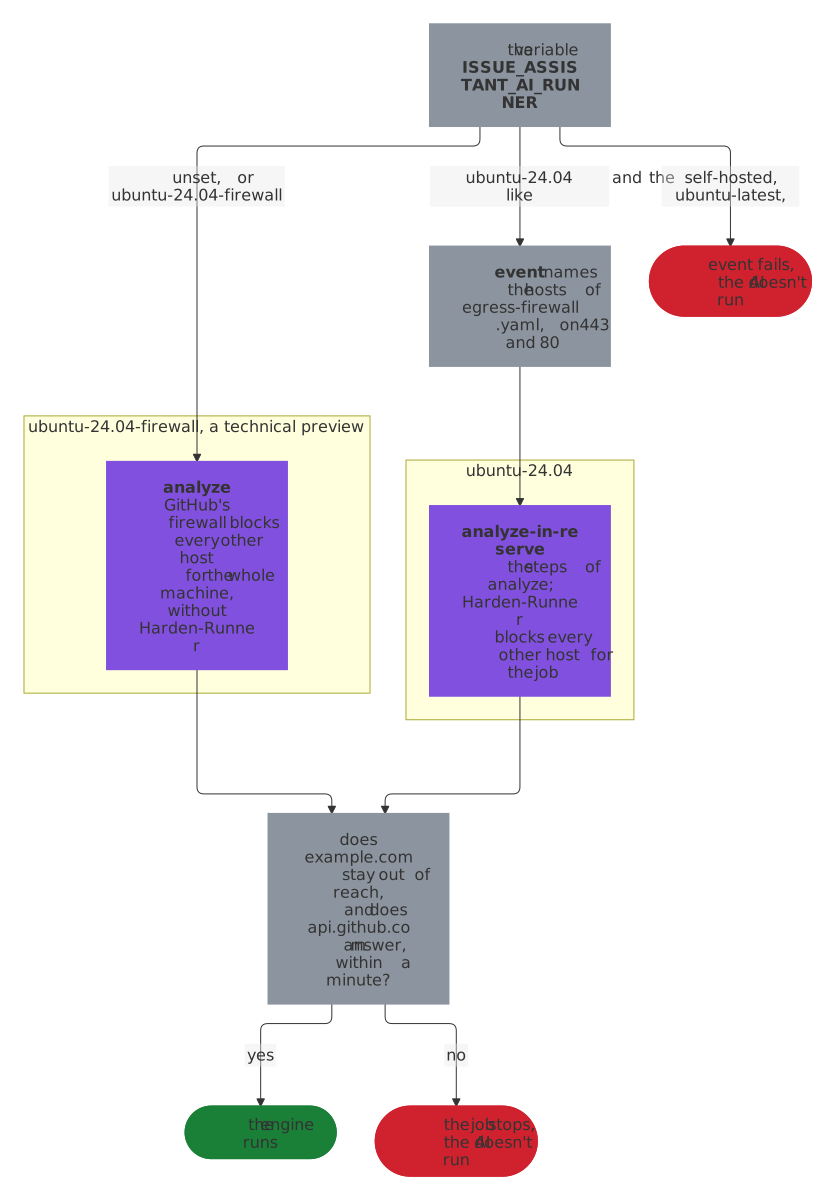
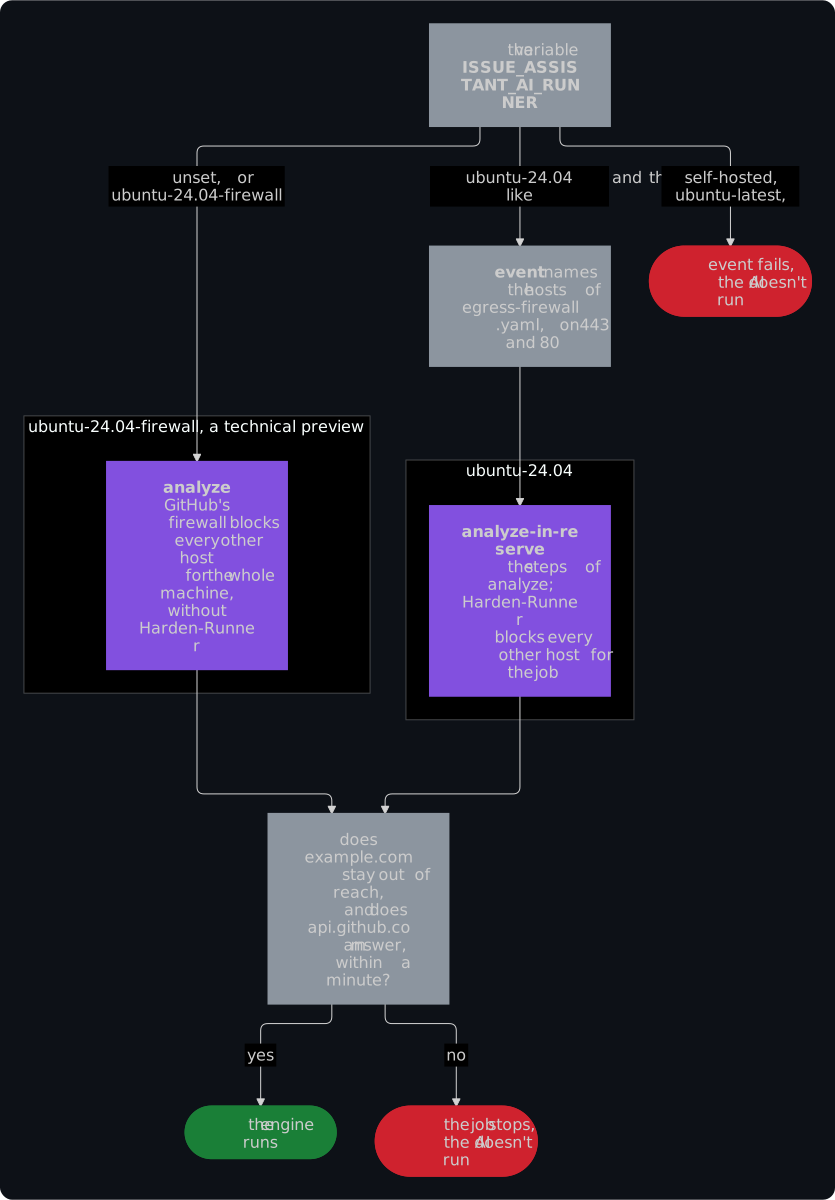
The command endpoints of the job event accepts only GitHub's runners of Ubuntu with a fixed version, and names the hosts of the repository's .github/egress-firewall.yaml and GitHub's own, github.com and codeload.github.com, each on the ports 443 and 80, as the endpoints of Harden-Runner for analyze-in-reserve, the steps of analyze in a job of its own (decision 0027). With the variable unset, every job runs as before. On either runner, a step then stops the job before the engine while a host outside the policy answers (decision 0025).
Design decisions
- The AI only reads, and a job without the AI writes. The answer of the engine is data that
applychecks before anything reaches GitHub. - Everything but one step is independent of the engine. Context, prompts, checks and writes are the same for every engine; a new engine is a step and an entry of
ENGINES, as Engines describes. - The requests follow a version of GitHub's API, not its default. Every call asks for
API_VERSION. The tests check every GraphQL document and every REST request against GitHub's own schema and description, and every week against those of that day; decision 0024 explains how. - An error of GitHub is never an answer. Only "not found" means that a thing is missing; any other error stops the run instead of changing what it posts, and a run again completes it without a second comment.
- No text can make it slow. Issues come from anyone, so every pattern that reads them takes time linear in the length of the text.
- No third-party packages. The package needs only the standard library,
ghandgit, which GitHub's runners have. - The maintainer has the last word. The assistant labels, asks and suggests; it never decides on behalf of the maintainer.
The details
Each of these has a page of its own: